

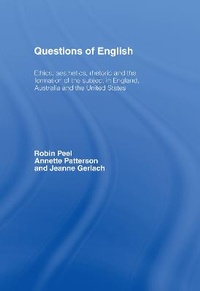
Questions of English
Aesthetics, Democracy and the Formation of Subject
1st Edition
Published on 9. March 2000
Book
Hardback
400 pages
978-0-415-19120-3 (ISBN)
Description
The impact and content of English as a subject on the curriculum is once more the subject of lively debate. Questions of English sets out to map the development of English as a subject and how it has come to encompass the diversity of ideas that currently characterise it.
Drawing on a combination of historical analysis and recent research findings Robin Peel, Annette Patterson and Jeanne Gerlach bring together and compare important new insights on curriculum development and teaching practice from England, Australia and the United States. They also discuss the development of teacher training, highlighting the variety of ways in which teachers build their own beliefs and knowledge about English.
Drawing on a combination of historical analysis and recent research findings Robin Peel, Annette Patterson and Jeanne Gerlach bring together and compare important new insights on curriculum development and teaching practice from England, Australia and the United States. They also discuss the development of teacher training, highlighting the variety of ways in which teachers build their own beliefs and knowledge about English.
Reviews / Votes
'... [a] helpful and beautifully produced book' - IRichard Andrews, European Journal of Teacher Education'At the level of argument (as opposed to metaphor), the book strikes a pragmatic note. To those still hankering after an Arnoldian or Leavisian role as an English teacher, it offers this practical advice: "Given that English wants to be properly funded and valued, it is proving strategically necessary for English to be more modest and specific in the claims it makes for itself as a subject." The book in its forward-looking way makes much of that "strategically necessary" argument. The book is good then in providing detailed contexts for readers to reassess their own ideas about English and in raising crucial issues.' - Anthony Kearney, Use of English
More details
Language
English
Place of publication
London
United Kingdom
Publishing group
Taylor & Francis Ltd
Target group
College/higher education
Professional and scholarly
Postgraduate and Professional
Illustrations
32 s/w Tabellen
32 Tables, black and white
Dimensions
Height: 234 mm
Width: 156 mm
Weight
703 gr
ISBN-13
978-0-415-19120-3 (9780415191203)
Copyright in bibliographic data and cover images is held by Nielsen Book Services Limited or by the publishers or by their respective licensors: all rights reserved.
Schweitzer Classification
Other editions
Additional editions
Jeanne Gerlach | Annette Patterson | Robin Peel
Questions of English
Aesthetics, Democracy and the Formation of Subject
E-Book
11/2002
Routledge
€68.49
Available for download
Jeanne Gerlach | Annette Patterson | Robin Peel
Questions of English
Aesthetics, Democracy and the Formation of Subject
E-Book
11/2002
Routledge
€68.49
Available for download
Jeanne Gerlach | Annette Patterson | Robin Peel
Questions of English
Aesthetics, Democracy and the Formation of Subject
Book
04/2000
1st Edition
Routledge
€80.65
Shipment within 15-20 days
Persons
Robin Peel is Senior Lecturer at the University of Plymouth, Annette Patterson is Senior Lecturer at James Cook University, Australia and Jeanne Gerlach is Associate Professor at the University of Texas at Arlington, United States.
Content
1. Introduction 2.'English' in England: its history and transformations 3. Beliefs about English in England 4. Shaping the English Specialist: initial teacher training for English teachers in England 5. 'English' in Australia: its history and transformations 6. Beliefs About English in Australia 7. Shaping the Specialist: qualifying as an English teacher in Australia 8. 'English' in the United States: its history and transformations 9. Beliefs About English in the United States 10. Shaping the Specialist: requirements of programs leading to teacher certification in the United States 11. English for the Twenty-First Century? summary and conclusions