

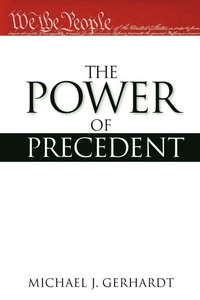
The Power of Precedent
1st Edition
Published on 28. July 2011
Book
Paperback/Softback
368 pages
978-0-19-979579-6 (ISBN)
Description
The role that precedent plays in constitutional decision making is a perennially divisive subject among scholars of law and American politics. The debate rages over both empirical and normative aspects of the issue: To what extent are the Supreme Court, Congress, and the executive branch constrained by precedent? To what extent should they be? Taking up a topic long overdue for comprehensive treatment, Michael Gerhardt connects the vast social science data and legal scholarship to provide the most wide-ranging assessment of precedent in several decades.
Updated to reflect recent legal cases, The Power of Precedent clearly outlines the major issues in the continuing debates on the significance of precedent and evenly considers all sides. For the Supreme Court, precedents take many forms, including not only the Court's past opinions, but also norms, historical practices, and traditions that the justices have deliberately chosen to follow. In these forms, precedent exerts more force than is commonly acknowledged. This force is encapsulated in the implementation and recognition of what Gerhardt calls the "golden rule of precedent," a major dynamic in constitutional law. The rule calls upon justices and other public authorities to recognize that since they expect others to respect their own precedents, they must provide the same respect to others' precedents. Gerhardt's extensive exploration of precedent leads him to formulate a more expansive definition of it, one that encompasses not only the prior constitutional decisions of courts but also the constitutional judgments of other public authorities. Gerhardt concludes his study by looking at what the future holds for the concept, as he examines the decisions and attitudes toward precedent exhibited by the shift from the Rehnquist to the Roberts Court.
Authoritative and incisive, Gerhardt presents an in-depth look at this central yet understudied phenomenon at the core of all constitutional conflicts and one of undeniable importance to American law and politics. Ultimately, The Power of Precedent vividly illustrates how constitutional law is made and evolves both in and outside of the courts.
Updated to reflect recent legal cases, The Power of Precedent clearly outlines the major issues in the continuing debates on the significance of precedent and evenly considers all sides. For the Supreme Court, precedents take many forms, including not only the Court's past opinions, but also norms, historical practices, and traditions that the justices have deliberately chosen to follow. In these forms, precedent exerts more force than is commonly acknowledged. This force is encapsulated in the implementation and recognition of what Gerhardt calls the "golden rule of precedent," a major dynamic in constitutional law. The rule calls upon justices and other public authorities to recognize that since they expect others to respect their own precedents, they must provide the same respect to others' precedents. Gerhardt's extensive exploration of precedent leads him to formulate a more expansive definition of it, one that encompasses not only the prior constitutional decisions of courts but also the constitutional judgments of other public authorities. Gerhardt concludes his study by looking at what the future holds for the concept, as he examines the decisions and attitudes toward precedent exhibited by the shift from the Rehnquist to the Roberts Court.
Authoritative and incisive, Gerhardt presents an in-depth look at this central yet understudied phenomenon at the core of all constitutional conflicts and one of undeniable importance to American law and politics. Ultimately, The Power of Precedent vividly illustrates how constitutional law is made and evolves both in and outside of the courts.
Reviews / Votes
"To seek a 'solution' to the problem of precedent is probably like trying to square a circle. Whether or not one agrees with Michael Gerhardt's particular solution, all readers will find themselves illuminated by Gerhardt's consistently interesting arguments (and the data on which they are built) and the insights they throw on the actual operation of the United States Supreme Court and its justices."--Sanford Levinson, Chair of Law and Professor of Government,University of Texas-Austin, and author of Our Undemocratic Constitution
"Michael Gerhardt's sophisticated and subtle book is the definitive treatment of how precedent really works in constitutional law. It should be the starting point for all future discussions of this important issue."--David A. Strauss, Professor of Law, University of Chicago Law School, and author of The Living Constitution
"When the subject is precedent, social scientists and legal academics often talk past each other. Gerhardt takes the time to listen. The result is a sophisticated yet sensible and accessible account of the role precedent plays in judicial decisions. But more than that, it is an account that no side in the debate can afford to ignore because Gerhardt ignores no side. At long last, let the conversation begin."--Lee Epstein, Professor, Northwestern University, and
co-author of Advice and Consent
More details
Language
English
Place of publication
New York
United States
Target group
Professional and scholarly
Students and scholars of United States legal history, Supreme Court history, constitutional law, judicial precedent
Illustrations
8 b/w illus.
Dimensions
Height: 234 mm
Width: 156 mm
Thickness: 20 mm
Weight
553 gr
ISBN-13
978-0-19-979579-6 (9780199795796)
Copyright in bibliographic data and cover images is held by Nielsen Book Services Limited or by the publishers or by their respective licensors: all rights reserved.
Schweitzer Classification
Other editions
Additional editions
Michael J. Gerhardt
The Power of Precedent
Book
03/2008
Oxford University Press Inc
€103.10
Shipment within 15-20 days
Michael J. Gerhardt
The Power of Precedent
E-Book
02/2008
1st Edition
OUP eBook
€27.49
Available for download
Person
Michael J. Gerhardt is Samuel Ashe Distinguished Professor of Constitutional Law and Director of the Center on Law and Government at the University of North Carolina Law School. He is one of the foremost scholars on constitutional conflicts between the president and congress, and he has testified numerous times before congress, including as the only joint witness before the house judiciary committee's hearings on the history of impeachment. He served as CNN's resident expert during President Clinton's impeachment proceedings and a frequent commentator on Supreme Court selection for NPR.
Content
Introduction ; 1. The Patterns Of Supreme Court Precedent ; 2. Theories Of Precedent ; 3. The Golden Rule ; 4. Non-Judicial Precedent ; 5. The Multiple Functions Of Precedent ; 6. Super Precedent ; Conclusion: The Future Of Precedent ; Appendix Tables I-VII ; Afterword