

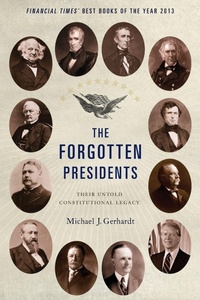
The Forgotten Presidents
Their Untold Constitutional Legacy
Published on 23. October 2014
Book
Paperback/Softback
352 pages
978-0-19-938998-8 (ISBN)
Description
Their names linger in memory mainly as punch lines, synonyms for obscurity: Millard Fillmore, Chester Arthur, Calvin Coolidge. They conjure up not the White House so much as a decaying middle school somewhere in New Jersey. But many forgotten presidents, writes Michael J. Gerhardt, were not weak or ineffective. They boldly fought battles over constitutional principles that resonate today.
Gerhardt, one of our leading legal experts, tells the story of The Forgotten Presidents. He surveys thirteen administrations in chronological order, from Martin Van Buren to Franklin Pierce to Jimmy Carter, distinguishing political failures from their constitutional impact. Again and again, he writes, they defied popular opinion to take strong stands. Martin Van Buren reacted to an economic depression by withdrawing federal funds from state banks in an attempt to establish the controversial independent treasury system. His objective was to shrink the federal role in the economy, but also to consolidate his power to act independently as president. Prosperity did not return, and he left office under the shadow of failure. Grover Cleveland radically changed his approach in his second (non-consecutive) term. Previously he had held back from interference with lawmakers; on his return to office, he aggressively used presidential power to bend Congress to his will. Now seen as an asterisk, Cleveland consolidated presidential authority over appointments, removals, vetoes, foreign affairs, legislation, and more. Jimmy Carter, too, proves surprisingly significant. In two debt-ceiling crises and battles over the Panama Canal treaty, affirmative action, and the First Amendment, he demonstrated how the presidency's inherent capacity for efficiency and energy gives it an advantage in battles with Congress, regardless of popularity.
Incisive, myth-shattering, and compellingly written, this book shows how even obscure presidents championed the White House's prerogatives and altered the way we interpret the Constitution.
Gerhardt, one of our leading legal experts, tells the story of The Forgotten Presidents. He surveys thirteen administrations in chronological order, from Martin Van Buren to Franklin Pierce to Jimmy Carter, distinguishing political failures from their constitutional impact. Again and again, he writes, they defied popular opinion to take strong stands. Martin Van Buren reacted to an economic depression by withdrawing federal funds from state banks in an attempt to establish the controversial independent treasury system. His objective was to shrink the federal role in the economy, but also to consolidate his power to act independently as president. Prosperity did not return, and he left office under the shadow of failure. Grover Cleveland radically changed his approach in his second (non-consecutive) term. Previously he had held back from interference with lawmakers; on his return to office, he aggressively used presidential power to bend Congress to his will. Now seen as an asterisk, Cleveland consolidated presidential authority over appointments, removals, vetoes, foreign affairs, legislation, and more. Jimmy Carter, too, proves surprisingly significant. In two debt-ceiling crises and battles over the Panama Canal treaty, affirmative action, and the First Amendment, he demonstrated how the presidency's inherent capacity for efficiency and energy gives it an advantage in battles with Congress, regardless of popularity.
Incisive, myth-shattering, and compellingly written, this book shows how even obscure presidents championed the White House's prerogatives and altered the way we interpret the Constitution.
Reviews / Votes
The Forgotten Presidents run the gamut, from the truly important like Grover Cleveland to the truly forgettable like William Henry Harrison. But in recovering these stories, Michael Gerhardt reminds us that every president leaves a trace. The occupants of the highest office exercised power to reshape the nation they inherited, and in doing so they all sparked constitutional debates and transformed the constitutional landscape. Even our forgotten presidents helped shape the world we live in; a lesson worth remembering today. * Keith E. Whittington, William Nelson Cromwell Professor of Politics, Princeton University * Forgotten but not gone. In these captivating stories, Professor Gerhardt shows how even our lesser presidents shaped the constitutional order and the political world that 21st century Americans inhabit. * Michael C. Dorf, Robert S. Stevens Professor, Cornell University Law School *More details
Language
English
Place of publication
New York
United States
Target group
College/higher education
Professional and scholarly
Illustrations
8 b/w halftones and 3 b/w charts
Dimensions
Height: 234 mm
Width: 156 mm
Thickness: 20 mm
Weight
577 gr
ISBN-13
978-0-19-938998-8 (9780199389988)
Copyright in bibliographic data and cover images is held by Nielsen Book Services Limited or by the publishers or by their respective licensors: all rights reserved.
Schweitzer Classification
Other editions
Additional editions
E-Book
03/2013
1st Edition
OUP eBook
€11.99
Available for download
E-Book
03/2013
1st Edition
OUP eBook
€11.99
Available for download
Person
Michael Gerhardt is Samuel Ashe Distinguished Professor of Constitutional Law at the University of North Carolina, Chapel Hill. A nationally recognized authority on constitutional conflicts, he has testified in several Supreme Court confirmation hearings, and has published five books, including The Power of Precedent.
Content
Table of Contents ; Introduction ; Acknowledgments ; Table of Recurrent Themes ; Chapter 1: Martin Van Buren ; Chapter 2: William Henry Harrison ; Chapter 3: John Tyler ; Chapter 4: Zachary Taylor ; Chapter 5: Millard Fillmore ; Chapter 6: Franklin Pierce ; Chapter 7: Chester Arthur ; Chapter 8: Grover Cleveland ; Chapter 9: Benjamin Harrison ; Chapter 10: Grover Cleveland ; Chapter 11: William Howard Taft ; Chapter 12: Calvin Coolidge ; Chapter 13: Jimmy Carter ; Conclusion ; Bibliographical Essay ; Appendix ; End Notes ; Index