

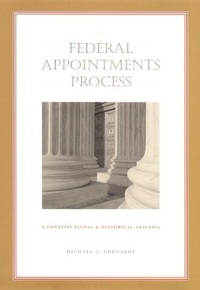
The Federal Appointments Process
A Constitutional and Historical Analysis
Will be published approx. on 22. August 2003
Book
Paperback/Softback
416 pages
978-0-8223-3199-5 (ISBN)
Description
Although the federal appointment of U.S. judges and executive branch officers has consistently engendered controversy, previous studies of the process have been limited to particular dramatic conflicts and have tended to view appointments in a vacuum without regard to other incidents in the process, other legislative matters, or broader social, political, and historical developments. The Federal Appointments Process fills this gap by providing the first comprehensive analysis of over two hundred years of federal appointments in the United States, revealing crucial patterns of growth and change in one of the most central of our democratic processes.
Michael J. Gerhardt includes each U.S. president's performance record regarding appointments, accounts of virtually all the major confirmation contests, as well as discussion of significant legal and constitutional questions raised throughout U.S. history. He also analyzes recess appointments, the Vacancies Act, the function of nominees in the appointment process, and the different treatment received by judicial and nonjudicial nominations. While discussing the important roles played by media and technology in federal appointments, Gerhardt not only puts particular controversies in perspective but also identifies important trends in the process, such as how leaders of different institutions attempt to protect-if not expand-their respective prerogatives by exercising their authority over federal appointments. Employing a newly emerging method of inquiry known as "historical institutionalism"-in which the ultimate goal is to examine the development of an institution in its entirety and not particular personalities or periods, this book concludes with suggestions for reforms in light of recent controversies springing from the longest delays in history that many judicial nominees face in the Senate.
Gerhardt's intensive treatment of the subject will be of interest to students and scholars of political science, government, history, and legal studies.
Michael J. Gerhardt includes each U.S. president's performance record regarding appointments, accounts of virtually all the major confirmation contests, as well as discussion of significant legal and constitutional questions raised throughout U.S. history. He also analyzes recess appointments, the Vacancies Act, the function of nominees in the appointment process, and the different treatment received by judicial and nonjudicial nominations. While discussing the important roles played by media and technology in federal appointments, Gerhardt not only puts particular controversies in perspective but also identifies important trends in the process, such as how leaders of different institutions attempt to protect-if not expand-their respective prerogatives by exercising their authority over federal appointments. Employing a newly emerging method of inquiry known as "historical institutionalism"-in which the ultimate goal is to examine the development of an institution in its entirety and not particular personalities or periods, this book concludes with suggestions for reforms in light of recent controversies springing from the longest delays in history that many judicial nominees face in the Senate.
Gerhardt's intensive treatment of the subject will be of interest to students and scholars of political science, government, history, and legal studies.
Reviews / Votes
"There is simply no other book available that comprehensively addresses the appointments process with the amount of care and historical detail that Gerhardt provides. Like his previous book on the impeachment process, this will be used for reference and as a jumping-off point for public debate triggered by important political controversies."-John O. McGinnis, Northwestern University School of Law "This book is destined to become the leading scholarly study of the American appointments process. It is comprehensive, eminently reasonable, and beautifully written. Gerhardt has assembled a rich collection of examples and he has persuasively interpreted their significance for American political practice. The Federal Appointments Process will be indispensible to political scientists, historians, and law professors who study the American separation of powers."-Christopher Eisgruber, Princeton UniversityMore details
Series
Edition
REV and Expanded Pbk edition
Language
English
Place of publication
North Carolina
United States
Target group
Professional and scholarly
Product notice
Paperback (trade)
Dimensions
Height: 226 mm
Width: 152 mm
Thickness: 28 mm
Weight
726 gr
ISBN-13
978-0-8223-3199-5 (9780822331995)
Copyright in bibliographic data and cover images is held by Nielsen Book Services Limited or by the publishers or by their respective licensors: all rights reserved.
Schweitzer Classification
Other editions
Additional editions
Michael J. Gerhardt | Neal Devins | Mark A. Graber
The Federal Appointments Process
A Constitutional and Historical Analysis
E-Book
01/2001
1st Edition
De Gruyter
€148.99
Available for download
Person
Michael J. Gerhardt is Professor of Law at the College of William and Mary School of Law. His other books include The Federal Impeachment Process: A Constitutional and Historical Analysis and Constitutional Theory: Arguments and Perspectives, each in their second edition.
Content
Acknowledgments
Introduction
Part One: The Origins, Structure, and Evolution of the Federal Appointments Process
Chapter 1: The Original Understanding of the Federal Appointments Process
Chapter 2: The Structure of the Federal Appointments Process
Chapter 3: Historical Changes and Patterns
Part Two: Evaluating the Roles of the Major Players in the Federal Appointments
Chapter 4: The President's Role in the Federal Appointments Process
Chapter 5: The Advice and Consent of the Senate
Chapter 6: The Nominee's Functions
Chapter 7: Public and Interest Group Participation in the Appointment Process
Chapter 8: The Impact of Media and Technology on the Federal Appointments Process
Part Three: Reforming the Federal Appointments Process
Chapter 9: The Need for Reform
Chapter 10: On the Future of Judicial Selection: Structure, Rules, and Norms
Postscript
Notes
Index
Introduction
Part One: The Origins, Structure, and Evolution of the Federal Appointments Process
Chapter 1: The Original Understanding of the Federal Appointments Process
Chapter 2: The Structure of the Federal Appointments Process
Chapter 3: Historical Changes and Patterns
Part Two: Evaluating the Roles of the Major Players in the Federal Appointments
Chapter 4: The President's Role in the Federal Appointments Process
Chapter 5: The Advice and Consent of the Senate
Chapter 6: The Nominee's Functions
Chapter 7: Public and Interest Group Participation in the Appointment Process
Chapter 8: The Impact of Media and Technology on the Federal Appointments Process
Part Three: Reforming the Federal Appointments Process
Chapter 9: The Need for Reform
Chapter 10: On the Future of Judicial Selection: Structure, Rules, and Norms
Postscript
Notes
Index