

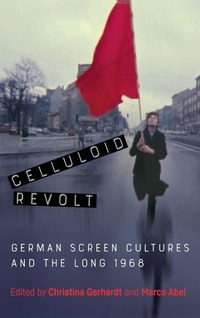
Celluloid Revolt
German Screen Cultures and the Long 1968
Published on 22. April 2019
Book
Hardback
338 pages
978-1-57113-995-5 (ISBN)
Description
Provides new insights into German-language cinema around 1968 and its relationship to the period's epoch-making cultural and political happenings.
The epoch-making revolutionary period universally known in Germany as '68 can be argued to have predated that year and to have extended well into the 1970s. It continues to affect German and Austrian society and culture to this day. Yet while scholars have written extensively about 1968 and the cinema of other countries, relatively little sustained scholarly attention has thus far been paid to 1968 and West German, East German, and Austrian cinemas. Now, five decades later, Celluloid Revolt sets out to redress that situation, generating new insights into what constituted German-language cinema around 1968 and beyond. Contributors engage a range of cinemas, spanning experimental and avant-garde cinema, installations and exhibits; short films, animated films, and crime films; collectively produced cinemas, feminist films, and Arbeiterfilme (workers' films); as well as their relationship to cinemas of other countries, such as French cinema verite and US direct cinema.
Contributors: Marco Abel, Tilman Baumgaertel, Madeleine Bernstorff, Timothy Scott Brown, Michael Dobstadt, Sean Eedy, Thomas Elsaesser, IanFleishman, Christina Gerhardt, Lisa Haegele, Randall Halle, Priscilla Layne, Ervin Malakaj, Kalani Michell, Evelyn Preuss, Patricia Anne Simpson, Fabian Tietke, Andrew Stefan Weiner.
Christina Gerhardt is Associate Professor of German and Film Studies at the University of Hawai'i at Manoa. Marco Abel is Professor of English and Film Studies at the University of Nebraska-Lincoln.
The epoch-making revolutionary period universally known in Germany as '68 can be argued to have predated that year and to have extended well into the 1970s. It continues to affect German and Austrian society and culture to this day. Yet while scholars have written extensively about 1968 and the cinema of other countries, relatively little sustained scholarly attention has thus far been paid to 1968 and West German, East German, and Austrian cinemas. Now, five decades later, Celluloid Revolt sets out to redress that situation, generating new insights into what constituted German-language cinema around 1968 and beyond. Contributors engage a range of cinemas, spanning experimental and avant-garde cinema, installations and exhibits; short films, animated films, and crime films; collectively produced cinemas, feminist films, and Arbeiterfilme (workers' films); as well as their relationship to cinemas of other countries, such as French cinema verite and US direct cinema.
Contributors: Marco Abel, Tilman Baumgaertel, Madeleine Bernstorff, Timothy Scott Brown, Michael Dobstadt, Sean Eedy, Thomas Elsaesser, IanFleishman, Christina Gerhardt, Lisa Haegele, Randall Halle, Priscilla Layne, Ervin Malakaj, Kalani Michell, Evelyn Preuss, Patricia Anne Simpson, Fabian Tietke, Andrew Stefan Weiner.
Christina Gerhardt is Associate Professor of German and Film Studies at the University of Hawai'i at Manoa. Marco Abel is Professor of English and Film Studies at the University of Nebraska-Lincoln.
Reviews / Votes
[A]bly edited by [Christina] Gerhardt and Marco Abel, [this volume] auspiciously brings together the work of scholars based in Europe and North America (still a rarity in German film studies). . . . A particular strength of the collection is its detailed attention to film feminisms. -- Hester Baer * GERMAN QUARTERLY * Thrilling in intellectual rigor and scope, the book's accomplishment is an inestimable one for future studies of committed film and media, particularly those interested in Tricontinental theory, post-socialist Europe, and the worldwide South. -- Nace Zavrl * NECSUS * [P]rovides fresh perspectives on the participation of German-language film in . . . social, cultural and political campaigns [around 1968]. . . . [H]ighlights how the vitality and abundance of cultural production at the time goes well beyond, stands aside from, and/or critiques leftist politics. Given these features, the volume becomes an invaluable source for the study of German and Austrian screen cultures aligned to the events of 1968, while also stimulating new directions and approaches around this subject. -- Claudia Sandberg * STUDIES IN EUROPEAN CINEMA * [This book] deepens the reader's understanding of how German-language cinema engaged with the events of the long 1968. Most importantly, it subverts the usual narrative that associates the politics of this era exclusively with West Germany. . . . [S]uccessfully redefine[s] cinema's relationship with 1968 across the axes of politics and aesthetics. -- Catriona Corke * GERMAN STUDIES REVIEW * The essays and interviews in this collection focus exclusively on German-language films -- West German, East German, and Austrian films -- looking at how the revolutionary happenings in Europe in 1968 were captured in the cinematic imaginations of young and sympathetic moviemakers. * CHOICE * Scholarship surrounding this era will benefit immensely from these well-curated articles and interviews and the huge range of filmic texts that they explore. -- Rob McFarland * FEMINIST GERMAN STUDIES * [B]roaden[s] its coverage to "greater Germany" (the GDR and Austria) as well as the FRG. The four essays on the GDR (by Ian Fleishman, Sean Eedy, Patricia Anne Simpson, and Evelyn Preuss) combine to dispel the common perception that East German cinema was a wasteland untouched by what was happening in the world outside and that it was so tightly controlled that directors were in effect hamstrung. . . . [This volume and two others by the editor Christina Gerhardt, also reviewed] are an admirable achievement. -- Denise J. Youngblood * HISTORICAL JOURNAL OF FILM, RADIO, AND TELEVISION *More details
Series
Language
English
Place of publication
Columbia, MD
United States
Publishing group
Boydell & Brewer Ltd
Target group
Professional and scholarly
Product notice
Cloth over boards
Illustrations
30 s/w Abbildungen
26 b/w illus.
Dimensions
Height: 235 mm
Width: 157 mm
Thickness: 23 mm
Weight
644 gr
ISBN-13
978-1-57113-995-5 (9781571139955)
Copyright in bibliographic data and cover images is held by Nielsen Book Services Limited or by the publishers or by their respective licensors: all rights reserved.
Schweitzer Classification
Other editions
Additional editions
E-Book
04/2019
1st Edition
De Gruyter
€48.99
Available for download
Persons
Evelyn Preuss is finishing her dissertation on East German cinema at Yale University. In addition, she is pursuing a project on neoliberalism and globalization(s) that examines the political effects of globalized media and culture and asks to what extent art can provide alternative, inclusive
platforms for building political and social consensus. Currently, she is coediting a volume, Through the Wall(s), examining the GDR's transnationalism in relation to informal networking and Eigensinn. She has published on East German Cinema, the intersection of media, architecture and politics, as well as on the disparity between Eastern and Western perspectives in a number of journals and anthologies. Lisa Haegele is assistant professor of German at Texas State University PATRICIA ANNE SIMPSON is Professor of German at the University of Nebraska-Lincoln. PRISCILLA LAYNE is Professor of German, with an adjunct appointment in African, African American and Diaspora Studies, at the University of North Carolina.
platforms for building political and social consensus. Currently, she is coediting a volume, Through the Wall(s), examining the GDR's transnationalism in relation to informal networking and Eigensinn. She has published on East German Cinema, the intersection of media, architecture and politics, as well as on the disparity between Eastern and Western perspectives in a number of journals and anthologies. Lisa Haegele is assistant professor of German at Texas State University PATRICIA ANNE SIMPSON is Professor of German at the University of Nebraska-Lincoln. PRISCILLA LAYNE is Professor of German, with an adjunct appointment in African, African American and Diaspora Studies, at the University of North Carolina.
Content
Introduction: German Screen Cultures and the Long 1968 - Christina Gerhardt and Marco Abel
PART I. ESSAYS
Peter Zadek's Film Ich bin ein Elefant, Madame (1969): Discussing "1968" by Means of "1968 Thinking" - Michael Dobstadt
"Break the Power of the Manipulators": Film and the West German 1968 - Timothy Scott Brown
Ideological Rupture in the dffb: An Analysis of Hans-Ruediger Minow's Berlin, 2. Juni - Priscilla Layne
Helke Sander's dffb Films and West Germany's Feminist Movement - Christina Gerhardt
Film Feminisms in West German Cinema: A Public Sphere for Feminist Politics - Madeleine Bernstorff
A Laboratory for Political Film: The Formative Years of the German Film and Television Academy and Participatory Filmmaking from Workerism to Feminism - Fabian Tietke
West Germany's "Workers' Films": A Cinema in the Service of Television? - Thomas Elsaesser
Guns, Girls, and Gynecologists: West German Exploitation Cinema and the St. Pauli Film Wave in the Late 1960s - Lisa Haegele
Mediation, Expansion, Event: Reframing the Austrian Filmmakers Cooperative - Andrew Stefan Weiner
Prague Displaced: Political Tourism in the East German Blockbuster Heisser Sommer - Ian Fleishman
Animating the Socialist Personality: DEFA Fairy Tale Trickfilme in the Shadow of 1968 - Sean Eedy
Allegories of Resistance: The Legacy of 1968 in GDR Visual Cultures - Patricia Anne Simpson
"You Say You Want a Revolution": East German Film at the Crossroads between the Cinemas - Evelyn Preuss
Cruel Optimism, Post-68 Nostalgia and the Limits of Political Activism in Helma Sanders-Brahms's Unter dem Pflaster ist der Strand (1975) - Ervin Malakaj
Revolting Formats: Hellmuth Costard's Der kleine Godard An das Kuratorium: Junger Deutscher Film - Kalani Michell
PART II. IN CONVERSATION: INTERVIEWS WITH FILMMAKERS
An Interview with Harun Farocki: "Holger Thought Aesthetics and Politics Together" - Tilman Baumgaertel
An Interview with Birgit Hein: "Art communicates knowledge that cannot be expressed in any other information system" - Randall Halle
An Interview with Klaus Lemke: "Being Smart Does Not Make Good Films" - Marco Abel
Notes on Contributors
PART I. ESSAYS
Peter Zadek's Film Ich bin ein Elefant, Madame (1969): Discussing "1968" by Means of "1968 Thinking" - Michael Dobstadt
"Break the Power of the Manipulators": Film and the West German 1968 - Timothy Scott Brown
Ideological Rupture in the dffb: An Analysis of Hans-Ruediger Minow's Berlin, 2. Juni - Priscilla Layne
Helke Sander's dffb Films and West Germany's Feminist Movement - Christina Gerhardt
Film Feminisms in West German Cinema: A Public Sphere for Feminist Politics - Madeleine Bernstorff
A Laboratory for Political Film: The Formative Years of the German Film and Television Academy and Participatory Filmmaking from Workerism to Feminism - Fabian Tietke
West Germany's "Workers' Films": A Cinema in the Service of Television? - Thomas Elsaesser
Guns, Girls, and Gynecologists: West German Exploitation Cinema and the St. Pauli Film Wave in the Late 1960s - Lisa Haegele
Mediation, Expansion, Event: Reframing the Austrian Filmmakers Cooperative - Andrew Stefan Weiner
Prague Displaced: Political Tourism in the East German Blockbuster Heisser Sommer - Ian Fleishman
Animating the Socialist Personality: DEFA Fairy Tale Trickfilme in the Shadow of 1968 - Sean Eedy
Allegories of Resistance: The Legacy of 1968 in GDR Visual Cultures - Patricia Anne Simpson
"You Say You Want a Revolution": East German Film at the Crossroads between the Cinemas - Evelyn Preuss
Cruel Optimism, Post-68 Nostalgia and the Limits of Political Activism in Helma Sanders-Brahms's Unter dem Pflaster ist der Strand (1975) - Ervin Malakaj
Revolting Formats: Hellmuth Costard's Der kleine Godard An das Kuratorium: Junger Deutscher Film - Kalani Michell
PART II. IN CONVERSATION: INTERVIEWS WITH FILMMAKERS
An Interview with Harun Farocki: "Holger Thought Aesthetics and Politics Together" - Tilman Baumgaertel
An Interview with Birgit Hein: "Art communicates knowledge that cannot be expressed in any other information system" - Randall Halle
An Interview with Klaus Lemke: "Being Smart Does Not Make Good Films" - Marco Abel
Notes on Contributors