

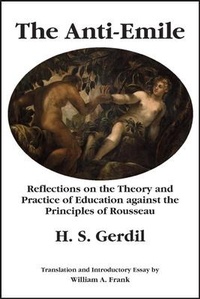
The Anti-Emile - Reflections on the Theory and Practice of Education against the Principles of Rousseau
Reflections on the Theory and Practice of Education Against the Principles of Rousseau
Will be published approx. on 30. November 2011
Book
Hardback
224 pages
978-1-58731-036-2 (ISBN)
Description
"In his Emile Rousseau proposes a new plan of education closely connected with a universal overthrow of civil order. The goal of the Emile is to prepare souls by means of a total revolution in their modes of thinking."-These words were penned in 1763, by the young Catholic philosopher, H. S. Gerdil, more than two decades before the French revolution. In a prophetic moment in the history of the philosophy of education, Gerdil noted that the pedagogy of Rousseau's book will inspire "vexation with and aversion for religious and social institutions . . . it will make bad Christians and bad citizens." The disenchantment with any authority or social forms sunk deep roots in the modern European social imagination. It has informed the many liberal reforms of education of the last two centuries. The Emile is still with us.
In his eminently readable reflections, H. S. Gerdil exposes the error of Rousseau's Romantic naturalism. In the process, he illustrates sensible judgment regarding concrete curricular matters and pedagogical practices. Gerdil's philosophy of education is grounded in the reality of original sin and the transcendent destiny of mankind. He provides both philosophical principles and concrete suggestions as to how parents and teachers might craft hearts and minds capable of serving "peace of families, the tranquility of states, and the general advantage of all men." Gerdil's humane Christian realism has lost none of its timeliness.
The Anti-Emile is an original English translation of Gerdil's work, first published in French under the title Reflexions sur la theorie, & la pratique de l'education contre les principes de Mr. Rousseau. In its day, the book was quickly diffused throughout Europe in its original French as well as in English, German, and Italian translations, and it soon picked up its popular title, The Anti-Emile. This translation is preceded by Frank's Introductory Essay, which draws out the radically different views of human nature represented by Rousseau and Gerdil. It makes clear what is at issue in Rousseau's rejection and Gerdil's advancement of the living tradition of classical education. In his essay, Frank also introduces H. S. Gerdil as an historical figure with a distinctive place in the history of modern philosophy.
In his eminently readable reflections, H. S. Gerdil exposes the error of Rousseau's Romantic naturalism. In the process, he illustrates sensible judgment regarding concrete curricular matters and pedagogical practices. Gerdil's philosophy of education is grounded in the reality of original sin and the transcendent destiny of mankind. He provides both philosophical principles and concrete suggestions as to how parents and teachers might craft hearts and minds capable of serving "peace of families, the tranquility of states, and the general advantage of all men." Gerdil's humane Christian realism has lost none of its timeliness.
The Anti-Emile is an original English translation of Gerdil's work, first published in French under the title Reflexions sur la theorie, & la pratique de l'education contre les principes de Mr. Rousseau. In its day, the book was quickly diffused throughout Europe in its original French as well as in English, German, and Italian translations, and it soon picked up its popular title, The Anti-Emile. This translation is preceded by Frank's Introductory Essay, which draws out the radically different views of human nature represented by Rousseau and Gerdil. It makes clear what is at issue in Rousseau's rejection and Gerdil's advancement of the living tradition of classical education. In his essay, Frank also introduces H. S. Gerdil as an historical figure with a distinctive place in the history of modern philosophy.
More details
Language
English
Place of publication
Indiana
United States
Target group
Professional and scholarly
Product notice
sewn/stitched
Cloth over boards
Dimensions
Height: 231 mm
Width: 155 mm
Thickness: 23 mm
Weight
454 gr
ISBN-13
978-1-58731-036-2 (9781587310362)
Copyright in bibliographic data and cover images is held by Nielsen Book Services Limited or by the publishers or by their respective licensors: all rights reserved.
Schweitzer Classification
Content
PrefacePart One. Theoretical Reflections on the Principles of Human Nature1. Rousseau's seductive rhetoric2. Emile is an unreal abstraction3. Whether contrariety is part of man's original nature4. Whether the self is ordered to others selves from the beginning5. Whether self-interest is a sufficient foundation for moral social relationships6. Love of honor and the attraction to an idea of perfection are natural inclinations7. The attraction to moral virtue is a natural inclination8. Whether society corrupts man's natural goodness9. Whether society invents the fear of death and makes men cowards10. Whether laws and society reduce man to a servile state of dependency1l. On the natural love of order and origins of society12. Man's reason, the natural analogue to animal instinct, requires education13. Whether children are capable of understanding moral categories14. On the importance of the fear of God in the moral education of children15.On the authority of fathers and the obedience of childrenPart Two. Reflections on Particular Educational Practices, and Most Especially on Matters of Curriculum16. On reasoning with children17. Rousseau's dialogue misrepresents how to reason morally with a child.18. On a child's capacity for handling ideas19. On teaching fables20. On the study of languages, and especially Latin21. On the study of history22. On the study of geography23. On the study of geometry24. Francis Bacon's observations on studying and reading25. The intellectual temperament of Rousseau's student26. On the native climate of the ideal student27. On the ideal student's physical constitution28. On the social status of Rousseau's student29. Insufficiency of philosophy for forming a national ethosConclusionEndnotesIndex