

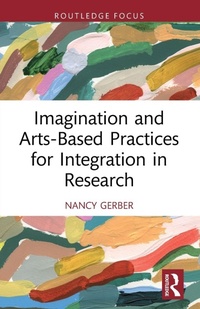
Imagination and Arts-Based Practices for Integration in Research
1st Edition
Published on 19. December 2024
Book
Paperback/Softback
90 pages
978-1-032-19642-8 (ISBN)
Description
Imagination and Arts-Based Practices for Integration in Research explores the philosophical assumptions, defining concepts, and methodological issues related to the introduction of intentional imaginative mental processes and arts-based practices into some or all phases of investigation, and data integration of particular research approaches.
Although typically central to mixed, multi-method, and arts-based research, the practice of integrating diverse forms of data might be applied to other research traditions. The integration of data diversity represents a deviation from traditional scientific thinking demanding a dramatic paradigm shift inclusive of multi-dimensional, nondiscursive, aesthetic, rhizomatic, and imaginative mental processes. In this book, imaginative mental processes and arts-based practices are described and illustrated as approaches to investigating, revealing, and understanding the elusive yet essential meanings hidden in the crevices, shadows, and liminal spaces in between diverse data sets leading to integration, illumination, and synthesis.
The book will appeal to arts-based, mixed methods, and adventurous researchers. It walks the reader through the revisionist philosophical assumptions and offers aligned methodological suggestions to the induction of imaginative mental processes and arts-based practices into research.
Although typically central to mixed, multi-method, and arts-based research, the practice of integrating diverse forms of data might be applied to other research traditions. The integration of data diversity represents a deviation from traditional scientific thinking demanding a dramatic paradigm shift inclusive of multi-dimensional, nondiscursive, aesthetic, rhizomatic, and imaginative mental processes. In this book, imaginative mental processes and arts-based practices are described and illustrated as approaches to investigating, revealing, and understanding the elusive yet essential meanings hidden in the crevices, shadows, and liminal spaces in between diverse data sets leading to integration, illumination, and synthesis.
The book will appeal to arts-based, mixed methods, and adventurous researchers. It walks the reader through the revisionist philosophical assumptions and offers aligned methodological suggestions to the induction of imaginative mental processes and arts-based practices into research.
More details
Series
Language
English
Place of publication
London
United Kingdom
Publishing group
Taylor & Francis Ltd
Target group
Professional and scholarly
College/higher education
Academic, Postgraduate, Professional, and Undergraduate Advanced
Illustrations
13 s/w Photographien bzw. Rasterbilder, 2 s/w Tabellen, 13 s/w Abbildungen
2 Tables, black and white; 13 Halftones, black and white; 13 Illustrations, black and white
Dimensions
Height: 216 mm
Width: 140 mm
Thickness: 5 mm
Weight
128 gr
ISBN-13
978-1-032-19642-8 (9781032196428)
Copyright in bibliographic data and cover images is held by Nielsen Book Services Limited or by the publishers or by their respective licensors: all rights reserved.
Schweitzer Classification
Other editions
Additional editions
Book
02/2022
1st Edition
Routledge
€76.60
Shipment within 10-20 days
E-Book
02/2022
1st Edition
Routledge
€27.49
Available for download
E-Book
02/2022
1st Edition
Routledge
€27.49
Available for download
Person
Nancy Gerber is an art psychotherapist, educator, and scholar. Through her years of clinical practice, teaching, and research, she has developed an interest in creating ways to capture and study the complexities and dimensions of the human condition through research methods that include and synthesize imaginative processes and arts-based practices.
Content
1. Introduction 2. Imagination: Changing Worldview and Social Discourse 3. Dialectical Aesthetic Intersubjectivity: A Philosophical Perspective 4. Imagination in Research: Reconceptualizing Method, Data, and Evidence 5. Imaginative Processes and Arts-based practices in Research 6. Imagination and Integration in Mixed and Multi-Method Research 7. Integration Using Imagination Processes and Arts-Based Practices 8. Conclusion