

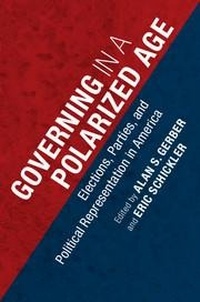
Governing in a Polarized Age
Elections, Parties, and Political Representation in America
Published on 31. October 2016
Book
Paperback/Softback
406 pages
978-1-107-47907-4 (ISBN)
Description
Many political observers have expressed doubts as to whether America's leaders are up to the task of addressing major policy challenges. Yet much of the critical commentary lacks grounding in the systematic analysis of the core institutions of the American political system including elections, representation, and the law-making process. Governing in a Polarized Age brings together more than a dozen leading scholars to provide an in-depth examination of representation and legislative performance. Drawing upon the seminal work of David Mayhew as a point of departure, these essays explore the dynamics of incumbency advantage in today's polarized Congress, asking whether the focus on individual re-election that was the hallmark of Mayhew's ground-breaking book, Congress: The Electoral Connection, remains useful for understanding today's Congress. The essays link the study of elections with close analysis of changes in party organization and with a series of systematic assessments of the quality of legislative performance.
Reviews / Votes
'Overall, Governing in a Polarized Age is focused on representation and the impact of a member's credit claiming, advertising, and position taking on Congress (specifically) and the executive branch (generally).' Jacob R. Straus, Congress and the PresidencyMore details
Language
English
Place of publication
Cambridge
United Kingdom
Target group
Professional and scholarly
College/higher education
Product notice
Paperback (trade)
Illustrations
47 Tables, black and white; 62 Line drawings, black and white
Dimensions
Height: 232 mm
Width: 154 mm
Thickness: 24 mm
Weight
553 gr
ISBN-13
978-1-107-47907-4 (9781107479074)
Copyright in bibliographic data and cover images is held by Nielsen Book Services Limited or by the publishers or by their respective licensors: all rights reserved.
Schweitzer Classification
Other editions
Additional editions
Alan S. Gerber | Eric Schickler
Governing in a Polarized Age
Elections, Parties, and Political Representation in America
Book
02/2017
Cambridge University Press
€127.50
Shipment within 15-20 days
Persons
Alan S. Gerber is Divisional Director for the Social Sciences and Dilley Professor of Political Science at Yale University, Connecticut. Co-author of an award-winning textbook on experimental methods, his work has appeared in the leading journals in political science and has received various awards, including the Heinz Eulau Award for the best article in the American Political Science Review. He was elected to the American Academy of Arts and Sciences (2009) and the American Academy of Political and Social Sciences (2013). Eric Schickler is Jeffrey and Ashley McDermott Professor of Political Science at the University of California, Berkeley. He is the author of Disjointed Pluralism, which won the Richard F. Fenno, Jr Prize for the best book on legislative politics in 2002. He is the co-author of Partisan Hearts and Minds, which was published in 2002, and Filibuster, which was published in 2006 and won the Fenno Prize.
Content
1. Introduction; Part I. Political Representation and Democratic Accountability: 2. The electoral connection, age 40 R. Douglas Arnold; 3. The electoral connection, then and now Gary Jacobson; 4. The congressional incumbency advantage over sixty years: measurement, trends, and implications Robert S. Erikson; 5. A baseline for incumbency effects Christopher Achen; Part II. Continuity and Change in Party Organizations: 6. Legislative parties in an era of alternating majorities Frances E. Lee; 7. Parties within parties: parties, factions, and coordinated politics, 1900-80 John Mark Hansen, Shigeo Hirano and James M. Snyder, Jr; 8. Where measures meet history: party polarization during the New Deal and Fair Deal Joshua D. Clinton, Ira Katznelson and John S. Lapinski; Part III. Partisanship and Governmental Performance: 9. Polarized we govern? Sarah Binder; 10. What has Congress done? Stephen Ansolabehere, Maxwell Palmer and Benjamin Schneer; 11. Can Congress do policy analysis? The politics of problem solving on Capitol Hill Eric M. Patashnik and Justin Peck; 12. Studying contingency systematically Katherine Levine Einstein and Jennifer Hochschild; 13. Majoritarianism, majoritarian tension, and the Reed revolution Keith Krehbiel; Part IV. Conclusions: 14. Intensified partisanship in congress: institutional effects David E. Price; 15. The origins of Congress: The Electoral Connection David R. Mayhew.