

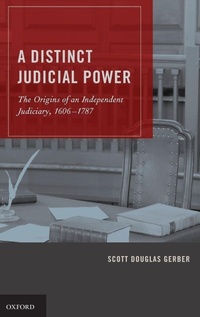
A Distinct Judicial Power
The Origins of an Independent Judiciary, 1606-1787
1st Edition
Published on 5. May 2011
Book
Hardback
440 pages
978-0-19-976587-4 (ISBN)
Description
A Distinct Judicial Power: The Origins of an Independent Judiciary, 1606-1787, by Scott Douglas Gerber, provides the first comprehensive critical analysis of the origins of judicial independence in the United States. Part I examines the political theory of an independent judiciary. Gerber begins chapter 1 by tracing the intellectual origins of a distinct judicial power from Aristotle's theory of a mixed constitution to John Adams's modifications of Montesquieu. Chapter 2 describes the debates during the framing and ratification of the federal Constitution regarding the independence of the federal judiciary. Part II, the bulk of the book, chronicles how each of the original thirteen states and their colonial antecedents treated their respective judiciaries. This portion, presented in thirteen separate chapters, brings together a wealth of information (charters, instructions, statutes, etc.) about the judicial power between 1606 and 1787, and sometimes beyond. Part III, the concluding segment, explores the influence the colonial and early state experiences had on the federal model that followed and on the nature of the regime itself. It explains how the political theory of an independent judiciary examined in Part I, and the various experiences of the original thirteen states and their colonial antecedents chronicled in Part II, culminated in Article III of the U.S. Constitution. It also explains how the principle of judicial independence embodied by Article III made the doctrine of judicial review possible, and committed that doctrine to the protection of individual rights.
Reviews / Votes
Beginning with a review of the intellectual history of judicial independence from Aristotle to John Adams, Gerber thoroughly chronicles the rise of protojudicial independence in the original thirteen colonies' foundational texts and practices. Gerber persuasively describes the colonies as lurching toward judicial independence slowly and unevenly, yet steadily. * Harvard Law Review. * Gerber's book is by far the most comprehensive examination of the manner by which colonial and state constitutions contributed to the federal Constitution His study not only highlights the legacy of the aforementioned area to the creation of Article III of the Constitution, but renews interest in the contribution of John Adams to the development of the courts and opens new ground about the relationship between judicial review and judicial independence. * Samuel B. Hoff, Law and Politics Book Review. * A valuable summary of the development of local judicial institutions that provides a welcome resource for students of the colonial and Revolutionary eras. * Edward A. Purcell, Jr., Tulsa Law Review. * There is much to praise in A Distinct Judicial Power. Tracing the history of a separate judicial branch as it developed in America is an important task in itself. Bringing together the experience of every one of the thirteen colonies in the development of its judiciary is a boon to us all. * Joyce Lee Malcolm, George Mason University School of Law. * Reason Papersber has authored a timely and thorough treatise on judicial review that traces the concept through 3,000 years of political thought. He also has provided an in-depth historical analysis on this country's struggles to create an independent judiciary founded on a compensation and tenure structure not subject to political whim. * Gerald Rafferty, Colorado Lawyer * Beginning with a review of the intellectual history of judicial independence from Aristotle to John Adams, Gerber thoroughly chronicles the rise of protojudicial independence in the original thirteen colonies foundational texts and practices. Gerber persuasively describes the colonies as lurching toward judicial independence slowly and unevenly, yet steadily. * Harvard Law Review *More details
Language
English
Place of publication
New York
United States
Target group
Professional and scholarly
Professors, students, scholars, etc. of legal history, constitutional law, political science
Dimensions
Height: 240 mm
Width: 161 mm
Thickness: 28 mm
Weight
816 gr
ISBN-13
978-0-19-976587-4 (9780199765874)
Copyright in bibliographic data and cover images is held by Nielsen Book Services Limited or by the publishers or by their respective licensors: all rights reserved.
Schweitzer Classification
Other editions
Additional editions
E-Book
01/2011
1st Edition
OUP eBook
€61.99
Available for download
Person
Scott Douglas Gerber is Professor of Law at Ohio Northern University and Senior Research Scholar in Law and Politics at the Social Philosophy and Policy Center. He teaches constitutional law and American legal history. He received both his Ph.D. and J.D. from the University of Virginia, and his B.A. from the College of William and Mary. His previous books include: The Declaration of Independence: Origins and Impact; First Principles: The Jurisprudence of Clarence Thomas; Seriatim: The Supreme Court Before John Marshall; and To Secure These Rights: The Declaration of Independence and Constitutional Interpretation. He has also published two novels.
Content
PREFACE; A NOTE ON METHODOLOGY; THE POLITICAL THEORY OF AN INDEPENDENT JUDICIARY; II THE JUDICIAL POWER IN THE ORIGINAL THIRTEEN STATES AND THEIR COLONIAL ANTECEDENTS; JUDICIAL INDEPENDENCE, JUDICIAL REVIEW, AND INDIVIDUAL RIGHTS; APPENDIX: POPULAR CONSTITUTIONALISM-THE CONTEMPORARY ASSAULT ON JUDICIAL REVIEW; WORKS CITED; INDEX