

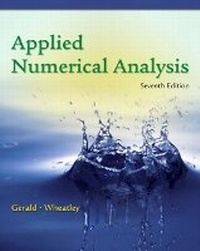
Applied Numerical Analysis
International Edition
7th Edition
Published on 4. September 2003
Book
Paperback/Softback
624 pages
978-0-321-19019-2 (ISBN)
Description
The seventh edition of this classic text has retained the features that make it popular, while updating its treatment and inclusion of Computer Algebra Systems and Programming Languages. Interesting and timely applications motivate and enhance students' understanding of methods and analysis of results. This text incorporates a balance of theory with techniques and applications, including optional theory-based sections in each chapter. The exercise sets include additional challenging problems and projects which show practical applications of the material. Also, sections which discuss the use of computer algebra systems such as Maple (R), Mathematica (R), and MATLAB (R), facilitate the integration of technology in the course. Furthermore, the text incorporates programming material in both FORTRAN and C. The breadth of topics, such as partial differential equations, systems of nonlinear equations, and matrix algebra, provide comprehensive and flexible, coverage of all aspects of numerical analysis.
More details
Edition
7th edition
Language
English
Place of publication
United States
Publishing group
Pearson Education (US)
Target group
Professional and scholarly
Dimensions
Height: 230 mm
Width: 190 mm
Thickness: 23 mm
Weight
926 gr
ISBN-13
978-0-321-19019-2 (9780321190192)
Copyright in bibliographic data and cover images is held by Nielsen Book Services Limited or by the publishers or by their respective licensors: all rights reserved.
Schweitzer Classification
Other editions
Previous edition
Book
09/2003
7th Edition
Pearson
€108.93
Article exhausted; check for reprint
Content
0. Preliminaries.
Analysis versus Numerical Analysis.
Computers and Numerical Analysis.
An Illustrative Example.
Kinds of Errors in Numerical Procedures.
Interval Arithmetic.
Parallel and Distributed Computing.
Measuring the Efficiency of Procedures.
1. Solving Nonlinear Equations.
Interval Halving (Bisection).
Linear Interpolation Methods.
Newton's Method.
Muller's Method.
Fixed-Point Iteration.
Other Methods.
Nonlinear Systems.
2. Solving Sets of Equations.
Matrices and Vectors.
Elimination Methods.
The Inverse of a Matrix and Matrix Pathology.
Almost Singular Matrices - Condition Numbers.
Interactive Methods.
Parallel Processing.
3. Interpolation and Curve Fitting.
Interpolating Polynomials.
Divided Differences.
Spline Curves.
Bezier Curves and B-Splines.
Interpolating on a Surface.
Least Squares Approximations.
4. Approximation of Functions.
Chebyshev Polynomials and Chebyshev Series.
Rational Function Approximations.
Fourier Series.
5. Numerical Differentiation and Integration.
Differentiation with a Computer.
Numerical Integration - The Trapezoidal Rule.
Simpson's Rules.
An Application of Numerical Integration - Fourier Series and Fourier Transforms Adaptive Integration.
Gaussian Quadrature.
Multiple Integrals.
Applications of Cubic Splines.
6. Numerical Solution of Ordinary Differential Equations.
The Taylor Series Method.
The Euler Method and Its Modification.
Runge-Kutta Methods.
Multistep Methods.
Higher-Order Equations and Systems.
Stiff Equations.
Boundary-Value Problems.
Characteristic-Value Problems.
7. Optimization.
Finding the Minimum of y = f(x).
Minimizing a Function of Several Variables.
Linear Programming.
Nonlinear Programming.
Other Optimizations.
8. Partial Differential Equations.
Elliptic Equations.
Parabolic Equations.
Hyperbolic Equations.
9. Finite Element Analysis.
Mathematical Background.
Finite Elements for Ordinary Differential Equation.
Finite Elements for Partial Differential Equation.
Appendices.
A. Some Basic Information from Calculus.
B. Software Resources.
Answers to Selected Exercises.
References.
Index.
Analysis versus Numerical Analysis.
Computers and Numerical Analysis.
An Illustrative Example.
Kinds of Errors in Numerical Procedures.
Interval Arithmetic.
Parallel and Distributed Computing.
Measuring the Efficiency of Procedures.
1. Solving Nonlinear Equations.
Interval Halving (Bisection).
Linear Interpolation Methods.
Newton's Method.
Muller's Method.
Fixed-Point Iteration.
Other Methods.
Nonlinear Systems.
2. Solving Sets of Equations.
Matrices and Vectors.
Elimination Methods.
The Inverse of a Matrix and Matrix Pathology.
Almost Singular Matrices - Condition Numbers.
Interactive Methods.
Parallel Processing.
3. Interpolation and Curve Fitting.
Interpolating Polynomials.
Divided Differences.
Spline Curves.
Bezier Curves and B-Splines.
Interpolating on a Surface.
Least Squares Approximations.
4. Approximation of Functions.
Chebyshev Polynomials and Chebyshev Series.
Rational Function Approximations.
Fourier Series.
5. Numerical Differentiation and Integration.
Differentiation with a Computer.
Numerical Integration - The Trapezoidal Rule.
Simpson's Rules.
An Application of Numerical Integration - Fourier Series and Fourier Transforms Adaptive Integration.
Gaussian Quadrature.
Multiple Integrals.
Applications of Cubic Splines.
6. Numerical Solution of Ordinary Differential Equations.
The Taylor Series Method.
The Euler Method and Its Modification.
Runge-Kutta Methods.
Multistep Methods.
Higher-Order Equations and Systems.
Stiff Equations.
Boundary-Value Problems.
Characteristic-Value Problems.
7. Optimization.
Finding the Minimum of y = f(x).
Minimizing a Function of Several Variables.
Linear Programming.
Nonlinear Programming.
Other Optimizations.
8. Partial Differential Equations.
Elliptic Equations.
Parabolic Equations.
Hyperbolic Equations.
9. Finite Element Analysis.
Mathematical Background.
Finite Elements for Ordinary Differential Equation.
Finite Elements for Partial Differential Equation.
Appendices.
A. Some Basic Information from Calculus.
B. Software Resources.
Answers to Selected Exercises.
References.
Index.