

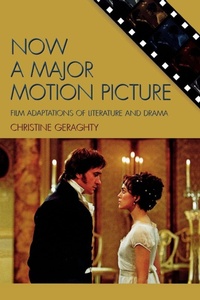
Now a Major Motion Picture
Film Adaptations of Literature and Drama
Published on 2. October 2007
Book
Paperback/Softback
232 pages
978-0-7425-3821-4 (ISBN)
Description
Going beyond the process of adaptation, Geraghty is more interested in the films themselves and how they draw on our sense of recall. While a film reflects its literary source, it also invites comparisons to our memories and associations with other versions of the original. For example, a viewer may watch the 2005 big-screen production of Pride and Prejudice and remember Austen's novel as well as the BBC's 1995 television movie. Adaptations also rely on the conventions of genre, editing, acting, and sound to engage our recall-elements that many movie critics tend to forget when focusing solely on faithfulness to the written word.
Reviews / Votes
This wide-ranging, multifaceted, accessible discussion thoughtfully addresses many understudied aspects of screen adaptation. -- Kamilla Elliott, Bowland College, author, Rethinking the Novel/Film Debate Geraghty covers a wide variety of works...demonstrating the flexibility and broad applicability of her innovative approach to film adaptation....This study provides a fresh perspective on film adaptation....Highly recommended. * Choice Reviews * Christine Geraghty's book is...methodologically clear, lucid, and consistent on all levels....At all times Geraghty's discussions remain detailed and nuanced to boot. * Image & Narrative * Christine Geraghty's book on the adaptation of literature into film comes like a breath of fresh critical air. She knows that the antecedent text can't be ignored, but she places the film in what may well be much more revealing contexts. Geraghty has not only chosen an imposing and unexpected range of literary texts and the films derived from them (from The Last of the Mohicans to Ulysses), but she also views them from new perspectives. Her emphasis is rewardingly on the films themselves and on their contexts: art-house cinema, the half-way house cinema of 'heritage filmmaking,' European independent film, or British New Wave. Adapted films, as Geraghty makes plain, will be read in radically different ways if the viewer has more in mind than a slavish concern for what has been 'done' to the earlier text. This is an important book, scholarly and stimulating and entirely readable. -- Brian McFarlane, Monash University, Australia, and the University of Hull, United KingdomMore details
Series
Language
English
Place of publication
United States
Publishing group
Bloomsbury Publishing Plc
Target group
College/higher education
Dimensions
Height: 229 mm
Width: 152 mm
Thickness: 13 mm
Weight
343 gr
ISBN-13
978-0-7425-3821-4 (9780742538214)
Copyright in bibliographic data and cover images is held by Nielsen Book Services Limited or by the publishers or by their respective licensors: all rights reserved.
Schweitzer Classification
Other editions
Additional editions
E-Book
10/2007
1st Edition
Rowman & Littlefield Publishers
€47.49
Available for download
E-Book
10/2007
1st Edition
Rowman & Littlefield Publishers
€47.49
Available for download
Person
Christine Geraghty is Professor of Film and Television Studies at the University of Glasgow, Scotland. She is the author of Women and Soap Opera (1991) and British Cinema in the Fifties (2000).
Content
Chapter 1 Introduction
Chapter 2 1 Narrative and Characterisation in Classic Adaptations: David Copperfield, Oliver Twist, and Pride and Prejudice
Chapter 3 2 Art Cinema, Authorship, and the Impossible Novel: Adaptations of Proust, Woolf, and Joyce
Chapter 4 3 Tennessee Williams on Film: Space, Melodrama, and Stardom
Chapter 5 4 Feminism, Authorship, and Genre: Adaptations of the Novels of Edna Ferber and Pearl S Buck
Chapter 6 5 Revising the Western: Movement and Description in The Last of the Mohicans(1992) and Brokeback Mountain
Chapter 7 6 Space, Setting, and Mobility in Old New York: The Heiress, The House of Mirth, and Gangs of New York
Chapter 8 Conclusion
Chapter 9 Filmography
Chapter 10 Bibliography
Chapter 2 1 Narrative and Characterisation in Classic Adaptations: David Copperfield, Oliver Twist, and Pride and Prejudice
Chapter 3 2 Art Cinema, Authorship, and the Impossible Novel: Adaptations of Proust, Woolf, and Joyce
Chapter 4 3 Tennessee Williams on Film: Space, Melodrama, and Stardom
Chapter 5 4 Feminism, Authorship, and Genre: Adaptations of the Novels of Edna Ferber and Pearl S Buck
Chapter 6 5 Revising the Western: Movement and Description in The Last of the Mohicans(1992) and Brokeback Mountain
Chapter 7 6 Space, Setting, and Mobility in Old New York: The Heiress, The House of Mirth, and Gangs of New York
Chapter 8 Conclusion
Chapter 9 Filmography
Chapter 10 Bibliography