

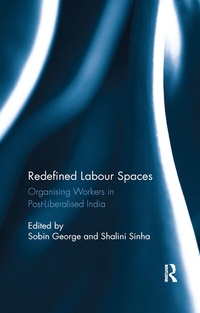
Redefined Labour Spaces
Organising Workers in Post-Liberalised India
1st Edition
Published on 12. December 2019
Book
Paperback/Softback
350 pages
978-0-367-88405-5 (ISBN)
Description
This book discusses the transformation of labour movements and trade unionism in post-liberalised India. It looks at emerging collectivism, both in formal and informal sectors, and relates it to changing political and industrial relations. Bringing together studies of resistance, struggles and new forms of negotiations from different industries -agriculture, fisheries, brick kiln, plantations, IT, domestic workers, shipbreakers, sex workers, and miners -this book exposes the myths, realities and challenges that the present generation of workers in India face and struggle with. With contributions from leading thinkers in the field, the work deepens the understanding of the current Indian labour spaces, possibilities for contestations and articulations from below.
The volume will be useful to students and researchers of labour studies, economics, sociology, development studies and public policy. It will be an invaluable resource to those engaged with industrial relations, trade unions, human rights, social exclusion as well as labour organisations and research institutions.
The volume will be useful to students and researchers of labour studies, economics, sociology, development studies and public policy. It will be an invaluable resource to those engaged with industrial relations, trade unions, human rights, social exclusion as well as labour organisations and research institutions.
Reviews / Votes
'The global ascendency of the neo-liberal economic reforms, for almost four decades now, has had profound implications for the politics of labour, in particular for the conventional strategies of organisation and mobilisation. The present volume, edited by Sobin George and Shalini Sinha, seeks to examine and analyse the plethora of responses and resistances by labour in India to claim/reclaim spaces for itself. Given that there has been a dearth of relevant literature on this theme, the volume is a welcome contribution. Furthermore, it is solidly grounded, in terms of capturing the processes 'from below' across several sectors (ranging from traditional to modern), empirically nuanced and analytically thought-provoking. This very worthwhile collection of essays engages remarkably well with the discourses on labour spaces in contemporary India and deepens our understanding significantly.'Praveen Jha, Professor of Economics, Jawaharlal Nehru University, New Delhi, India
'This volume is essential reading for anyone wanting to understand challenges faced by the contemporary labour movement. While providing fresh insights into the nature of these challenges, it avoids pessimism by reflecting on new possibilities for organising through inspiring case studies - a wonderful contribution to knowledge on this issue, for scholars, the engaged public and activists alike.'
Caroline Skinner, African Centre for Cities, University of Cape Town, South Africa and Urban Research Director, Women in Informal Employment: Globalizing and Organizing (WIEGO)
'The informal economy dominates the Indian economy in terms of size, and yet far from enough is known about the empirical realities of informal workers. This book is a valuable contribution to advancing knowledge about ways in which informal workers have mobilised to improve their life situations, as well as new forms of mobilisations within the organised sector.'
Ratna M. Sudarshan, Former Director, Institute of Social Studies Trust, New Delhi, India
More details
Language
English
Place of publication
London
United Kingdom
Publishing group
Taylor & Francis Ltd
Target group
College/higher education
Postgraduate
Dimensions
Height: 216 mm
Width: 138 mm
Weight
700 gr
ISBN-13
978-0-367-88405-5 (9780367884055)
Copyright in bibliographic data and cover images is held by Nielsen Book Services Limited or by the publishers or by their respective licensors: all rights reserved.
Schweitzer Classification
Other editions
Additional editions
E-Book
07/2017
1st Edition
Routledge
€59.49
Available for download
E-Book
07/2017
1st Edition
Routledge
€59.49
Available for download
Book
07/2017
1st Edition
Routledge
€206.80
Shipment within 10-20 days

Redefined Labour Spaces
Organising Workers in Post-Liberalised India
Book
04/2017
Routledge
€147.30
No shipping information available
Persons
Sobin George is Assistant Professor at the Centre for Studies of Social Change and Development, Institute for Social and Economic Change, Bengaluru, India.
Shalini Sinha is the India Country Representative of the global action-research-policy network, Women in Informal Employment: Globalizing and Organizing (WIEGO), and is based in New Delhi, India.
Shalini Sinha is the India Country Representative of the global action-research-policy network, Women in Informal Employment: Globalizing and Organizing (WIEGO), and is based in New Delhi, India.
Content
List of Figures. List of Tables. Contributors. Foreword. Acknowledgements. List of Abbreviations Introduction. PART I THE CONTEMPORARY INDIAN LABOUR SPACE 1. Labourscape and Labour space in Post-Liberalised India: Critical Reflections 2. Unionisation in Post-Reform India: A Review of Trends and Trajectories 3. Globalisation Dynamics and the Working-Class Movement: An Agenda for Future PART II RESPONDING TO INFORMALITY: NEW APPROACHES 4. Breaking the Bondage: Organising Brick Kiln Workers in Rural Punjab 5. Safeguarding Livelihoods in Fisheries: A Complex Organisational Challenge 6. The Struggle for Space: Organising Street Vendors in India 7. Domestic Workers' Movement in Maharashtra: Organising Experiences of Pune City Domestic Workers' Organisation PART III NEW ARTICULATIONS 8. New Identities Require New Strategies: Union Formation in the Indian IT/ITES Sector 9. The SEWA Lok Swasthya Mandali: A Dual Experiment in Organising and Service Provisioning in Gujarat 10. "As Human Beings and As Workers": Sex Worker Unionisation in Karnataka, India 11. Organising the Unorganised: Academic and Activist Insights from Shipbreaking Yards in Mumbai PART IV THE NEW WAVES: MYTHS AND REALITIES 12. Mistaken Identities in Information Technology Sector in India: Implications for Unionisation 13. Possibilities and Barriers of Workers' Co-Operative: Lessons from Failed Takeover Experience of a Closed Mine in Jharkhand 14. Uprisings by Women in Tea Plantations: Contextualising the Pombilai Orumai Movement in Kerala. Glossary. Index