

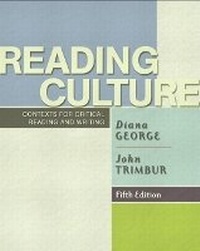
Reading Culture
Contexts for Critical Reading and Writing
5th Edition
Published on 18. February 2004
Book
Paperback/Softback
608 pages
978-0-321-12220-9 (ISBN)
Description
The original cultural studies reader, this essay collection is widely-used for its provocative readings and images on relevant cultural issues and for its outstanding pedagogy. Written by two respected composition theorists, Reading Culture truly makes use of cultural studies methods-from analyzing texts and historical documents, to conducting fieldwork and mini-ethnographies. The first cultural studies reader to also address visual literacy, the text includes over 100 images of posters, advertisements, photos, and art to accompany and illustrate the readings or as "Visual Essays" and "Visual Culture" segments that stand on their own. The fifth edition enhances that coverage with an appealing new four-color format and full-color art throughout the text. Helping students gain the necessary critical thinking skills to observe and analyze cultural phenomena, the opening chapter introduces reading and writing strategies and features a case study-new to this edition-that shows students how to "read" culture. Always up-to-date, this edition represents a significant revision with several new readings, themes, and visual images.
More details
Edition
5th edition
Language
English
Place of publication
United States
Publishing group
Pearson Education (US)
Target group
Professional and scholarly
Dimensions
Height: 235 mm
Width: 191 mm
Thickness: 22 mm
Weight
912 gr
ISBN-13
978-0-321-12220-9 (9780321122209)
Copyright in bibliographic data and cover images is held by Nielsen Book Services Limited or by the publishers or by their respective licensors: all rights reserved.
Schweitzer Classification
Other editions
New editions
Book
04/2006
6th Edition
Pearson
€53.22
Article exhausted; check for reprint
Previous edition
Book
03/2002
4th Edition
Pearson
€33.41
Article exhausted; check for reprint
Content
* Denotes a new section.Introduction.
*Raymond Williams, "Culture Is Ordinary."
*1. Reading the News.
Thinking About the News.
Reading Television News.
Terms to Keep in Mind as You Read Television News.
What is News? Analyzing Content and Audience.
Analyzing Visual and Verbal Codes.
Reading Newspapers.
The Look of the Page: Analyzing Visual Design.
Continuing News: Covering a Story.
Reading News Magazines.
Analyzing Visual Design: The Two-Page Spread.
Cover Stories: Putting a Face on the News.
Reading News on the Web.
Reading About the News-The Case of 9/11.
*Leonard Downie, Jr. and Robert G. Kaiser, "News Values."
*Jim Rutenberg, "Fox Portrays a War of Good and Evil, and Many Applaud."
*William Uricchio, "Television Conventions."
Writing About the News.
Conclusion.
2. Generations.
Reading the Culture of Generations.
Gloria Naylor, "Kiswana Browne."
Dave Marsh, "Fortunate Son."
Lawrence Grossberg, "Youth and American Identity."
Donna Gaines, "Teenage Wasteland."
Thomas Hine, "Goths in Tomorrowland."
*Mike Pope, "Gen X's Enduring Legacy: The Internet."
PERSPECTIVES: Before and After 9/11.
*Arlie Russell Hochschild, "Gen (Fill in the Blank): Coming of Age, Seeking an Identity."
*Barbara Kantrowitz and Keith Naughton, "Generation 9-11."
CLASSIC READING.
*Allen Ginsberg, "Howl."
CHECKING OUT THE WEB.
VISUAL CULTURE: Representations of Youth Culture in Movies.
James Gilbert, "Juvenile Delinquency Films."
FIELDWORK: Ethnographic Interviews.
Susan D. Craft, Daniel Cavicchi, and Charles Keil, "My Music."
Fieldwork Project.
Editing.
Writing an Introduction.
MINING THE ARCHIVE: Life Magazine.
3. Schooling.
Reading the Culture of Schooling.
Theodore R. Sizer, "What High School Is."
Leon Botstein, "Let Teenagers Try Adulthood."
PERSPECTIVES: School Vouchers.
*Supreme Court Majority Opinion and Dissenting Views.
*"Give Vouchers a Try."
*"The Wrong Ruling on Vouchers."
Mike Rose, "Crossing Boundaries."
Margaret J. Finders, "Note-Passing: Struggles for Status."
Min-zhan Lu, "From Silence to Words: Writing as Struggle."
June Jordan, "Nobody Mean More to Me Than You and the Future Life of Willie Jordan."
CLASSIC READING.
*Lisa Delpit, "Skills and Other Dilemmas of a Progressive Black Educator."
CHECKING OUT THE WEB.
VISUAL CULTURE: Picturing Schooldays.
FIELDWORK: Classroom Observation.
Field Log.
Background.
Field Notes.
Analysis.
Writing the Report.
Introduction.
Method.
Observations.
Conclusions.
Worth Anderson, et al., Observations and Conclusions from "Cross-Curricular Underlife: A Collaborative Report on Ways with Academic Words."
MINING THE ARCHIVES: Textbooks from the Past.
4. Images.
Reading Images.
Stuart and Elizabeth Ewen, "In the Shadow of the Image."
*VISUAL ESSAY: "Selling Magic."
*VISUAL ESSAY: "It's a Woman Thing."
*bell hooks, "Facing Difference: The Black Female Body."
*Kalle Lasn, "Hype."
*VISUAL ESSAY: "Rewriting the Image."
VISUAL ESSAY: "Public Health Messages."
*CLASSIC READING.
James Agee, "A Way of Seeing: An Introduction to the Photographs of Helen Levitt."
CHECKING OUT THE WEB.
MINING THE ARCHIVE: Advertising Through the Ages.
5. Style.
Reading Style.
Dick Hebdige, "Style in Revolt: Revolting Style."
VISUAL ESSAY: Graphic Design in Rock Culture.
PERSPECTIVES: Analyzing Product Design.
*Richard Porch, "The Digital Watchs: Tribal Bracelets of the Consumer Society."
*Judith Williamson, "Urban Spaceman."
*Steven Skov Holt, "Beauty and Blob: Product Culture Now."
*VISUAL ESSAY: "The Age of Blobjects."
PERSPECTIVES: Branding.
*Naomi Klein, "No Logo."
*The Economist, "Who's Wearing the Trousers."
*Jonah Peretti "No Sweat, No Slang."
*VISUAL ESSAY: Tiber Kalman, "Sweet-Talking Spaghetti Sauce: How to Read a Label."
CLASSIC READING.
*Roland Barthes, "Wine and Milk."
CHECKING OUT THE WEB.
*MINING THE ARCHIVE: Race and Branding.
6. Public Space.
Reading Public Space.
Barry Lopez, "Borders."
John Fiske, "Shopping for Pleasure: Malls, Power, and Resistance."
Mike Davis, "Fortress Los Angeles: The Militarization of Urban Space."
*Murphy Davis, "Woodruff Park and the Search for Common Ground."
Eva Sperling Cockcroft and Holly Barnet Sanchez, "Signs from the Heart: California Chicano Murals."
PERSPECTIVES: Ground Zero-Commerce and Commemoration.
*Herbert Muschamp, "The Commemorative Beauty of Tragic Wreckage."
*Larry Silverstein, "Rebuild at Ground Zero."
CLASSIC READING.
*Jane Jacobs, "The Uses of Sidewalks-Safety."
VISUAL CULTURE: Reading Interpretive Space.
FIELDWORK: Observing the Uses of Public Space.
Fieldwork Project.
Mapping the Space.
Taking Notes.
Watching People.
Asking Questions.
Writing Up Your Findings.
CHECKING OUT THE WEB.
MINING THE ARCHIVES: Take a Walking Tour.
7. Storytelling.
Reading Storytelling.
Jan Harold Brunvand, "` The Hook' and Other Teenage Horrors."
*Patricia A. Turner, "I Heard It Through the Grapevine."
Stephen King, "Why We Crave Horror Movies."
*A.O. Scott, "A Hunger for Fantasy and an Empire to Feed It."
PERSPECTIVES: Writing Superheroes.
*Roger Ebert, "Spider-Man."
*Michael Chabon, from The Amazing Adventures of Kavalier and Clay.
CLASSIC READING.
*Robert Warshow, "The Gangster as Tragic Hero."
VISUAL CULTURE: Composing a Visual Narrative.
*Jacob Lawrence, The Harriet Tubman Series.
FIELDWORK: Writing a Questionnaire.
Suggestions for Designing a Questionnaire.
Sample Questionnaire.
Report on Your Findings.
CHECKING OUT THE WEB.
MINING THE ARCHIVE: Comic Strips and Comic Books.
8. Work.
Reading Work.
Sandra Cisneros, "The First Job."
Scott Adams, "The Dilbert Principle."
Arlie Russell Hoschschild, "Work: The Great Escape."
Barbara Ehrenreich, "Nickel-and-Dimed: On (Not) Getting By in America."
PERSPECTIVES: Sweatshop Economy.
*Nicholas D. Kristof and Sheryl WuDunn, "Two Cheers for Sweatshops."
*Tom Hayden and Charles Kernaghan, "Pennies an Hour and No Way Up."
CLASSIC READING.
*Tillie Olson, "I Stand Here Ironing."
VISUAL CULTURE: Women's Work.
FIELDWORK: Reconstructing the Network of a Workplace.
James P. Spradley and Brenda J. Mann, "The Cocktail Waitress."
Fieldwork Project.
Background.
Analysis: Reconstructing the Social Network of the Workplace.
Conclusion.
CHECKING OUT THE WEB.
MINING THE ARCHIVE: Lewis Hine and the Social Uses of Photography.
9. American History.
Reading History.
Mary Gordon, "More than Just a Shrine: Paying Homage to the Ghosts of Ellis Island."
Jane Tompkins, "Indians': Textualism, Morality, and the Problem of History."
Christopher Phillips, "Necessary Fictions: Warren Neidach's Early American Cover-Ups."
*VISUAL ESSAY: Warren Neidach, "Contra-Curtis: Early American Cover-Ups."
PERSPECTIVES: Interpreting the Vietnam War.
George B. Tindall and David E. Shi, "The Tragedy of Vietnam."
Loren Baritz, "God's Country and American Know-How."
Wallace Terry, "Private First Class Reginald` Malik' Edwards.
Kristin Ann Hass, "Making a Memory of War: Building the Vietnam Veterans Memorial."
*Marita Sturken, "Spectacle of Memory and Amnesia: Remembering the Persian Gulf War."
CLASSIC READING.
Margaret Mead, "We Are All Third Generation."
CHECKING OUT THE WEB.
VISUAL CULTURE: Photographing History.
Alan Trachtenberg, "Reading American Photographs."
VISUAL ESSAY The Vietnam War.
FIELDWORK: Oral History.
Considerations in Doing an Oral History.
MINING THE ARCHIVE: Local Museums and Historical Societies.
*10. Living in a Postcolonial World.
Reading Life in a Postcolonial World.
*Amitava Kumar, "Passport Photos."
*Elaine H. Kim, "Home is Where the Han' Is: A Korean American Perspective on the Los Angeles Upheavals."
Gloria Anzaldua, "How to Tame a Wild Tongue."
*CASE STUDY: The Politics of World English.
*Alastair Pennycock, "Our Marvelous Tongue; The Wondrous Spread of English."
*PERSPECTIVES: African Writing, Mother Tongue, and the English Language.
*Chinua Achebe, "The African Writer and the English Language."
*Ngugi wa Thiong ' o, "The Language of African Literature."
*Edward W. Said, "Culture and Imperialism."
CLASSIC READING.
*W.E.B. DuBois, "The Souls of Our Striving."
CHECKING OUT THE WEB.
*VISUAL CULTURE: Coco Fusco and Guillermo Gomez-Pena: Postcolonial Representation.
*MINING THE ARCHIVE: 19th Century Orientalist Painting.
*Raymond Williams, "Culture Is Ordinary."
*1. Reading the News.
Thinking About the News.
Reading Television News.
Terms to Keep in Mind as You Read Television News.
What is News? Analyzing Content and Audience.
Analyzing Visual and Verbal Codes.
Reading Newspapers.
The Look of the Page: Analyzing Visual Design.
Continuing News: Covering a Story.
Reading News Magazines.
Analyzing Visual Design: The Two-Page Spread.
Cover Stories: Putting a Face on the News.
Reading News on the Web.
Reading About the News-The Case of 9/11.
*Leonard Downie, Jr. and Robert G. Kaiser, "News Values."
*Jim Rutenberg, "Fox Portrays a War of Good and Evil, and Many Applaud."
*William Uricchio, "Television Conventions."
Writing About the News.
Conclusion.
2. Generations.
Reading the Culture of Generations.
Gloria Naylor, "Kiswana Browne."
Dave Marsh, "Fortunate Son."
Lawrence Grossberg, "Youth and American Identity."
Donna Gaines, "Teenage Wasteland."
Thomas Hine, "Goths in Tomorrowland."
*Mike Pope, "Gen X's Enduring Legacy: The Internet."
PERSPECTIVES: Before and After 9/11.
*Arlie Russell Hochschild, "Gen (Fill in the Blank): Coming of Age, Seeking an Identity."
*Barbara Kantrowitz and Keith Naughton, "Generation 9-11."
CLASSIC READING.
*Allen Ginsberg, "Howl."
CHECKING OUT THE WEB.
VISUAL CULTURE: Representations of Youth Culture in Movies.
James Gilbert, "Juvenile Delinquency Films."
FIELDWORK: Ethnographic Interviews.
Susan D. Craft, Daniel Cavicchi, and Charles Keil, "My Music."
Fieldwork Project.
Editing.
Writing an Introduction.
MINING THE ARCHIVE: Life Magazine.
3. Schooling.
Reading the Culture of Schooling.
Theodore R. Sizer, "What High School Is."
Leon Botstein, "Let Teenagers Try Adulthood."
PERSPECTIVES: School Vouchers.
*Supreme Court Majority Opinion and Dissenting Views.
*"Give Vouchers a Try."
*"The Wrong Ruling on Vouchers."
Mike Rose, "Crossing Boundaries."
Margaret J. Finders, "Note-Passing: Struggles for Status."
Min-zhan Lu, "From Silence to Words: Writing as Struggle."
June Jordan, "Nobody Mean More to Me Than You and the Future Life of Willie Jordan."
CLASSIC READING.
*Lisa Delpit, "Skills and Other Dilemmas of a Progressive Black Educator."
CHECKING OUT THE WEB.
VISUAL CULTURE: Picturing Schooldays.
FIELDWORK: Classroom Observation.
Field Log.
Background.
Field Notes.
Analysis.
Writing the Report.
Introduction.
Method.
Observations.
Conclusions.
Worth Anderson, et al., Observations and Conclusions from "Cross-Curricular Underlife: A Collaborative Report on Ways with Academic Words."
MINING THE ARCHIVES: Textbooks from the Past.
4. Images.
Reading Images.
Stuart and Elizabeth Ewen, "In the Shadow of the Image."
*VISUAL ESSAY: "Selling Magic."
*VISUAL ESSAY: "It's a Woman Thing."
*bell hooks, "Facing Difference: The Black Female Body."
*Kalle Lasn, "Hype."
*VISUAL ESSAY: "Rewriting the Image."
VISUAL ESSAY: "Public Health Messages."
*CLASSIC READING.
James Agee, "A Way of Seeing: An Introduction to the Photographs of Helen Levitt."
CHECKING OUT THE WEB.
MINING THE ARCHIVE: Advertising Through the Ages.
5. Style.
Reading Style.
Dick Hebdige, "Style in Revolt: Revolting Style."
VISUAL ESSAY: Graphic Design in Rock Culture.
PERSPECTIVES: Analyzing Product Design.
*Richard Porch, "The Digital Watchs: Tribal Bracelets of the Consumer Society."
*Judith Williamson, "Urban Spaceman."
*Steven Skov Holt, "Beauty and Blob: Product Culture Now."
*VISUAL ESSAY: "The Age of Blobjects."
PERSPECTIVES: Branding.
*Naomi Klein, "No Logo."
*The Economist, "Who's Wearing the Trousers."
*Jonah Peretti "No Sweat, No Slang."
*VISUAL ESSAY: Tiber Kalman, "Sweet-Talking Spaghetti Sauce: How to Read a Label."
CLASSIC READING.
*Roland Barthes, "Wine and Milk."
CHECKING OUT THE WEB.
*MINING THE ARCHIVE: Race and Branding.
6. Public Space.
Reading Public Space.
Barry Lopez, "Borders."
John Fiske, "Shopping for Pleasure: Malls, Power, and Resistance."
Mike Davis, "Fortress Los Angeles: The Militarization of Urban Space."
*Murphy Davis, "Woodruff Park and the Search for Common Ground."
Eva Sperling Cockcroft and Holly Barnet Sanchez, "Signs from the Heart: California Chicano Murals."
PERSPECTIVES: Ground Zero-Commerce and Commemoration.
*Herbert Muschamp, "The Commemorative Beauty of Tragic Wreckage."
*Larry Silverstein, "Rebuild at Ground Zero."
CLASSIC READING.
*Jane Jacobs, "The Uses of Sidewalks-Safety."
VISUAL CULTURE: Reading Interpretive Space.
FIELDWORK: Observing the Uses of Public Space.
Fieldwork Project.
Mapping the Space.
Taking Notes.
Watching People.
Asking Questions.
Writing Up Your Findings.
CHECKING OUT THE WEB.
MINING THE ARCHIVES: Take a Walking Tour.
7. Storytelling.
Reading Storytelling.
Jan Harold Brunvand, "` The Hook' and Other Teenage Horrors."
*Patricia A. Turner, "I Heard It Through the Grapevine."
Stephen King, "Why We Crave Horror Movies."
*A.O. Scott, "A Hunger for Fantasy and an Empire to Feed It."
PERSPECTIVES: Writing Superheroes.
*Roger Ebert, "Spider-Man."
*Michael Chabon, from The Amazing Adventures of Kavalier and Clay.
CLASSIC READING.
*Robert Warshow, "The Gangster as Tragic Hero."
VISUAL CULTURE: Composing a Visual Narrative.
*Jacob Lawrence, The Harriet Tubman Series.
FIELDWORK: Writing a Questionnaire.
Suggestions for Designing a Questionnaire.
Sample Questionnaire.
Report on Your Findings.
CHECKING OUT THE WEB.
MINING THE ARCHIVE: Comic Strips and Comic Books.
8. Work.
Reading Work.
Sandra Cisneros, "The First Job."
Scott Adams, "The Dilbert Principle."
Arlie Russell Hoschschild, "Work: The Great Escape."
Barbara Ehrenreich, "Nickel-and-Dimed: On (Not) Getting By in America."
PERSPECTIVES: Sweatshop Economy.
*Nicholas D. Kristof and Sheryl WuDunn, "Two Cheers for Sweatshops."
*Tom Hayden and Charles Kernaghan, "Pennies an Hour and No Way Up."
CLASSIC READING.
*Tillie Olson, "I Stand Here Ironing."
VISUAL CULTURE: Women's Work.
FIELDWORK: Reconstructing the Network of a Workplace.
James P. Spradley and Brenda J. Mann, "The Cocktail Waitress."
Fieldwork Project.
Background.
Analysis: Reconstructing the Social Network of the Workplace.
Conclusion.
CHECKING OUT THE WEB.
MINING THE ARCHIVE: Lewis Hine and the Social Uses of Photography.
9. American History.
Reading History.
Mary Gordon, "More than Just a Shrine: Paying Homage to the Ghosts of Ellis Island."
Jane Tompkins, "Indians': Textualism, Morality, and the Problem of History."
Christopher Phillips, "Necessary Fictions: Warren Neidach's Early American Cover-Ups."
*VISUAL ESSAY: Warren Neidach, "Contra-Curtis: Early American Cover-Ups."
PERSPECTIVES: Interpreting the Vietnam War.
George B. Tindall and David E. Shi, "The Tragedy of Vietnam."
Loren Baritz, "God's Country and American Know-How."
Wallace Terry, "Private First Class Reginald` Malik' Edwards.
Kristin Ann Hass, "Making a Memory of War: Building the Vietnam Veterans Memorial."
*Marita Sturken, "Spectacle of Memory and Amnesia: Remembering the Persian Gulf War."
CLASSIC READING.
Margaret Mead, "We Are All Third Generation."
CHECKING OUT THE WEB.
VISUAL CULTURE: Photographing History.
Alan Trachtenberg, "Reading American Photographs."
VISUAL ESSAY The Vietnam War.
FIELDWORK: Oral History.
Considerations in Doing an Oral History.
MINING THE ARCHIVE: Local Museums and Historical Societies.
*10. Living in a Postcolonial World.
Reading Life in a Postcolonial World.
*Amitava Kumar, "Passport Photos."
*Elaine H. Kim, "Home is Where the Han' Is: A Korean American Perspective on the Los Angeles Upheavals."
Gloria Anzaldua, "How to Tame a Wild Tongue."
*CASE STUDY: The Politics of World English.
*Alastair Pennycock, "Our Marvelous Tongue; The Wondrous Spread of English."
*PERSPECTIVES: African Writing, Mother Tongue, and the English Language.
*Chinua Achebe, "The African Writer and the English Language."
*Ngugi wa Thiong ' o, "The Language of African Literature."
*Edward W. Said, "Culture and Imperialism."
CLASSIC READING.
*W.E.B. DuBois, "The Souls of Our Striving."
CHECKING OUT THE WEB.
*VISUAL CULTURE: Coco Fusco and Guillermo Gomez-Pena: Postcolonial Representation.
*MINING THE ARCHIVE: 19th Century Orientalist Painting.