

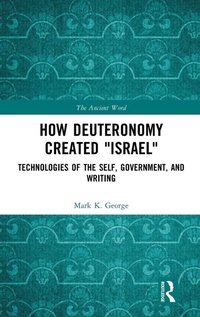
How Deuteronomy Created "Israel"
Technologies of the Self, Government, and Writing
1st Edition
Will be published approx. on 11. March 2026
Book
Hardback
296 pages
978-1-032-59416-3 (ISBN)
Description
In this book, Mark George argues that the goal of Deuteronomy is not merely to provide ancient Judah with another set of laws but to write "Israel" itself into existence. He reads Deuteronomy as a manual for self-definition with two key aspects: being Israelite means recognizing oneself as a subject under Yahweh's control, and Deuteronomy is the handbook of techniques by which one monitors oneself to become Israel.
Scholars have acknowledged the influence of certain literary features of ancient Assyrian imperial treaties on Deuteronomy. In this book, George argues that the key to both Deuteronomy and Assyrian rituals of control is their monitoring mechanism, not only speaking to their audiences but also providing them with new ways to understand themselves and behave. He suggests that Deuteronomy redefines not only Israel but Yahweh himself according to an Assyrian imperial model, with Israel as the subject, God as a distant imperial ruler and the text itself as a local monitor. In showing this, he extends the insights of Michel Foucault, who urged us to look at power as not just something imposed by force from the top, but something that can entwine and shape us from below.
This book provides an invaluable exploration of Deuteronomy, of interest to scholars and students working on Deuteronomy itself and biblical studies more generally, questions of ancient politics and governmentality, Foucault studies, and the history and material culture of the Ancient Near East.
Scholars have acknowledged the influence of certain literary features of ancient Assyrian imperial treaties on Deuteronomy. In this book, George argues that the key to both Deuteronomy and Assyrian rituals of control is their monitoring mechanism, not only speaking to their audiences but also providing them with new ways to understand themselves and behave. He suggests that Deuteronomy redefines not only Israel but Yahweh himself according to an Assyrian imperial model, with Israel as the subject, God as a distant imperial ruler and the text itself as a local monitor. In showing this, he extends the insights of Michel Foucault, who urged us to look at power as not just something imposed by force from the top, but something that can entwine and shape us from below.
This book provides an invaluable exploration of Deuteronomy, of interest to scholars and students working on Deuteronomy itself and biblical studies more generally, questions of ancient politics and governmentality, Foucault studies, and the history and material culture of the Ancient Near East.
More details
Series
Language
English
Place of publication
London
United Kingdom
Publishing group
Taylor & Francis Ltd
Target group
College/higher education
Postgraduate and Undergraduate Advanced
Dimensions
Height: 240 mm
Width: 161 mm
Thickness: 18 mm
Weight
543 gr
ISBN-13
978-1-032-59416-3 (9781032594163)
Copyright in bibliographic data and cover images is held by Nielsen Book Services Limited or by the publishers or by their respective licensors: all rights reserved.
Schweitzer Classification
Other editions
Additional editions
E-Book
03/2026
Routledge
€60.99
Available for download
E-Book
03/2026
Routledge
€60.99
Available for download
Person
Mark K. George, Professor of Bible and Ancient Systems of Thought, taught for nearly 30 years at the Iliff School of Theology. His research focuses on the Torah and how to think differently about it. His publications include Israel's Tabernacle as Social Space and numerous articles, essays, and other materials.
Content
1. Creating Subjects; 2. Thinking Differently; 3. "Monitor Your Being Intently"; 4. Conduct Becoming Israel; 5. Normalizing Judgments; 6. Governmentality and the Technology of Writing; 7. Conclusions.