

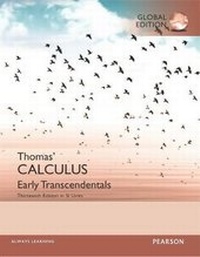
Thomas' Calculus: Early Transcendentals in SI Units
13th Edition
Published on 9. June 2016
Book
Paperback/Softback
1200 pages
978-1-292-16344-4 (ISBN)
Description
Were you looking for the book with access to MyMathLab Global? This product is the book alone and does NOT come with access to MyMathLab Global. Buy Thomas' Calculus: Early Transcendentals in SI Units, 13th edition with MyMathLab Global access card (ISBN 9781292163543) if you need access to MyMathLab Global as well, and save money on this resource. You will also need a course ID from your instructor to access MyMathLab Global. This text is designed for a three-semester or four-quarter calculus course (math, engineering, and science majors). Thomas' Calculus: Early Transcendentals, Thirteenth Edition, introduces students to the intrinsic beauty of calculus and the power of its applications. For more than half a century, this text has been revered for its clear and precise explanations, thoughtfully chosen examples, superior figures, and time-tested exercise sets. With this new edition, the exercises were refined, updated, and expanded-always with the goal of developing technical competence while furthering students' appreciation of the subject.
Co-authors Hass and Weir have made it their passion to improve the text in keeping with the shifts in both the preparation and ambitions of today's students. The text is available with a robust MyMathLab(R) course-an online homework, tutorial, and study solution. In addition to interactive multimedia features like lecture videos and eBook, nearly 9,000 algorithmic exercises are available for students to get the practice they need.
Co-authors Hass and Weir have made it their passion to improve the text in keeping with the shifts in both the preparation and ambitions of today's students. The text is available with a robust MyMathLab(R) course-an online homework, tutorial, and study solution. In addition to interactive multimedia features like lecture videos and eBook, nearly 9,000 algorithmic exercises are available for students to get the practice they need.
More details
Edition
13th edition
Language
English
Place of publication
Harlow
United Kingdom
Target group
College/higher education
Professional and scholarly
Dimensions
Height: 276 mm
Width: 217 mm
Thickness: 43 mm
Weight
2528 gr
ISBN-13
978-1-292-16344-4 (9781292163444)
Copyright in bibliographic data and cover images is held by Nielsen Book Services Limited or by the publishers or by their respective licensors: all rights reserved.
Schweitzer Classification
Other editions
New editions
Joel Hass | Christopher Heil | Maurice Weir
Thomas' Calculus: Early Transcendentals in SI Units
Book
02/2019
14th Edition
Pearson Education Limited
€109.27
Shipment within 10-20 days
Previous edition
George B. Thomas | Maurice D. Weir | Joel R. Hass
Thomas' Calculus Early Transcendentals: Pearson New International Edition
Book
07/2013
12th Edition
Pearson Education Limited
€76.87
Article exhausted; check for reprint
Content
1 Functions
1.1 Functions and Their Graphs
1.2 Combining Functions; Shifting and Scaling Graphs
1.3 Trigonometric Functions
1.4 Graphing with Software
1.5 Exponential Functions
1.6 Inverse Functions and Logarithms
2 Limits and Continuity
2.1 Rates of Change and Tangents to Curves
2.2 Limit of a Function and Limit Laws
2.3 The Precise Definition of a Limit
2.4 One-Sided Limits
2.5 Continuity
2.6 Limits Involving Infinity; Asymptotes of Graphs
3 Derivatives
3.1 Tangents and the Derivative at a Point
3.2 The Derivative as a Function
3.3 Differentiation Rules
3.4 The Derivative as a Rate of Change
3.5 Derivatives of Trigonometric Functions
3.6 The Chain Rule
3.7 Implicit Differentiation
3.8 Derivatives of Inverse Functions and Logarithms
3.9 Inverse Trigonometric Functions
3.10 Related Rates
3.11 Linearization and Differentials
4 Applications of Derivatives
4.1 Extreme Values of Functions
4.2 The Mean Value Theorem
4.3 Monotonic Functions and the First Derivative Test
4.4 Concavity and Curve Sketching
4.5 Indeterminate Forms and L'Hopital's Rule
4.6 Applied Optimization
4.7 Newton's Method
4.8 Antiderivatives
5 Integrals
5.1 Area and Estimating with Finite Sums
5.2 Sigma Notation and Limits of Finite Sums
5.3 The Definite Integral
5.4 The Fundamental Theorem of Calculus
5.5 Indefinite Integrals and the Substitution Method
5.6 Definite Integral Substitutions and the Area Between Curves
6 Applications of Definite Integrals
6.1 Volumes Using Cross-Sections
6.2 Volumes Using Cylindrical Shells
6.3 Arc Length
6.4 Areas of Surfaces of Revolution
6.5 Work and Fluid Forces
6.6 Moments and Centers of Mass
7 Integrals and Transcendental Functions
7.1 The Logarithm Defined as an Integral
7.2 Exponential Change and Separable Differential Equations
7.3 Hyperbolic Functions
7.4 Relative Rates of Growth
8 Techniques of Integration
8.1 Using Basic Integration Formulas
8.2 Integration by Parts
8.3 Trigonometric Integrals
8.4 Trigonometric Substitutions
8.5 Integration of Rational Functions by Partial Fractions
8.6 Integral Tables and Computer Algebra Systems
8.7 Numerical Integration
8.8 Improper Integrals
8.9 Probability
9 First-Order Differential Equations
9.1 Solutions, Slope Fields, and Euler's Method
9.2 First-Order Linear Equations
9.3 Applications
9.4 Graphical Solutions of Autonomous Equations
9.5 Systems of Equations and Phase Planes
10 Infinite Sequences and Series
10.1 Sequences
10.2 Infinite Series
10.3 The Integral Test
10.4 Comparison Tests
10.5 Absolute Convergence; The Ratio and Root Tests
10.6 Alternating Series and Conditional Convergence
10.7 Power Series
10.8 Taylor and Maclaurin Series
10.9 Convergence of Taylor Series
10.10 The Binomial Series and Applications of Taylor Series
11 Parametric Equations and Polar Coordinates
11.1 Parametrizations of Plane Curves
11.2 Calculus with Parametric Curves
11.3 Polar Coordinates
11.4 Graphing Polar Coordinate Equations
11.5 Areas and Lengths in Polar Coordinates
11.6 Conic Sections
11.7 Conics in Polar Coordinates
12 Vectors and the Geometry of Space
12.1 Three-Dimensional Coordinate Systems
12.2 Vectors
12.3 The Dot Product
12.4 The Cross Product
12.5 Lines and Planes in Space
<
1.1 Functions and Their Graphs
1.2 Combining Functions; Shifting and Scaling Graphs
1.3 Trigonometric Functions
1.4 Graphing with Software
1.5 Exponential Functions
1.6 Inverse Functions and Logarithms
2 Limits and Continuity
2.1 Rates of Change and Tangents to Curves
2.2 Limit of a Function and Limit Laws
2.3 The Precise Definition of a Limit
2.4 One-Sided Limits
2.5 Continuity
2.6 Limits Involving Infinity; Asymptotes of Graphs
3 Derivatives
3.1 Tangents and the Derivative at a Point
3.2 The Derivative as a Function
3.3 Differentiation Rules
3.4 The Derivative as a Rate of Change
3.5 Derivatives of Trigonometric Functions
3.6 The Chain Rule
3.7 Implicit Differentiation
3.8 Derivatives of Inverse Functions and Logarithms
3.9 Inverse Trigonometric Functions
3.10 Related Rates
3.11 Linearization and Differentials
4 Applications of Derivatives
4.1 Extreme Values of Functions
4.2 The Mean Value Theorem
4.3 Monotonic Functions and the First Derivative Test
4.4 Concavity and Curve Sketching
4.5 Indeterminate Forms and L'Hopital's Rule
4.6 Applied Optimization
4.7 Newton's Method
4.8 Antiderivatives
5 Integrals
5.1 Area and Estimating with Finite Sums
5.2 Sigma Notation and Limits of Finite Sums
5.3 The Definite Integral
5.4 The Fundamental Theorem of Calculus
5.5 Indefinite Integrals and the Substitution Method
5.6 Definite Integral Substitutions and the Area Between Curves
6 Applications of Definite Integrals
6.1 Volumes Using Cross-Sections
6.2 Volumes Using Cylindrical Shells
6.3 Arc Length
6.4 Areas of Surfaces of Revolution
6.5 Work and Fluid Forces
6.6 Moments and Centers of Mass
7 Integrals and Transcendental Functions
7.1 The Logarithm Defined as an Integral
7.2 Exponential Change and Separable Differential Equations
7.3 Hyperbolic Functions
7.4 Relative Rates of Growth
8 Techniques of Integration
8.1 Using Basic Integration Formulas
8.2 Integration by Parts
8.3 Trigonometric Integrals
8.4 Trigonometric Substitutions
8.5 Integration of Rational Functions by Partial Fractions
8.6 Integral Tables and Computer Algebra Systems
8.7 Numerical Integration
8.8 Improper Integrals
8.9 Probability
9 First-Order Differential Equations
9.1 Solutions, Slope Fields, and Euler's Method
9.2 First-Order Linear Equations
9.3 Applications
9.4 Graphical Solutions of Autonomous Equations
9.5 Systems of Equations and Phase Planes
10 Infinite Sequences and Series
10.1 Sequences
10.2 Infinite Series
10.3 The Integral Test
10.4 Comparison Tests
10.5 Absolute Convergence; The Ratio and Root Tests
10.6 Alternating Series and Conditional Convergence
10.7 Power Series
10.8 Taylor and Maclaurin Series
10.9 Convergence of Taylor Series
10.10 The Binomial Series and Applications of Taylor Series
11 Parametric Equations and Polar Coordinates
11.1 Parametrizations of Plane Curves
11.2 Calculus with Parametric Curves
11.3 Polar Coordinates
11.4 Graphing Polar Coordinate Equations
11.5 Areas and Lengths in Polar Coordinates
11.6 Conic Sections
11.7 Conics in Polar Coordinates
12 Vectors and the Geometry of Space
12.1 Three-Dimensional Coordinate Systems
12.2 Vectors
12.3 The Dot Product
12.4 The Cross Product
12.5 Lines and Planes in Space
<