

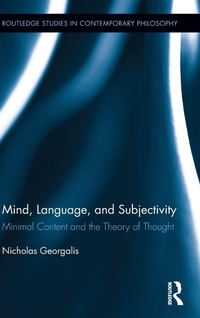
Mind, Language and Subjectivity
Minimal Content and the Theory of Thought
1st Edition
Published on 23. October 2014
Book
Hardback
260 pages
978-1-138-79596-9 (ISBN)
Description
In this monograph Nicholas Georgalis further develops his important work on minimal content, recasting and providing novel solutions to several of the fundamental problems faced by philosophers of language. His theory defends and explicates the importance of 'thought-tokens' and minimal content and their many-to-one relation to linguistic meaning, challenging both 'externalist' accounts of thought and the solutions to philosophical problems of language they inspire. The concepts of idiolect, use, and statement made are critically discussed, and a classification of kinds of utterances is developed to facilitate the latter. This is an important text for those interested in current theories and debates on philosophy of mind, philosophy of language, and their points of intersection.
Reviews / Votes
'Philosophical conversations tend to wear deep ruts into the intellectual landscape, and the continuations of these conversations often have a hard time finding their way out of these ruts. In the case of meaning...there are problematic assumptions to the effect (1) that there is something called "meaning" or "content" that can be attributed univocally to thought-tokens and utterances (much less sentences), and (2) that an analysis of "meaning" should be restricted to facts accessible from a third-person perspective....This book stands out as one of the few things I've read to take on these assumptions in a sustained fashion, proposes an alternative that distinguishes the content of thought-tokens from linguistic meaning, and does so in a way that emphasizes the uniquely first-person element of minimal content. This makes it, in my opinion, an important and much-needed book.' -- Steven Horst, Wesleyan University, USA 'As mentioned at the beginning of this review, there is an increasing number of philosophers who reject externalism. Georgalis's framework stands out as a bold and original alternative. The insistence that we need to take the first-person perspective seriously is powerfully motivated.' - Joe Y.F. Lau, The University of Hong Kong, Notre Dame Philosophical ReviewsMore details
Series
Language
English
Place of publication
London
United Kingdom
Publishing group
Taylor & Francis Ltd
Target group
College/higher education
Dimensions
Height: 235 mm
Width: 157 mm
Thickness: 20 mm
Weight
560 gr
ISBN-13
978-1-138-79596-9 (9781138795969)
Copyright in bibliographic data and cover images is held by Nielsen Book Services Limited or by the publishers or by their respective licensors: all rights reserved.
Schweitzer Classification
Other editions
Additional editions
Book
11/2017
1st Edition
Routledge
€76.40
Shipment within 15-20 days
E-Book
11/2014
1st Edition
Routledge
€69.99
Available for download
E-Book
11/2014
1st Edition
Routledge
€69.99
Available for download
Person
Nicholas Georgalis is Distinguished Research Professor of Philosophy at East Carolina University. His publications include: The Primacy of the Subjective: Foundations for a Unified Theory of Mind and Language, "Representation and the First-Person Perspective" in Synthese, "The Fiction of Phenomenal Intentionality" in Consciousness and Emotion, and "Rethinking Burge's Thought Experiment" in Synthese.
Content
1. Minimal Content and Intentionality 2. More on Minimal Content and Related Issues 3. Thinking Differently about Thought and Language 4. The Superiority of the New Theory to Frege's 5. Kripke's Puzzle about Belief Solved 6. Use, Idiolect, and Statement Made 7. Speaker's Referent 8. Speaker's Referent and the Referential/Attributive Distinction 9. Proper Names 10. Solutions to Classic Problems 11. Securing Determinate Meaning-Part I: Against Kripkenstein 12. Securing Determinate Meaning-Part II: Against Quine