

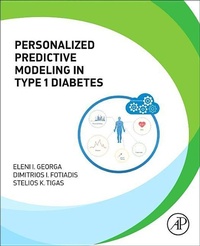
Personalized Predictive Modeling in Type 1 Diabetes
Published on 29. November 2017
Book
Paperback/Softback
252 pages
978-0-12-804831-3 (ISBN)
Description
Personalized Predictive Modeling in Diabetes features state-of-the-art methodologies and algorithmic approaches which have been applied to predictive modeling of glucose concentration, ranging from simple autoregressive models of the CGM time series to multivariate nonlinear regression techniques of machine learning. Developments in the field have been analyzed with respect to: (i) feature set (univariate or multivariate), (ii) regression technique (linear or non-linear), (iii) learning mechanism (batch or sequential), (iv) development and testing procedure and (v) scaling properties. In addition, simulation models of meal-derived glucose absorption and insulin dynamics and kinetics are covered, as an integral part of glucose predictive models.
This book will help engineers and clinicians to: select a regression technique which can capture both linear and non-linear dynamics in glucose metabolism in diabetes, and which exhibits good generalization performance under stationary and non-stationary conditions; ensure the scalability of the optimization algorithm (learning mechanism) with respect to the size of the dataset, provided that multiple days of patient monitoring are needed to obtain a reliable predictive model; select a features set which efficiently represents both spatial and temporal dependencies between the input variables and the glucose concentration; select simulation models of subcutaneous insulin absorption and meal absorption; identify an appropriate validation procedure, and identify realistic performance measures.
This book will help engineers and clinicians to: select a regression technique which can capture both linear and non-linear dynamics in glucose metabolism in diabetes, and which exhibits good generalization performance under stationary and non-stationary conditions; ensure the scalability of the optimization algorithm (learning mechanism) with respect to the size of the dataset, provided that multiple days of patient monitoring are needed to obtain a reliable predictive model; select a features set which efficiently represents both spatial and temporal dependencies between the input variables and the glucose concentration; select simulation models of subcutaneous insulin absorption and meal absorption; identify an appropriate validation procedure, and identify realistic performance measures.
More details
Language
English
Place of publication
San Diego
United States
Publishing group
Elsevier Science Publishing Co Inc
Target group
Professional and scholarly
Bioengineers, Clinicians, graduate and undergraduate students in the field of medicine and biomedical engineering.
Product notice
Paperback (trade)
Unsewn / adhesive bound
Dimensions
Height: 235 mm
Width: 191 mm
Weight
540 gr
ISBN-13
978-0-12-804831-3 (9780128048313)
Copyright in bibliographic data and cover images is held by Nielsen Book Services Limited or by the publishers or by their respective licensors: all rights reserved.
Schweitzer Classification
Other editions
Additional editions
Eleni I. Georga | Dimitrios I. Fotiadis | Stelios K. Tigas
Personalized Predictive Modeling in Type 1 Diabetes
E-Book
12/2017
Academic Press
€119.00
Available for download
Persons
Ph.D. candidate at the Department of Materials Science and Engineering, University of Ioannina, Greece Dimitrios I. Fotiadis received his Diploma degree in chemical engineering from National Technical University of Athens, Athens, Greece, in 1985 and the Ph.D. degree in chemical engineering from the University of Minnesota, Minneapolis, MN, in 1990. He is currently Professor at the Department of Materials Science and Engineering, University of Ioannina, Greece, and affiliated researcher at the Biomedical Research Dept. of the Institute of Molecular Biology and Biotechnology - FORTH. He is the Director of the Unit of Medical Technology and Intelligent Information Systems, Greece. He is the member of the board of Michailideion Cardiology Center. His research interests include modeling of human tissues and organs, intelligent wearable devices for automated diagnosis and processing/analysis of biomedical data. Stelios Tigas is awarded PhD in Endocrinology from the University of Ioannina. Stelios Tigas international experience includes various programs, contributions and participation in different countries for diverse fields of study. Stelios Tigas research interests as an Associate Professor reflect in wide range of publications in various national and international journals
Author
Ph.D. candidate, Department of Materials Science and Engineering, University of Ioannina, Greece
Professor of Biomedical Engineering, Department of Materials Science and Engineering, University of Ioannina, Greece
Assistant Professor of Endocrinology, Department of Endocrinology and Diabetes, University of Ioannina, Greece
Content
1. Introduction2. Data-Driven Prediction of Glucose Concentration in Type 1 Diabetes3. Linear Models of Glucose Concentration4. Non-linear Models of Glucose Concentration5. Prediction Models of Hypoglycaemia6. Adaptive Glucose Prediction Models7. Anticipatory Mobile Systems in Diabetes8. Conclusions and Future Trends