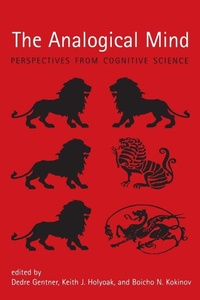
Analogy has been the focus of extensive research in cognitive science over the past two decades. Through analogy, novel situations and problems can be understood in terms of familiar ones. Indeed, a case can be made for analogical processing as the very core of cognition. This is the first book to span the full range of disciplines concerned with analogy. Its contributors represent cognitive, developmental, and comparative psychology; neuroscience; artificial intelligence; linguistics; and philosophy.
The book is divided into three parts. The first part describes computational models of analogy as well as their relation to computational models of other cognitive processes. The second part addresses the role of analogy in a wide range of cognitive tasks, such as forming complex cognitive structures, conveying emotion, making decisions, and solving problems. The third part looks at the development of analogy in children and the possible use of analogy in nonhuman primates.
Contributors
Miriam Bassok, Consuelo B. Boronat, Brian Bowdle, Fintan Costello, Kevin Dunbar, Gilles Fauconnier, Kenneth D. Forbus, Dedre Gentner, Usha Goswami, Brett Gray, Graeme S. Halford, Douglas Hofstadter, Keith J. Holyoak, John E. Hummel, Mark T. Keane, Boicho N. Kokinov, Arthur B. Markman, C. Page Moreau, David L. Oden, Alexander A. Petrov, Steven Phillips, David Premack, Cameron Shelley, Paul Thagard, Roger K.R. Thompson, William H. Wilson, Phillip Wolff
Series
Language
Place of publication
Massachusetts
United States
Publishing group
Target group
College/higher education
Interest Age: From 18 years
Product notice
Dimensions
Height: 229 mm
Width: 152 mm
Thickness: 30 mm
Weight
ISBN-13
978-0-262-57139-5 (9780262571395)
Copyright in bibliographic data and cover images is held by Nielsen Book Services Limited or by the publishers or by their respective licensors: all rights reserved.
Schweitzer Classification
edited by Dedre Gentner, Keith J. Holyoak, and Boicho N. Kokinov
Editor
Distinguished Professor of PsychologyUCLA
New Bulgarian Univ