

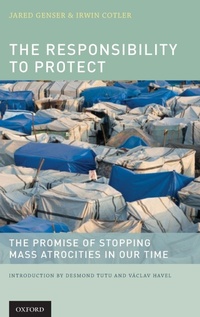
The Responsibility to Protect
The Promise of Stopping Mass Atrocities in Our Time
1st Edition
Published on 15. December 2011
Book
Hardback
448 pages
978-0-19-979776-9 (ISBN)
Description
In The Responsibility to Protect: The Promise of Stopping Mass Atrocities in Our Time, Jared Genser and Irwin Cotler provide a comprehensive overview on how this contemporary principle of international law has developed and analyze how best to apply it to current and future humanitarian crises. The "responsibility to protect" is a doctrine unanimously adopted by the UN World Summit in 2005, which says that all states have an obligation to protect their own citizens from mass atrocities, which includes genocide, war crimes, crimes against humanity, and ethnic cleansing. Its adoption and application has generated a passionate debate in law schools, professional organizations, media and within the U.N. system.
To present a full picture of where the doctrine now stands and where it could go in the future, editors Jared Genser and Irwin Cotler have assembled a global team of authors with diverse backgrounds and differing viewpoints, including Edward Luck, the UN Secretary-General's Special Advisor on the Responsibility to Protect. Genser and Cotler balance the pro-RtoP chapters with more skeptical arguments from agency staff and scholars with long experience in addressing mass atrocities. Framed by a Preface from Desmond Tutu and Vaclav Havel and a Conclusion from Gareth Evans, these in-depth and authoritative analyses move beyond theory to demonstrate how RtoP has worked on the ground and should work if applied to other crises. The global focus of this book, as well as its detailed application of the principle in case studies make it uniquely useful to staff at international organizations and NGOs considering use of the principle in a given circumstance, to scholars providing advice to governments, and to students seeking guidance on this still-expanding subject.
To present a full picture of where the doctrine now stands and where it could go in the future, editors Jared Genser and Irwin Cotler have assembled a global team of authors with diverse backgrounds and differing viewpoints, including Edward Luck, the UN Secretary-General's Special Advisor on the Responsibility to Protect. Genser and Cotler balance the pro-RtoP chapters with more skeptical arguments from agency staff and scholars with long experience in addressing mass atrocities. Framed by a Preface from Desmond Tutu and Vaclav Havel and a Conclusion from Gareth Evans, these in-depth and authoritative analyses move beyond theory to demonstrate how RtoP has worked on the ground and should work if applied to other crises. The global focus of this book, as well as its detailed application of the principle in case studies make it uniquely useful to staff at international organizations and NGOs considering use of the principle in a given circumstance, to scholars providing advice to governments, and to students seeking guidance on this still-expanding subject.
Reviews / Votes
In a recent Oxford University Press book * The Responsibility to Protect: The Promise of Stopping Mass Atrocities in Our Timehuman rights lawyers Jared Genser and Irwin Cotler edit a volume of essays that range from endorsement to skeptical views of the doctrine. With an introduction by Desmond Tutu and the late Vaclav Havel, the assembled contributors have produced the best discussion on how best to apply R2P to current and future humanitarian crises."Thor Halvorssen, Founder, Human Rights Foundation
Huffington Post, January 2012
* Including perspectives from a diverse group of experts, The Responsibility to Protect makes an important contribution to the growing scholarship about this new and evolving doctrine. At the same time, however, the case studies in the book illustrate the painful reality of the large gap between the world's stated commitment to halting mass atrocities and its ongoing practice. Ultimately, it recommends a series of practical steps that should be taken by the international community to bring its promise to fruition."
- The Honourable Romeo A. Dallaire, Senator (Canada) and Lieutenant General (Ret.) The goalposts have moved in recent years as much more robust obligations are expected of states and intergovernmental organizations when vulnerable groups face humanitarian crises, be these man-made or natural. Nowhere is this more clearly manifested than in the evolving doctrine of the Responsibility to Protect, This rich and authoritative collection of essays provides a superb tour d'horizon of the subject, explaining the theoretical and political issues and setting out the relevance of the concept to the great challenges of our times."
- William Schabas, professor of international law, Middlesex University, London The book is both informative and stimulating, as it pairs nuanced doctrinal analysis with captivating political and historical studies of RtoP's development and its influence on modern mass atrocities. Ultimately, anyone looking for exposure to this burgeoning principle of international law, the politics that underlie its developing norms, or a brief history of contemporary mass atrocities will find The Responsibility to Protect captivating." * Matthew B. Simon, NYU School of Law Journal of International Law and Politics (Vol 45, Issue 3)
*
More details
Language
English
Place of publication
New York
United States
Target group
College/higher education
Legal academics, political scientists, historians, law students, policymakers, agency staff, NGO officers, and journalists.
Dimensions
Height: 240 mm
Width: 161 mm
Thickness: 28 mm
Weight
822 gr
ISBN-13
978-0-19-979776-9 (9780199797769)
Copyright in bibliographic data and cover images is held by Nielsen Book Services Limited or by the publishers or by their respective licensors: all rights reserved.
Schweitzer Classification
Other editions
Additional editions
Jared Genser | Irwin M. P. Cotler | Desmond Tutu
The Responsibility to Protect
E-Book
11/2011
1st Edition
OUP eBook
€63.49
Available for download
Persons
Preface by Desmond Tutu and Vaclav Havel
Irwin Cotler is Professor of Law and Director of the Human Rights Programme at McGill University. He previously served as Canada's Minister of Justice and Attorney General and currently serves as an M.P. in Canada's Parliament. He has taught as a Visiting Professor at Harvard and Yale.
Jared Genser is Managing Director of Perseus Strategies, a law firm whose practice focuses on international human rights. Independently, he is founder of Freedom Now, a non-profit organization that works to free prisoners of conscience worldwide. Previously, he was a partner in the government affairs practice of DLA Piper LL P and a management consultant with McKinsey & Company. He has taught semester-long seminars about the UN Security Council at the University of Michigan and University of Pennsylvania law schools. He holds a B.S. from Cornell University, an M.P.P. from the John F. Kennedy School of Government at Harvard University, and a J.D. cum laude from the University of Michigan Law School.
Irwin Cotler is Professor of Law and Director of the Human Rights Programme at McGill University. He previously served as Canada's Minister of Justice and Attorney General and currently serves as an M.P. in Canada's Parliament. He has taught as a Visiting Professor at Harvard and Yale.
Jared Genser is Managing Director of Perseus Strategies, a law firm whose practice focuses on international human rights. Independently, he is founder of Freedom Now, a non-profit organization that works to free prisoners of conscience worldwide. Previously, he was a partner in the government affairs practice of DLA Piper LL P and a management consultant with McKinsey & Company. He has taught semester-long seminars about the UN Security Council at the University of Michigan and University of Pennsylvania law schools. He holds a B.S. from Cornell University, an M.P.P. from the John F. Kennedy School of Government at Harvard University, and a J.D. cum laude from the University of Michigan Law School.
Content
Preface ; Jared Genser and Irwin Cotler ; Abbreviations ; Introduction ; Vaclav Havel and Desmond M. Tutu ; Part I. The Development of the Responsibility to Protect ; 1 Evolution of the Concept of State Sovereignty, Lloyd Axworthy ; 2 Adoption of the Responsibility to Protect, William W. Burke-White ; 3 Defining the Mass-Atrocity Crimes Covered, Tarun Chhabra and Jeremy B. Zucker ; 4 Challenges and Controversies, Nicole Deller ; 5 Implementing the Responsibility to Protect, Edward C. Luck ; Part II. Regional Perspectives ; 6 Africa, Ademola Abass ; 7 Asia and the Pacific, Noel M. Morada ; 8 Europe and North America, Mark V. Vlasic ; 9 Latin America and the Caribbean, Gilberto Marcos Antonio Rodrigues ; 10 Middle East, Mohamed S. Helal ; Part III. Case Studies ; 11 Darfur (Sudan), Andrew S. Natsios and Zachary Scott ; 12 Burma (Myanmar), Paulo Sergio Pinheiro and Meghan Barron ; 13 Kenya, Meredith Preston-McGhie and Serena Sharma ; 14 Sri Lanka, Damien Kingsbury ; 15 Democratic Republic of Congo, Delphine Schrank ; 16 Democratic People's Republic of Korea (North Korea), Kjell Magne Bondevik and Kristen Abrams ; Conclusion: Lessons and Challeges ; Gareth Evans