

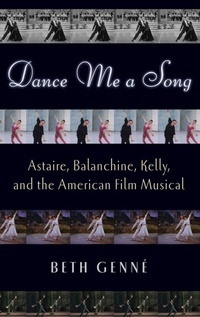
Dance Me a Song
Astaire, Balanchine, Kelly and the American Film Musical
Published on 23. August 2018
Book
Hardback
376 pages
978-0-19-538218-1 (ISBN)
Description
Dancer-choreographer-directors Fred Astaire, George Balanchine and Gene Kelly and their colleagues helped to develop a distinctively modern American film-dance style and recurring dance genres for the songs and stories of the American musical. Freely crossing stylistic and class boundaries, their dances were rooted in the diverse dance and music cultures of European immigrants and African-American migrants who mingled in jazz age America. The new technology of sound cinema let them choreograph and fuse camera movement, light, and color with dance and music. Preserved intact for the largest audiences in dance history, their works continue to influence dance and film around the world. This book centers them and their colleagues within the history of dance (where their work has been marginalized) as well as film tracing their development from Broadway to Hollywood (1924-58) and contextualizing them within the American history and culture of their era.
This modern style, like the nation in which it developed, was pluralist and populist. It drew from aspects of the old world and new, "high" and "low", theatrical and social dance forms, creating new sites for dance from the living room to the street. A definitive ingredient was the freer more informal movement and behavior of their jazz-age generation, which fit with song lyrics that poeticized slangy American English. The Gershwins, Rodgers and Hart, and others wrote not only songs but extended dance-driven scores tailored to their choreography, giving a new prominence to the choreographer and dancer-actor. This book discuss how these choreographers collaborated with directors like Vincente Minnelli and Stanley Donen and cinematographers like Gregg Toland, musicians, dancers, designers and technicians to synergize music and moving image in new ways. Eventually, concepts and visual-musical devices derived from dance-making would give entire films the rhythmic flow and feeling of dance. Dancing Americans came to be seen around the world as archetypal embodiments of the free-spirited optimism and energy of America itself.
This modern style, like the nation in which it developed, was pluralist and populist. It drew from aspects of the old world and new, "high" and "low", theatrical and social dance forms, creating new sites for dance from the living room to the street. A definitive ingredient was the freer more informal movement and behavior of their jazz-age generation, which fit with song lyrics that poeticized slangy American English. The Gershwins, Rodgers and Hart, and others wrote not only songs but extended dance-driven scores tailored to their choreography, giving a new prominence to the choreographer and dancer-actor. This book discuss how these choreographers collaborated with directors like Vincente Minnelli and Stanley Donen and cinematographers like Gregg Toland, musicians, dancers, designers and technicians to synergize music and moving image in new ways. Eventually, concepts and visual-musical devices derived from dance-making would give entire films the rhythmic flow and feeling of dance. Dancing Americans came to be seen around the world as archetypal embodiments of the free-spirited optimism and energy of America itself.
Reviews / Votes
[A] rich and readable love letter to the Golden Age movie musical * Times Literary Supplement * This entertaining examination of dance on screen and the singular pioneers during the Golden Age of movie musicals provides a fresh angle on this much-studied subject. ... Well researched and handsomely bound, this valuable and richly illustrated book includes a helpful time line of the accomplishments of Astaire, Balanchine, and Kelly and a lengthy bibliography for further study of musical films. * CHOICE * Genne's book will be a welcome volume for scholars interested in the aesthetics of film dance and popular culture, and, in particular, fans of Astaire, Balanchine, and Kelly will enjoy its many wonderful descriptive details. * Theatre Survey * impressive! ... She has spent many decades preparing this book and the amount of research is considerable ... Beth Genne is the only author I know who takes into account at the same level, in her analyses, the precision of the choreography, the personality of the performers, the important role of musical arrangers, and the contribution of directors. * Yann Tobin, Positif [translation] * What this book does is vitally important work in illuminating that uniquely American genre, the movie musical. It shows that the outlaw style of dance at the heart of it was created by freeform borrowings from both so-called highbrow end of the art and so-called lowbrow. In fact, Genne brings together not only styles but artists who don't usually meet in the same book -- like Balanchine and Astaire. With lucid and exuberant prose, she throws new light not only on the great dance-makers like Balanchine, Astaire, Kelly, but on their usually unsung but vital collaborators -- composers, arrangers, assistants, cameramen and a host of others who brought live dance to the big screen. * Elizabeth Kendall, author of Balanchine and the Lost Muse: Revolution and the Making of a Choreographer *More details
Language
English
Place of publication
New York
United States
Target group
Professional and scholarly
Illustrations
305 halftones
Dimensions
Height: 240 mm
Width: 161 mm
Thickness: 25 mm
Weight
722 gr
ISBN-13
978-0-19-538218-1 (9780195382181)
Copyright in bibliographic data and cover images is held by Nielsen Book Services Limited or by the publishers or by their respective licensors: all rights reserved.
Schweitzer Classification
Other editions
Additional editions
E-Book
05/2018
1st Edition
OUP eBook
€18.99
Available for download
E-Book
05/2018
1st Edition
OUP eBook
€18.99
Available for download
Person
Beth Genne is Professor of Dance History and Art History at the University of Michigan, Ann Arbor, in the Dance Department and the Arts and Ideas concentration of the Residential College. She has written numerous book chapters on British ballet and dance in film (including Gene Kelly and Vincente Minnelli) and articles in such journals as Dance Research, Dance Chronicle, and Art Journal. She has contributed criticism and feature articles to The Dancing Times of London. She was Director of research for Balanchine's musical films for the Popular Balanchine Project of the George Balanchine Foundation. Her first book, The Making of a Choreographer, was on the early training and choreographic development of Ninette de Valois, founder of the Royal Ballet.
Content
Introduction: The Choreographer-Director and the Synergy of Music and Moving Image
Part I. From Stage to Screen
1. Astaire's Outlaw Style and Its New World Roots
2. Astaire's Roots in Ballroom, Ballet, and Other Forms
3. Old World Meets New World on Broadway: Balanchivadze and Dukelsky Meet the Gershwins and Rodgers and Hart
4. Balanchine in Hollywood: Jazz Ballet for the Camera
5. Dancing with the Camera: Introducing Kelly and Donen
Part II. Film-Dance Genres
6. Song and Dance as Courtship
7. Freedom Incarnate: The Dancing Sailor as an Icon of American Values in World War II
8. 'S Wonderful: Euphoric Street Dances
9. Dreaming in Dance: Astaire, Minnelli, Kelly, and Donen and the Cinematic Dance
Part III. Making Film Dance
10. Making Film Dance: The Through-Composed, Through-Choreographed Musical
11. Legacy
Appendix: Timeline
Notes
Part I. From Stage to Screen
1. Astaire's Outlaw Style and Its New World Roots
2. Astaire's Roots in Ballroom, Ballet, and Other Forms
3. Old World Meets New World on Broadway: Balanchivadze and Dukelsky Meet the Gershwins and Rodgers and Hart
4. Balanchine in Hollywood: Jazz Ballet for the Camera
5. Dancing with the Camera: Introducing Kelly and Donen
Part II. Film-Dance Genres
6. Song and Dance as Courtship
7. Freedom Incarnate: The Dancing Sailor as an Icon of American Values in World War II
8. 'S Wonderful: Euphoric Street Dances
9. Dreaming in Dance: Astaire, Minnelli, Kelly, and Donen and the Cinematic Dance
Part III. Making Film Dance
10. Making Film Dance: The Through-Composed, Through-Choreographed Musical
11. Legacy
Appendix: Timeline
Notes