

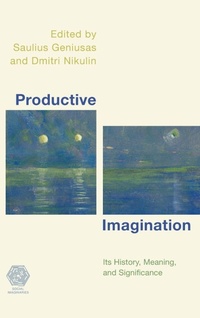
Productive Imagination
Its History, Meaning and Significance
Published on 30. May 2018
Book
Hardback
206 pages
978-1-78660-430-9 (ISBN)
Description
Although the concept of productive imagination plays a fundamental role in Kant, German Idealism, Romanticism, Phenomenology and Hermeneutics, the meaning of this central concept remains largely undetermined. The significance of productive imagination is therefore all-too-often either inflated or underrated. The articles collected in this volume trace the development of productive imagination through the history of philosophy, identify the different meanings this concept has been ascribed in different philosophical frameworks, and raise the question anew concerning this concept's philosophical significance. Special attention is given to the historical background that underlies the emergence of productive imagination in modernity, to Kant's concept of productive imagination, to the further development of this concept in German Idealism, Wilhelm Dilthey, Edmund Husserl, Ernst Cassirer and Martin Heidegger, Jean-Paul Sartre and Paul Ricoeur. A group of leading scholars present a systematic and comprehensive reference tool for anyone working in the fields of social imaginaries.
Reviews / Votes
This welcome volume explores the conceptual history of productive imagination by focusing on the development of the concept from its prefiguration in antiquity to its modern articulation in and after Kant. Special attention is paid to the romantic, phenomenological and hermeneutical traditions, with the main reference authors being F. Schlegel, Novalis, Dilthey and Ricoeur, as well as Cassirer and Heidegger. -- Guenter Zoeller, Professor of Philosophy, University of Munich [This volume] offers a valuable combination of introductory guidance and original theses. It contains helpful clarifications of how philosophical concepts develop through inter-philosophical dialogue but also in conversation with the arts. It likewise opens avenues for exploring the grand, metaphysical question of human creativity in history. If we approach it aware of its deliberate focus on the Kantian and continental tradition, we will see that its chapters develop a coherent "conceptual history" of a core moment in philosophy. * Phenomenological Reviews *More details
Language
English
Place of publication
United Kingdom
Publishing group
Bloomsbury Publishing PLC
Target group
Professional and scholarly
US School Grade: From College Senior to College Graduate Student
Dimensions
Height: 235 mm
Width: 157 mm
Thickness: 17 mm
Weight
496 gr
ISBN-13
978-1-78660-430-9 (9781786604309)
Copyright in bibliographic data and cover images is held by Nielsen Book Services Limited or by the publishers or by their respective licensors: all rights reserved.
Schweitzer Classification
Other editions
Additional editions
E-Book
05/2018
1st Edition
Rowman & Littlefield International
€42.99
Available for download
Persons
Saulius Geniusas is Associate Professor of Philosophy at the Chinese University of Hong Kong. He is the author of The Origins of the Horizon in Husserl's Phenomenology (2012), co-editor of Hermeneutics and Phenomenology: Figures and Themes (with Paul Fairfield, forthcoming), Relational Hermeneutics: Essays in Comparative Philosophy (with Paul Fairfield, forthcoming), and Phenomenological Ethics (A Special Issue of Santalka: Filosofija, 17/3, 2009).
Dmitri Nikulin is Professor of Philosophy at The New School for Social Research in New York. He is the author of a number of books including Matter, Imagination and Geometry (2002), On Dialogue (2006), Dialectic and Dialogue (2010), Comedy, Seriously (2014), and The Concept of History (2017).
Dmitri Nikulin is Professor of Philosophy at The New School for Social Research in New York. He is the author of a number of books including Matter, Imagination and Geometry (2002), On Dialogue (2006), Dialectic and Dialogue (2010), Comedy, Seriously (2014), and The Concept of History (2017).
Content
Editors' Introduction / 1. What is Productive Imagination? Dmitri Nikulin / 2. Productive and Practical Imagination: What Does Productive Imagination Produce? Alfredo Ferrarin / 3. Fantasy as Productive Imagination According to Friedrich Schlegel and Novalis or the Creativity of What is Human, Laura S. Carugati / 4. The Productive Imagination in Hegel and Classical German Philosophy, Angelica Nuzzo / 5. Dilthey's Typifying Imagination, Rudolf A. Makkreel / 6. Imagination of Stupidity: Jules de Gaultier, Flaubert and Le Bovarysme, Nicolas de Warren / 7. Productive Imagination and the Cassirer-Heidegger Disputation, Saulius Geniusas / 8. The Deeper Significance of Ricoeur's Philosophy of Productive Imagination: The Role of Figuration, George H. Taylor / Index