

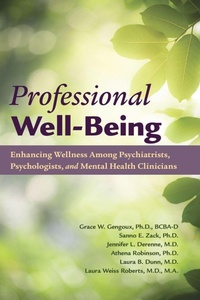
Professional Well-Being
Enhancing Wellness Among Psychiatrists, Psychologists, and Mental Health Clinicians
Published on 23. May 2020
Book
Paperback/Softback
298 pages
978-1-61537-229-4 (ISBN)
Description
Although data exist to support the notion that physician
self-care is correlated with patient care, the culture of medicine has
traditionally valued the ideals of self-sacrifice and perfectionism-often to
the detriment of clinicians themselves.
Professional Well-Being:
Enhancing Wellness Among Psychiatrists, Psychologists, and Mental Health
Clinicians, the result of a collaboration by several psychologists
and psychiatrists in the School of Medicine at Stanford University, posits a
new culture, one that is supportive of the health and well-being of health
care professionals and the patients and populations they serve.
The
book's first section examines individual and systemic barriers to
professional well-being, chronicling the unique challenges faced by health
care providers at different stages of professional and personal development.
Detailed case studies and vignettes illustrate effective methods for
reducing burnout while also enhancing professional fulfillment.
Thought-provoking discussion questions encourage readers to focus on
implementation tactics applicable to their own health care
practices.
Part II discusses personal resilience and realistic
strategies-from the mental and social to the physical-to improve well-being.
Specific exercises encourage mental health professionals to engage in
pragmatic action for improved personal and professional
well-being.
Throughout the book, a wealth of tables and figures
illustrate important points. The inclusion of "positive practices" and
recommended readings offers readers the opportunity to integrate what they
have learned and to expand their study.
Patients benefit when treated
by clinicians who value and model self-care. Professional Well-Being
outlines for mental health care providers, including psychiatrists,
psychologists, mental health clinicians, and trainees, how to become such a
professional.
self-care is correlated with patient care, the culture of medicine has
traditionally valued the ideals of self-sacrifice and perfectionism-often to
the detriment of clinicians themselves.
Professional Well-Being:
Enhancing Wellness Among Psychiatrists, Psychologists, and Mental Health
Clinicians, the result of a collaboration by several psychologists
and psychiatrists in the School of Medicine at Stanford University, posits a
new culture, one that is supportive of the health and well-being of health
care professionals and the patients and populations they serve.
The
book's first section examines individual and systemic barriers to
professional well-being, chronicling the unique challenges faced by health
care providers at different stages of professional and personal development.
Detailed case studies and vignettes illustrate effective methods for
reducing burnout while also enhancing professional fulfillment.
Thought-provoking discussion questions encourage readers to focus on
implementation tactics applicable to their own health care
practices.
Part II discusses personal resilience and realistic
strategies-from the mental and social to the physical-to improve well-being.
Specific exercises encourage mental health professionals to engage in
pragmatic action for improved personal and professional
well-being.
Throughout the book, a wealth of tables and figures
illustrate important points. The inclusion of "positive practices" and
recommended readings offers readers the opportunity to integrate what they
have learned and to expand their study.
Patients benefit when treated
by clinicians who value and model self-care. Professional Well-Being
outlines for mental health care providers, including psychiatrists,
psychologists, mental health clinicians, and trainees, how to become such a
professional.
Reviews / Votes
Professional Well-Being: Enhancing WellnessAmong
Psychiatrists, Psychologists, and Mental
Health Clinicians is an
excellent resource for mapping out wellness throughout one's career as
a
clinician. The book begins with the stressors and
mental health
concerns that arise early in training
as a medical student and continues
on the path
through graduate residency training and throughout various
stages of the clinician's career. The
chronological and developmental
nature of how
wellness is discussed is very helpful and
relatable.
There is also substantial focus on wellness
and
nonclinical aspects of taking care of one's mental
health as
well as more clinical approaches, which
creates a balanced perspective.
For example, the
authors emphasize mentorship, informal consultation,
and various lifestyle approaches as nonclinical ways to promote wellness.
Considerable
attention is devoted to the clinical sequalae experienced
by clinicians, including burnout, depressive
symptoms, and suicidal
thoughts. Sufficient attention is also given to the potentially
deleterious
impact a lack of well-being in a clinician can have
on
patient/client care.
Some of the strengths of Professional
Well-Being
are the details that encourage the reader to
think
critically about the complexity of treating mental
health
issues among clinicians. For example, the
chapter on considerations for
providing care to fellow
clinicians is helpful as it provides details on
ethical
considerations, flexibility in scheduling, and how
to
approach therapy without making assumptions that
could interfere
with the therapeutic process. Another
chapter focuses on building
support within systems,
highlighting some of the unique challenges (eg,
isolation, lack of autonomy) that may arise depending
on the setting
where the clinician works, such as
private practice, hospital, or school
system. The
chapter focusing on stressors associated with
various
career milestones is also quite helpful and encourages
clinicians to think about wellness over the
course of their entire
training and career.
Other strengths of this book include the
broad
range of interventions discussed. The chapters
focusing on
wellness and self-care highlight a number
of useful approaches,
including energy management,
time in nature, and mindfulness. Engagement
in
health-promoting behaviors, such as nutrition, exercise, sleep, and
social connectedness, are addressed.
However, the book also discusses
the point when
mental health needs reach a higher threshold, and
it
covers topics related to impairment and recovery.
This book will
be appealing to clinicians in the
mental health field (eg,
psychiatrists, psychiatric
nurse practitioners, psychologists, mental
health
counselors, and clinical social workers). I think the
book
could offer benefit to an even broader readership, such as family
physicians, internists, or those
who practice lifestyle medicine and who
treat a high
volume of patients with mental health issues.
Questions
and vignettes throughout the book make
the chapters more experiential.
From my perspective, this book could have been strengthened by
including
even more self-disclosures and personal
case examples. The preface
starts with salient examples that are extremely relatable to
clinicians
practicing in the mental health field and more of
such
examples throughout the later chapters would
have been helpful.
In
summary, Professional Well-Being: Enhancing
Wellness Among
Psychiatrists, Psychologists, and
Mental Health Clinicians is a great
resource for
clinicians. I recommend reading it early
during
training because many of the resources and strategies described
are preventive and promote positive
mental health. However, it is
applicable to clinicians at any level including those who are
more
advanced in the profession. The focus of the book on
well-being
is especially timely as the COVID-19
pandemic continues. COVID and the
associated loss
and uncertainty have created more demand and
need
for mental health care which in turn creates
increased stress, greater
work demands, and risk of
burnout for providers. This book is a great
reminder
to all clinicians-especially those treating patients
and
clients with mental health concerns-not to
forget about their own
wellness and to make it
a priority so that they may provide the best
care
possible. -- Katherine Daly, PhD * Journal pf Psychiatric Practice *
More details
Language
English
Place of publication
VA
United States
Target group
Professional and scholarly
US School Grade: College Graduate Student and over
Product notice
Paperback (trade)
Illustrations
28 Tables, unspecified; 16 Figures
Dimensions
Height: 229 mm
Width: 152 mm
Thickness: 16 mm
Weight
406 gr
ISBN-13
978-1-61537-229-4 (9781615372294)
Copyright in bibliographic data and cover images is held by Nielsen Book Services Limited or by the publishers or by their respective licensors: all rights reserved.
Schweitzer Classification
Other editions
Additional editions
Grace Gengoux | Sanno E. Zack | Jennifer L. Derenne
Professional Well-Being
Enhancing Wellness Among Psychiatrists, Psychologists, and Mental Health Clinicians
E-Book
03/2020
American Psychiatric Association Publishing
€43.49
Available for download
Persons
Grace W. Gengoux, Ph.D., BCBA-D, is a Clinical
Associate Professor
in the Department of Psychiatry and Behavioral
Sciences at the Stanford University School of Medicine in Stanford,
California.
Sanno E. Zack, Ph.D., is a Clinical Associate
Professor in the Department of Psychiatry and Behavioral Sciences at the
Stanford University School of Medicine in Stanford,
California.
Jennifer L. Derenne, M.D., is a Clinical
Associate Professor in the Department of Psychiatry and Behavioral Sciences
at the Stanford University School of Medicine in Stanford,
California.
Athena Robinson, Ph.D., is Chief Clinical
Officer at Woebot Labs, Inc. in San Francisco, California.
Laura B.
Dunn, M.D., is a Professor in the Department of Psychiatry and
Behavioral Sciences at the Stanford University School of Medicine in
Stanford, California.
Laura Weiss Roberts, M.D., M.A., is
Chairman and Katharine Dexter McCormick and Stanley McCormick Memorial
Professor in the Department of Psychiatry and Behavioral Sciences at
Stanford University School of Medicine; Editor-in-Chief of the journal
Academic Medicine; and Editor-in-Chief, Books, at American Psychiatric
Association Publishing in Washington, D.C.
Associate Professor
in the Department of Psychiatry and Behavioral
Sciences at the Stanford University School of Medicine in Stanford,
California.
Sanno E. Zack, Ph.D., is a Clinical Associate
Professor in the Department of Psychiatry and Behavioral Sciences at the
Stanford University School of Medicine in Stanford,
California.
Jennifer L. Derenne, M.D., is a Clinical
Associate Professor in the Department of Psychiatry and Behavioral Sciences
at the Stanford University School of Medicine in Stanford,
California.
Athena Robinson, Ph.D., is Chief Clinical
Officer at Woebot Labs, Inc. in San Francisco, California.
Laura B.
Dunn, M.D., is a Professor in the Department of Psychiatry and
Behavioral Sciences at the Stanford University School of Medicine in
Stanford, California.
Laura Weiss Roberts, M.D., M.A., is
Chairman and Katharine Dexter McCormick and Stanley McCormick Memorial
Professor in the Department of Psychiatry and Behavioral Sciences at
Stanford University School of Medicine; Editor-in-Chief of the journal
Academic Medicine; and Editor-in-Chief, Books, at American Psychiatric
Association Publishing in Washington, D.C.
Content
Part I Well-Being and Wellness: An Emerging Imperative
for the Health Professions
Chapter 1. Healthy Clinicians,
Healthy Patients
Chapter 2. Professional and Personal Developmental
Milestones
Chapter 3. Burnout and Clinician Mental Health
Chapter 4.
Approaches to Mental Health Care for Fellow Clinicians
Chapter 5.
Special Challenges for Clinicians-in-Training
Chapter 6. Systems and
Supports for Clinician Wellness
Chapter 7. Legal and Ethical Issues in
the Context of Impairment and Recovery
Part II Well-Being and
Positive Self-Care: Practical Approaches for Psychiatrists and Mental
Health Professionals
Chapter 8. Preventive Health Care Strategies: Fostering Positive
Self-Care and Resilience
Chapter 9. Mindfulness and Spiritual
Well-Being
Chapter 10. Nutrition and Physical Activity
Chapter 11.
Sleep
Chapter 12. Relationships and Social Connection
Chapter 13.
Psychiatric Care and Psychotherapy
Chapter 14. Meaningful Professional
Index
for the Health Professions
Chapter 1. Healthy Clinicians,
Healthy Patients
Chapter 2. Professional and Personal Developmental
Milestones
Chapter 3. Burnout and Clinician Mental Health
Chapter 4.
Approaches to Mental Health Care for Fellow Clinicians
Chapter 5.
Special Challenges for Clinicians-in-Training
Chapter 6. Systems and
Supports for Clinician Wellness
Chapter 7. Legal and Ethical Issues in
the Context of Impairment and Recovery
Part II Well-Being and
Positive Self-Care: Practical Approaches for Psychiatrists and Mental
Health Professionals
Chapter 8. Preventive Health Care Strategies: Fostering Positive
Self-Care and Resilience
Chapter 9. Mindfulness and Spiritual
Well-Being
Chapter 10. Nutrition and Physical Activity
Chapter 11.
Sleep
Chapter 12. Relationships and Social Connection
Chapter 13.
Psychiatric Care and Psychotherapy
Chapter 14. Meaningful Professional
Index