

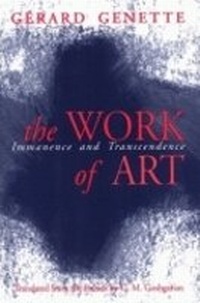
The Work of Art
Immanence and Transcendence
Published on 8. May 1997
Book
Paperback/Softback
288 pages
978-0-8014-8272-4 (ISBN)
Description
What art is-its very nature-is the subject of this book by one of the most distinguished continental theorists writing today. Informed by the aesthetics of Nelson Goodman and referring to a wide range of cultures, contexts, and media, The Work of Art seeks to discover, explain, and define how art exists and how it works. To this end, Gerard Genette explores the distinction between a work of art's immanence-its physical presence-and transcendence-the experience it induces. That experience may go far beyond the object itself.
Genette situates art within the broad realm of human practices, extending from the fine arts of music, painting, sculpture, and literature to humbler but no less fertile fields such as haute couture and the culinary arts. His discussion touches on a rich array of examples and is bolstered by an extensive knowledge of the technology involved in producing and disseminating a work of art, regardless of whether that dissemination is by performance, reproduction, printing, or recording. Moving beyond examples, Genette proposes schemata for thinking about the different manifestations of a work of art. He also addresses the question of the artwork's duration and mutability.
Genette situates art within the broad realm of human practices, extending from the fine arts of music, painting, sculpture, and literature to humbler but no less fertile fields such as haute couture and the culinary arts. His discussion touches on a rich array of examples and is bolstered by an extensive knowledge of the technology involved in producing and disseminating a work of art, regardless of whether that dissemination is by performance, reproduction, printing, or recording. Moving beyond examples, Genette proposes schemata for thinking about the different manifestations of a work of art. He also addresses the question of the artwork's duration and mutability.
Reviews / Votes
"One must admire these books for their interesting and well-chosen examples, drawn from a wide-ranging experience in practically all the arts, and for their well-informed thoughtfulness. . . .Those interested in an aesthetic theory applicable to all the arts will find these volumes informative, provocative, challenging, and quite rewarding."-Harold F. Mosher, Style, Summer 1999 "The lucidity, elegance, and sophistication that have always characterized Genette's writing are present in his new study as well."-Eyal Segal, Poetics Today, Summer 2002 "Genette's exploration of the ontology of art builds a bridge between poststructuralist and analytic work on the theory of the arts. I see Genette's move in the direction of a sophisticated fusion of continental and analytic sources as a highly promising event."-Paisley Livingston, McGill UniversityMore details
Language
English
Place of publication
Ithaca
United States
Target group
College/higher education
Professional and scholarly
Product notice
Paperback (trade)
Dimensions
Height: 229 mm
Width: 152 mm
Thickness: 19 mm
Weight
454 gr
ISBN-13
978-0-8014-8272-4 (9780801482724)
Copyright in bibliographic data and cover images is held by Nielsen Book Services Limited or by the publishers or by their respective licensors: all rights reserved.
Schweitzer Classification
Persons
Gerard Genette teaches at l'Ecole des Hautes en Science Sociales, Paris. He is the author of many books, including three published in translation by Cornell. G. M. Goshgarian is the translator of several books from Cornell, including The Jew and the Other and Three Women in Dark Times: Edith Stein, Hannah Arendt, Simone Weil.