

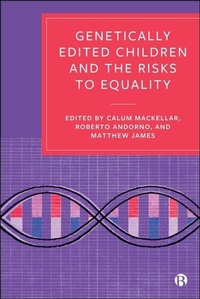
Genetically Edited Children and the Risks to Equality
Examining Heritable Genome Editing in the Light of Social Justice
Bristol University Press
1st Edition
Will be published approx. on 10. September 2026
Book
Hardback
240 pages
978-1-5292-4953-8 (ISBN)
Description
Advances in heritable genome editing, such as with CRISPR-Cas9, promise to ensure that some possible future children with genetic disorders are not created - but at what cost to equality? If only certain kinds of people are brought into existence, do we risk undermining the very foundations of social justice?
This groundbreaking volume brings together leading philosophical, ethical and legal scholars to explore the implications of selecting future children.
Examining this urgent issue through the lens of equality, it challenges us to consider whether genetic selection of children aligns with the core principles of a fair and just society.
This groundbreaking volume brings together leading philosophical, ethical and legal scholars to explore the implications of selecting future children.
Examining this urgent issue through the lens of equality, it challenges us to consider whether genetic selection of children aligns with the core principles of a fair and just society.
More details
Edition
First Edition
Language
English
Place of publication
Bristol
United Kingdom
Target group
Professional and scholarly
Illustrations
Not illustrated
Dimensions
Height: 234 mm
Width: 156 mm
ISBN-13
978-1-5292-4953-8 (9781529249538)
Copyright in bibliographic data and cover images is held by Nielsen Book Services Limited or by the publishers or by their respective licensors: all rights reserved.
Schweitzer Classification
Persons
Calum MacKellar is the Director of Research of the Scottish Council on Human Bioethics in Edinburgh and a member of the Advisory Board of the Centre for Bioethics and Emerging Technologies at St Mary's University.
Roberto Andorno is Associate Professor in the Faculty of Law and a Research Associate in the Institute of Biomedical Ethics and History of Medicine, University of Zurich.
Matthew James is Associate Professor in Bioethics and Medical Law and the Director of the Centre for Bioethics and Emerging Technologies at St Mary's University.
Roberto Andorno is Associate Professor in the Faculty of Law and a Research Associate in the Institute of Biomedical Ethics and History of Medicine, University of Zurich.
Matthew James is Associate Professor in Bioethics and Medical Law and the Director of the Centre for Bioethics and Emerging Technologies at St Mary's University.
Content
1. Introduction - Calum MacKellar, Matthew James, and Roberto Andorno
Part One - Equality: Its Origins and Applications in International Law
2. The Origins of Equality - Matthew James
3. What makes human beings morally equal? -Roberto Andorno
4. Equality and the History of Eugenics -David A. Jones
5. Changing understandings of equality in the human rights debate on heritable genome editing - Britta van Beers
6. The Human Genome as Heritage of Humanity: Why Equality Matters - Laura E. Jacobs
Part Two - Would Heritable Genome Editing Undermine Equality in Society?
7. Does a 'life unworthy of life' actually exist in the case of very severe genetic disability? - Pia Matthews
8. Equality, Heritable Genome Editing and the Expressivist Argument - Calum MacKellar
9. The Dark Side of CRISPR: Its potential ability to "fix" people at the genetic level is a threat to those who are judged by society to be biologically inferior - Sandy Sufian and Rosemarie Garland-Thomson
10. Could Heritable Genome Editing be used without undermining equality? - Richard Playford
Part Three - Heritable Genome Editing and the Future
11. Equality of Access to Heritable Genome Editing - Trevor Stammers
12. Heritable Genome Editing and Intergenerational Equality -Vicente Bellver
13. Heritable Genome Editing, the Future of Equality, and the Need for Social Justice and Human Rights Perspectives - Katie Hasson
14. Free and Equal: The (il)liberal promise of human genome editing - J. Benjamin Hurlbut
15. Conclusion - Calum MacKellar, Matthew James and Roberto Andorno
Part One - Equality: Its Origins and Applications in International Law
2. The Origins of Equality - Matthew James
3. What makes human beings morally equal? -Roberto Andorno
4. Equality and the History of Eugenics -David A. Jones
5. Changing understandings of equality in the human rights debate on heritable genome editing - Britta van Beers
6. The Human Genome as Heritage of Humanity: Why Equality Matters - Laura E. Jacobs
Part Two - Would Heritable Genome Editing Undermine Equality in Society?
7. Does a 'life unworthy of life' actually exist in the case of very severe genetic disability? - Pia Matthews
8. Equality, Heritable Genome Editing and the Expressivist Argument - Calum MacKellar
9. The Dark Side of CRISPR: Its potential ability to "fix" people at the genetic level is a threat to those who are judged by society to be biologically inferior - Sandy Sufian and Rosemarie Garland-Thomson
10. Could Heritable Genome Editing be used without undermining equality? - Richard Playford
Part Three - Heritable Genome Editing and the Future
11. Equality of Access to Heritable Genome Editing - Trevor Stammers
12. Heritable Genome Editing and Intergenerational Equality -Vicente Bellver
13. Heritable Genome Editing, the Future of Equality, and the Need for Social Justice and Human Rights Perspectives - Katie Hasson
14. Free and Equal: The (il)liberal promise of human genome editing - J. Benjamin Hurlbut
15. Conclusion - Calum MacKellar, Matthew James and Roberto Andorno