

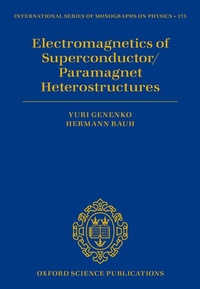
Electromagnetics of Superconductor/Paramagnet Heterostructures
Published on 4. February 2025
Book
Hardback
320 pages
978-0-19-871457-6 (ISBN)
Description
Conditioning of magnetic fields is a novel route to improve type-II superconductor performance in high-current and high-field applications directed at increasing the current-carrying capability and the critical fields of superconductor/paramagnet heterostructures, as well as reducing their hysteretic AC loss.
Through a methodical analysis and noteworthy solutions, Electromagnetics of Superconductor/Paramagnet Heterostructures presents a phenomenological account of the remarkable electromagnetic properties of superconductor paramagnet heterostructures, as captured by Maxwell's electrodynamics, generalized London theory, and Bean's model of the critical state. Beginning with the introduction of the basic concepts of superconductivity which are necessary for understanding of the following studies, exact closed-form solutions are revealed for a range of idealized heterostructures.
Investigations of the superconductor constituents primarily focus on strips or tapes, filaments and tubes, with a transport current imposed or a magnetic field applied. Geometrical as well as materials aspects of both the magnetic shielding effect and the hysteretic AC loss undergo detailed analysis which permits identification of the conditions for non-dissipative critical, or even overcritical, states to exist. Crucial issues such as the barrier against the penetration of magnetic flux at superconductor/paramagnet interfaces or the nucleation of magnetic vortex loops equally find their place.
Finally, based on the magnetostatic-electrostatic analogues, the finite-element simulations of the Meissner state and the critical state of thin superconductors in paramagnetic environments of arbitrary shape and permeability are performed. This presents an effective tool for designing superconductor/paramagnet heterostructures.
Through a methodical analysis and noteworthy solutions, Electromagnetics of Superconductor/Paramagnet Heterostructures presents a phenomenological account of the remarkable electromagnetic properties of superconductor paramagnet heterostructures, as captured by Maxwell's electrodynamics, generalized London theory, and Bean's model of the critical state. Beginning with the introduction of the basic concepts of superconductivity which are necessary for understanding of the following studies, exact closed-form solutions are revealed for a range of idealized heterostructures.
Investigations of the superconductor constituents primarily focus on strips or tapes, filaments and tubes, with a transport current imposed or a magnetic field applied. Geometrical as well as materials aspects of both the magnetic shielding effect and the hysteretic AC loss undergo detailed analysis which permits identification of the conditions for non-dissipative critical, or even overcritical, states to exist. Crucial issues such as the barrier against the penetration of magnetic flux at superconductor/paramagnet interfaces or the nucleation of magnetic vortex loops equally find their place.
Finally, based on the magnetostatic-electrostatic analogues, the finite-element simulations of the Meissner state and the critical state of thin superconductors in paramagnetic environments of arbitrary shape and permeability are performed. This presents an effective tool for designing superconductor/paramagnet heterostructures.
More details
Series
Language
English
Place of publication
Oxford
United Kingdom
Target group
Professional and scholarly
College/higher education
Product notice
sewn/stitched
Cloth over boards
Illustrations
100 line drawings
Dimensions
Height: 251 mm
Width: 176 mm
Thickness: 22 mm
Weight
757 gr
ISBN-13
978-0-19-871457-6 (9780198714576)
Copyright in bibliographic data and cover images is held by Nielsen Book Services Limited or by the publishers or by their respective licensors: all rights reserved.
Schweitzer Classification
Other editions
Additional editions
Yuri Genenko | Hermann Rauh
Electromagnetics of Superconductor/Paramagnet Heterostructures
E-Book
01/2025
1st Edition
OUP eBook
€97.99
Available for download
Persons
Yuri Genenko obtained his PhD in 1987 and worked for the Donetsk Physical and Technical Institute until 1996. In 1993 he was awarded the national prize for young scientists for studies of layered superconductors and a DSc from the Institute for Metal Physics in Kiev for investigations of magnetic flux structures in low-dimensional superconductors (1995). He currently works at the Technical University of Darmstadt as a research professor.
Hermann Rauh graduated from the University of Tuebingen, Germany, in 1971. Following work on the electrical resistivity of dislocations in copper performed at the Max Planck Institute for Metals Research afterwards, he obtained his PhD from the University of Stuttgart in 1975. Having obtained his habilitation in 1985, Rauh joined the Materials Department at the University of Oxford as a Visiting Fellow. With simultaneous affiliations to the Harwell Laboratory, he held a Research Fellowship at Wolfson College, Oxford. In 1994 Rauh became Professor of Theoretical Materials Science at the Technical University of Darmstadt.
Hermann Rauh graduated from the University of Tuebingen, Germany, in 1971. Following work on the electrical resistivity of dislocations in copper performed at the Max Planck Institute for Metals Research afterwards, he obtained his PhD from the University of Stuttgart in 1975. Having obtained his habilitation in 1985, Rauh joined the Materials Department at the University of Oxford as a Visiting Fellow. With simultaneous affiliations to the Harwell Laboratory, he held a Research Fellowship at Wolfson College, Oxford. In 1994 Rauh became Professor of Theoretical Materials Science at the Technical University of Darmstadt.
Author
Apl. Professor of Theoretical Materials ScienceApl. Professor of Theoretical Materials Science, Institute of Materials Science of the Technical University of Darmstadt
Professor Emeritus of Materials ScienceProfessor Emeritus of Materials Science, Institute of Materials Science of the Technical University of Darmstadt
Content
1: Introduction
2: Phenomenological concepts in superconductivity
3: Meissner state of a superconductor strip in ideal paramagnetic environments
4: Critical state of a superconductor strip in ideal paramagnetic environments
5: Meissner state and critical state of a superconductor strip in ideal diamagnetic environments
6: Meissner state of thin superconductors in non-ideal paramagnetic environments
7: Critical characteristics of bulk superconductors in non-ideal paramagnetic environments
8: Meissner state and critical state of thin superconductors in arbitrary paramagnetic environments: finite-element simulations
9: Epilogue
Appendix A: Magnetic dipole moment of supercurrent distributions in paramagnetic environments
Appendix B: Electromagnetic energy associated with magnetic vortices in superconductor/paramagnet heterostructures
References
Author index
Subject index
2: Phenomenological concepts in superconductivity
3: Meissner state of a superconductor strip in ideal paramagnetic environments
4: Critical state of a superconductor strip in ideal paramagnetic environments
5: Meissner state and critical state of a superconductor strip in ideal diamagnetic environments
6: Meissner state of thin superconductors in non-ideal paramagnetic environments
7: Critical characteristics of bulk superconductors in non-ideal paramagnetic environments
8: Meissner state and critical state of thin superconductors in arbitrary paramagnetic environments: finite-element simulations
9: Epilogue
Appendix A: Magnetic dipole moment of supercurrent distributions in paramagnetic environments
Appendix B: Electromagnetic energy associated with magnetic vortices in superconductor/paramagnet heterostructures
References
Author index
Subject index