

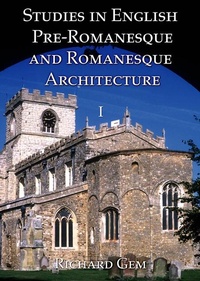
Studies in English Pre-Romanesque and Romanesque Architecture Volume II
Published on 31. December 2003
Book
Hardback
450 pages
978-1-904597-10-0 (ISBN)
Description
Trained as both an archaeologist and an art historian, Richard Gem established his specialist interest in pre-Romanesque and Romanesque architecture with his doctoral research at Cambridge University. Since then he has researched, published and lectured widely in this subject, while holding posts in different fields of cultural resource management.
Dr Gem's earlier work aimed to establish an understanding of English architecture in the 11th century that would break away from the view that cultural development in this period could be simply explained in terms of whether buildings were constructed before or after the Norman Conquest. He has taken a wide view of how cultural processes in England need to be seen in the context of broader European trends, in order to understand both English architecture's indebtedness to the Continent, and also what gives it its specific national character. His earlier papers applied this approach to the development of the Romanesque style of architecture in England through the course of the 11th century while more recently he has applied a similar approach to earlier centuries, including the Carolingian period. Taking a broad view of cultural trends as his starting point, he has always anchored his work on a detailed archaeological, historical and stylistic analysis of individual buildings before drawing conclusions.
This publication includes Dr Gem's main work over a period of quarter of a century. Taken together, these studies present an overview of the development of English Church architecture from the 7th century to the 12th.
Dr Gem's earlier work aimed to establish an understanding of English architecture in the 11th century that would break away from the view that cultural development in this period could be simply explained in terms of whether buildings were constructed before or after the Norman Conquest. He has taken a wide view of how cultural processes in England need to be seen in the context of broader European trends, in order to understand both English architecture's indebtedness to the Continent, and also what gives it its specific national character. His earlier papers applied this approach to the development of the Romanesque style of architecture in England through the course of the 11th century while more recently he has applied a similar approach to earlier centuries, including the Carolingian period. Taking a broad view of cultural trends as his starting point, he has always anchored his work on a detailed archaeological, historical and stylistic analysis of individual buildings before drawing conclusions.
This publication includes Dr Gem's main work over a period of quarter of a century. Taken together, these studies present an overview of the development of English Church architecture from the 7th century to the 12th.
More details
Language
English
Place of publication
London
United Kingdom
Target group
College/higher education
Professional and scholarly
Product notice
Laminated cover
Illustrations
216 illus.
Dimensions
Height: 240 mm
Width: 170 mm
Thickness: 23 mm
Weight
1221 gr
ISBN-13
978-1-904597-10-0 (9781904597100)
Copyright in bibliographic data and cover images is held by Nielsen Book Services Limited or by the publishers or by their respective licensors: all rights reserved.
Schweitzer Classification
Person
Trained as both an archaeologist and an art historian, Richard Gem established his specialist interest in pre-Romanesque and Romanesque architecture with his doctoral research at Cambridge University. Since then he has researched, published and lectured widely in this subject, while holding posts in different fields of cultural resource management.
Content
England and the Resistance to Romanesque Architecture
The Romanesque Rebuilding of Westminster Abbey
The Significance of the 11th-Century Rebuilding of Christ Church and St Augustine's, Canterbury, in the Development of Romanesque Architecture
Canterbury and the Cushion Capital: a Commentary on Passages from Goscelin's de miraculis sancti Augustini
The Romanesque Architecture of Old St Paul's Cathedral and its Late 11th-Century Context
Chichester Cathedral: When was the Romanesque Church Begun
The Romanesque Cathedral of Winchester: Patron and Design in the 11th Century
The First Romanesque Cathedral of Old Salisbury
Bishop Wulfstan II and the Romanesque Cathedral Church of Worcester
The Bishop's Chapel at Hereford: the Roles of Patron and Craftsman
Lincoln Minster: Ecclesia Pulchra, Ecclesia Fortis
Romanesque Architecture in Chester c. 1075 to 1117
The English Parish Church in the 11th and 12th Centuries: a 'Great Rebuilding';The Early Romanesque Tower of Sompting Church, Sussex
An Early Church of the Knights Templars at Shipley, Sussex
The Church of St Michael and St Mary, Melbourne, Derbyshire
Additional Notes
Index
The Romanesque Rebuilding of Westminster Abbey
The Significance of the 11th-Century Rebuilding of Christ Church and St Augustine's, Canterbury, in the Development of Romanesque Architecture
Canterbury and the Cushion Capital: a Commentary on Passages from Goscelin's de miraculis sancti Augustini
The Romanesque Architecture of Old St Paul's Cathedral and its Late 11th-Century Context
Chichester Cathedral: When was the Romanesque Church Begun
The Romanesque Cathedral of Winchester: Patron and Design in the 11th Century
The First Romanesque Cathedral of Old Salisbury
Bishop Wulfstan II and the Romanesque Cathedral Church of Worcester
The Bishop's Chapel at Hereford: the Roles of Patron and Craftsman
Lincoln Minster: Ecclesia Pulchra, Ecclesia Fortis
Romanesque Architecture in Chester c. 1075 to 1117
The English Parish Church in the 11th and 12th Centuries: a 'Great Rebuilding';The Early Romanesque Tower of Sompting Church, Sussex
An Early Church of the Knights Templars at Shipley, Sussex
The Church of St Michael and St Mary, Melbourne, Derbyshire
Additional Notes
Index