

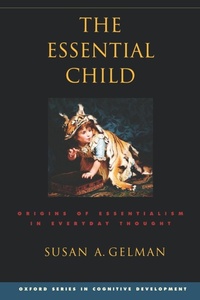
The Essential Child
Origins of Essentialism in Everyday Thought
Published on 12. May 2005
Book
Paperback/Softback
392 pages
978-0-19-518198-2 (ISBN)
Description
Essentialism is the idea that certain categories, such as "dog," "man," or "intelligence," have an underlying reality or true nature that gives objects their identity. Where does this idea come from? In this book, Susan Gelman argues that essentialism is an early cognitive bias. Young children's concepts reflect a deep commitment to essentialism, and this commitment leads children to look beyond the obvious in many converging ways: when learning words, generalizing knowledge to new category members, reasoning about the insides of things, contemplating the role of nature versus nurture, and constructing causal explanations. Gelman argues against the standard view of children as concrete or focused on the obvious, instead claiming that children have an early, powerful tendency to search for hidden, non-obvious features of things. She also attacks claims that children build up their knowledge of the world based on simple, associative learning strategies, arguing that children's concepts are embedded in rich folk theories. Parents don't explicitly teach children to essentialize; instead, during the preschool years, children spontaneously construct concepts and beliefs that reflect an essentialist bias.
Essentialist accounts have been offered, in one form or another, for thousands of years, extending back at least to Aristotle and Plato. Yet this book is the first to address the issues surrounding essentialism from a psychological perspective. Gelman synthesizes over 15 years of empirical research on essentialism into a unified framework and explores the broader lessons that the research imparts concerning, among other things, human concepts, children's thinking, and the ways in which language influences thought. This volume will appeal to developmental, cognitive, and social psychologists, as well as to scholars in cognitive science and philosophy.
Essentialist accounts have been offered, in one form or another, for thousands of years, extending back at least to Aristotle and Plato. Yet this book is the first to address the issues surrounding essentialism from a psychological perspective. Gelman synthesizes over 15 years of empirical research on essentialism into a unified framework and explores the broader lessons that the research imparts concerning, among other things, human concepts, children's thinking, and the ways in which language influences thought. This volume will appeal to developmental, cognitive, and social psychologists, as well as to scholars in cognitive science and philosophy.
Reviews / Votes
"Susan Gelman's The Essential Child is both deep and accessible. She does the field a great service just by pulling together her truly remarkable research program into one integrated story. In doing so, she shows how the data that support the claim that young children have essentialist commitments challenge deeply held views about the nature of young children's thinking and about the nature of human concepts in general. Anybody concerned with understanding conceptual development and anybody concerned with understanding human concepts should read this book." --Susan E. Carey, Professor of Psychology, Harvard University "This is a path-breaking book on children's conceptual development with important implications for virtually all of cognitive science." --Douglas Medin, Professor of Psychology, Northwestern UniversityMore details
Series
Language
English
Place of publication
New York
United States
Target group
Professional and scholarly
Illustrations
numerous tables, figures, one illustration and 4 halftones
Dimensions
Height: 234 mm
Width: 156 mm
Thickness: 21 mm
Weight
600 gr
ISBN-13
978-0-19-518198-2 (9780195181982)
Copyright in bibliographic data and cover images is held by Nielsen Book Services Limited or by the publishers or by their respective licensors: all rights reserved.
Schweitzer Classification
Other editions
Additional editions

E-Book
04/2005
1st Edition
OUP USA
€27.49
Available for download
Book
05/2003
Oxford University Press Inc
€78.20
Shipment within 15-20 days
E-Book
03/2003
1st Edition
OUP USA
€40.49
Available for download
Person
Susan A. Gelman is the Frederick G. L. Huetwell Professor of Psychology at the University of Michigan. She has authored more than one hundred publications on language and cognitive development and has received numerous honors and awards, including a J.S. Guggenheim Fellowship, a Distinguished Scientific Award from the American Psychological Association for Early Career Contribution to Psychology, and a Boyd McCandless Young Scientist Award from Division 7 of the American Psychological Association. She also serves on the editorial board of several journals. Her research has been funded by the National Institutes of Child Health and Human Development, the National Science Foundation, and the Spencer Foundation.
Content
PART I: THE PHENOMENA ; PART II: MECHANISMS OF ACQUISITION ; PART III: IMPLICATIONS AND SPECULATIONS