

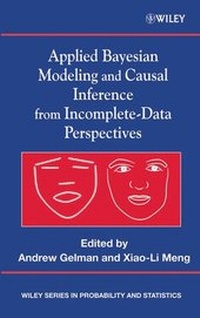
Applied Bayesian Modeling and Causal Inference from Incomplete-Data Perspectives
An Essential Journey with Donald Rubin's Statistical Family
Published on 23. July 2004
Book
Hardback
440 pages
978-0-470-09043-5 (ISBN)
Description
This book brings together a collection of articles on statistical methods relating to missing data analysis, including multiple imputation, propensity scores, instrumental variables, and Bayesian inference. Covering new research topics and real-world examples which do not feature in many standard texts. The book is dedicated to Professor Don Rubin (Harvard). Don Rubin has made fundamental contributions to the study of missing data.
Key features of the book include:
* Comprehensive coverage of an imporant area for both research and applications.
* Adopts a pragmatic approach to describing a wide range of intermediate and advanced statistical techniques.
* Covers key topics such as multiple imputation, propensity scores, instrumental variables and Bayesian inference.
* Includes a number of applications from the social and health sciences.
* Edited and authored by highly respected researchers in the area.
Reviews / Votes
"I congratulate the editors on this volume; it really is an essential and very enjoyable journey with Don Rubin's statistical family." (Biometrics, September 2006) "...contains much current important work..." (Technometrics, November 2005)"This a useful reference book on an important topic with applications to a wide range of disciplines." (CHOICE, September 2005)
"With this variety of papers, the reader is bound to find some papers interesting..." (Journal of Applied Statistics, Vol.32, No.3, April 2005)
"I strongly recommend that libraries have a copy of this book in their reference section." (Journal of the Royal Statistical Society Series A, June 2005)
"...a very useful addition to academic libraries..." (Short Book Reviews, Vol.24, No.3, December 2004)
More details
Series
Edition
1. Auflage
Language
English
Place of publication
New York
United States
Target group
Professional and scholarly
Product notice
sewn/stitched
Cloth over boards
Dimensions
Height: 240 mm
Width: 161 mm
Thickness: 28 mm
Weight
824 gr
ISBN-13
978-0-470-09043-5 (9780470090435)
Schweitzer Classification
Other editions
Additional editions
Andrew Gelman | Xiao-Li Meng
Applied Bayesian Modeling and Causal Inference from Incomplete-Data Perspectives
E-Book
08/2004
Wiley
€105.99
Available for download
Persons
Andrew Gelman is Professor of Statistics and Professor of Political Science at Columbia University. He has published over 150 articles in statistical theory, methods, and computation, and in applications areas including decision analysis, survey sampling, political science, public health, and policy. His other books are Bayesian Data Analysis (1995, second edition 2003) and Teaching Statistics: A Bag of Tricks (2002).
Content
Preface.
I Casual inference and observational studies.
1 An overview of methods for causal inference from observational studies, by Sander Greenland.
2 Matching in observational studies, by Paul R. Rosenbaum.
3 Estimating causal effects in nonexperimental studies, by Rajeev Dehejia.
4 Medication cost sharing and drug spending in Medicare, by Alyce S. Adams.
5 A comparison of experimental and observational data analyses, by Jennifer L. Hill, Jerome P. Reiter, and Elaine L. Zanutto.
6 Fixing broken experiments using the propensity score, by Bruce Sacerdote.
7 The propensity score with continuous treatments, by Keisuke Hirano and Guido W. Imbens.
8 Causal inference with instrumental variables, by Junni L. Zhang.
9 Principal stratification, by Constantine E. Frangakis.
II Missing data modeling.
10 Nonresponse adjustment in government statistical agencies: constraints, inferential goals, and robustness issues, by John L. Eltinge.
11 Bridging across changes in classification systems, by Nathaniel Schenker.
12 Representing the Census undercount by multiple imputation of households, by Alan M. Zaslavsky.
13 Statistical disclosure techniques based on multiple imputation, by Roderick J. A. Little, Fang Liu, and Trivellore E. Raghunathan.
14 Designs producing balanced missing data: examples from the National Assessment of Educational Progress, by Neal Thomas.
15 Propensity score estimation with missing data, by Ralph B. D'Agostino Jr.
16 Sensitivity to nonignorability in frequentist inference, by Guoguang Ma and Daniel F. Heitjan.
III Statistical modeling and computation.
17 Statistical modeling and computation, by D. Michael Titterington.
18 Treatment effects in before-after data, by Andrew Gelman.
19 Multimodality in mixture models and factor models, by Eric Loken.
20 Modeling the covariance and correlation matrix of repeated measures, by W. John Boscardin and Xiao Zhang.
21 Robit regression: a simple robust alternative to logistic and probit regression, by Chuanhai Liu.
22 Using EM and data augmentation for the competing risks model, by Radu V. Craiu and Thierry Duchesne.
23 Mixed effects models and the EM algorithm, by Florin Vaida, Xiao-Li Meng, and Ronghui Xu.
24 The sampling/importance resampling algorithm, by Kim-Hung Li.
IV Applied Bayesian inference.
25 Whither applied Bayesian inference?, by Bradley P. Carlin.
26 Efficient EM-type algorithms for fitting spectral lines in high-energy astrophysics, by David A. van Dyk and Taeyoung Park.
27 Improved predictions of lynx trappings using a biological model, by Cavan Reilly and Angelique Zeringue.
28 Record linkage using finite mixture models, by Michael D. Larsen.
29 Identifying likely duplicates by record linkage in a survey of prostitutes, by Thomas R. Belin, Hemant Ishwaran, Naihua Duan, Sandra H. Berry, and David E. Kanouse.
30 Applying structural equation models with incomplete data, by Hal S. Stern and Yoonsook Jeon.
31 Perceptual scaling, by Ying Nian Wu, Cheng-En Guo, and Song Chun Zhu.
References.
Index.