

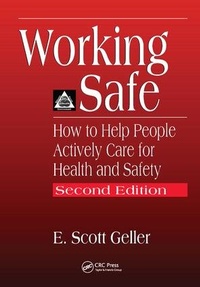
Working Safe
How to Help People Actively Care for Health and Safety, Second Edition
2nd Edition
Published on 27. July 2017
Book
Hardback
328 pages
978-1-138-43094-5 (ISBN)
Description
Written by world-renowned health and safety researcher E. Scott Geller, Working Safe: How to Help People Actively Care for Health and Safety, Second Edition presents science-based and practical approaches to improving attitudes and behavior for achieving an injury-free work environment. This book teaches proactive applications of behavior-based psychology for improving health and safety. Relevant theory and principles are clearly explained and practical step-by-step procedures are detailed. Dr. Geller's anecdotal and non-academic writing style makes the book fun and easy to read.
This research-based text is completely updated and expanded from the 1996 edition. It includes three new chapters: one on behavioral safety analysis, another on intervening with supportive conversation, and the third on how to promote high performance teamwork. Thus, this second edition continues to provide the practical advice safety leaders rely on.
Working Safe: How to Help People Actively Care for Health and Safety supplies the research and theory needed to customize effective behavior-based procedures and tools in your workplace. The information and examples provide health and safety professionals with behavioral science methods capable of enhancing safety awareness, reducing at-risk behavior, and facilitating ongoing participation in safety-related activities.
This research-based text is completely updated and expanded from the 1996 edition. It includes three new chapters: one on behavioral safety analysis, another on intervening with supportive conversation, and the third on how to promote high performance teamwork. Thus, this second edition continues to provide the practical advice safety leaders rely on.
Working Safe: How to Help People Actively Care for Health and Safety supplies the research and theory needed to customize effective behavior-based procedures and tools in your workplace. The information and examples provide health and safety professionals with behavioral science methods capable of enhancing safety awareness, reducing at-risk behavior, and facilitating ongoing participation in safety-related activities.
Reviews / Votes
"Dr. Geller teaches us that safety is really in our own hands for ourselves and those around us."-Morris E. Chafetz, MD, 1995 Inductee into the Health and Safety Hall of Fame International
"This book is absolutely extraordinary. It is extremely well written, accurate, and factual. I highly recommend it for both the safety professional and the general business community."
-John G. Cope, Ph.D., Professor, East Carolina University
More details
Edition
2nd edition
Language
English
Place of publication
London
United Kingdom
Publishing group
Taylor & Francis Ltd
Target group
College/higher education
Undergraduate
Dimensions
Height: 254 mm
Width: 178 mm
Weight
453 gr
ISBN-13
978-1-138-43094-5 (9781138430945)
Copyright in bibliographic data and cover images is held by Nielsen Book Services Limited or by the publishers or by their respective licensors: all rights reserved.
Schweitzer Classification
Other editions
New editions
Book
06/2024
3rd Edition
CRC Press
€169.60
Shipment within 10-20 days
Additional editions
Book
05/2001
2nd Edition
CRC Press
€109.27
Article exhausted; check different version
Person
Content
ORIENTATION AND ALIGNMENT. Choosing the Right Approach. Starting with Theory. Shifting Paradigms. HUMAN BARRIERS TO SAFETY. The Complexity of People. Sensation, Perception, and Perceived Risk. Stress vs Distress. BEHAVIOR-BASED PSYCHOLOGY. Basic Principles. Identifying Critical Behaviors. Behavioral Safety Analysis. BEHAVIOR-BASED INTERVENTION. Intervening with Activators. Intervening with Consequences. Intervening as a Behavior-Change Agent. Intervening with Supportive Conversation. ACTIVELY CARING FOR SAFETY. Understanding Actively Caring. The Person-Based Approach to Actively Caring. Increasing Actively Caring Behaviors. PUTTING IT ALL TOGETHER. Promoting High-Performance Teamwork. Evaluating for Continuous Improvement. Obtaining and Maintaining Involvement. Reviewing the Principles.