

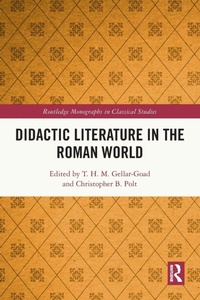
Didactic Literature in the Roman World
1st Edition
Published on 13. March 2025
Book
Paperback/Softback
202 pages
978-1-032-45651-5 (ISBN)
Description
This book collects new work on Latin didactic poetry and prose in the late Republic and early Empire, and it evaluates the varied, shifting roles that literature of teaching and learning played during this period.
Instruction was of special interest in the culture and literature of the late Roman Republic and the Age of Augustus, as attitudes towards education found complex, fluid, and multivalent expressions. The era saw a didactic boom, a cottage industry whose surviving authors include Vergil, Lucretius, Ovid, Horace, Cicero, Varro, Germanicus, and Grattius, who are all reexamined here. The contributors to this volume bring fresh approaches to the study of educational literature from the end of the Roman Republic and early Empire, and their essays discover unexpected connections between familiar authors. Chapters explore, interrogate, and revise some aspect of our understanding of these generic and modal boundaries, while considering understudied points of contact between art and education, poetry and prose, and literature and philosophy, among others. Altogether, the volume shows how lively, experimental, and intertextual the didactic ethos of this period is, and how deeply it engages with social, political, and philosophical questions that are of critical importance to contemporary Rome and of enduring interest into the modern world.
Didactic Literature in the Roman World is of interest to students and scholars of Latin literature, particularly the late Republic and early Empire, and of Classics more broadly. In addition, the volume's focus on didactic poetry and prose appeals to those working on literature outside of Classics and on intellectual history.
Instruction was of special interest in the culture and literature of the late Roman Republic and the Age of Augustus, as attitudes towards education found complex, fluid, and multivalent expressions. The era saw a didactic boom, a cottage industry whose surviving authors include Vergil, Lucretius, Ovid, Horace, Cicero, Varro, Germanicus, and Grattius, who are all reexamined here. The contributors to this volume bring fresh approaches to the study of educational literature from the end of the Roman Republic and early Empire, and their essays discover unexpected connections between familiar authors. Chapters explore, interrogate, and revise some aspect of our understanding of these generic and modal boundaries, while considering understudied points of contact between art and education, poetry and prose, and literature and philosophy, among others. Altogether, the volume shows how lively, experimental, and intertextual the didactic ethos of this period is, and how deeply it engages with social, political, and philosophical questions that are of critical importance to contemporary Rome and of enduring interest into the modern world.
Didactic Literature in the Roman World is of interest to students and scholars of Latin literature, particularly the late Republic and early Empire, and of Classics more broadly. In addition, the volume's focus on didactic poetry and prose appeals to those working on literature outside of Classics and on intellectual history.
Reviews / Votes
"...the ten chapters that comprise the book are a most valuable contribution to the existing bibliography on the didactic 'genre' in Latin literature, as they offer new and insightful readings and perspectives on the texts and themes under discussion... this is a very well-produced book, and scholars of ancient literature, not just Roman, will find very fruitful and useful reading." - The Classical ReviewMore details
Series
Language
English
Place of publication
London
United Kingdom
Publishing group
Taylor & Francis Ltd
Target group
College/higher education
Postgraduate and Undergraduate Advanced
Illustrations
3 s/w Tabellen
3 Tables, black and white
Dimensions
Height: 234 mm
Width: 156 mm
Thickness: 12 mm
Weight
336 gr
ISBN-13
978-1-032-45651-5 (9781032456515)
Copyright in bibliographic data and cover images is held by Nielsen Book Services Limited or by the publishers or by their respective licensors: all rights reserved.
Schweitzer Classification
Other editions
Additional editions
T. H. M. Gellar-Goad | Christopher B. Polt
Didactic Literature in the Roman World
E-Book
08/2023
1st Edition
Routledge
€55.49
Available for download
T. H. M. Gellar-Goad | Christopher B. Polt
Didactic Literature in the Roman World
Book
08/2023
1st Edition
Routledge
€206.20
Shipment within 10-20 days
T. H. M. Gellar-Goad | Christopher B. Polt
Didactic Literature in the Roman World
E-Book
08/2023
1st Edition
Routledge
€55.49
Available for download
Persons
T. H. M. Gellar-Goad is Associate Professor of Classics at Wake Forest University. He specializes in Latin poetry, especially the funny stuff: Roman comedy, Roman erotic elegy, Roman satire, and-if you believe him-the allegedly philosophical poet Lucretius. He is author of Laughing Atoms, Laughing Matter: Lucretius' De Rerum Natura and Satire (Michigan 2020), Plautus: Curculio (Bloomsbury 2021), and Masks (Tangent 2023).
Christopher B. Polt is Assistant Professor of Classical Studies at Boston College. His research centers on Latin poetry of the late Republic and early Empire, and he is the author of numerous articles on Roman comedy, ancient epic, and fable. He is the author of Catullus and Roman Comedy: Theatricality and Personal Drama in the Late Republic (Cambridge 2021).
Christopher B. Polt is Assistant Professor of Classical Studies at Boston College. His research centers on Latin poetry of the late Republic and early Empire, and he is the author of numerous articles on Roman comedy, ancient epic, and fable. He is the author of Catullus and Roman Comedy: Theatricality and Personal Drama in the Late Republic (Cambridge 2021).
Content
Introduction - T. H. M. Gellar-Goad and Christopher B. Polt; Part One - Teaching Philosophies; 1. Lucretius' DRN and Callimachus' Hymn to Zeus: Comparing and Contrasting Didactic Projects - Michael Paschalis; 2. Epicurean Codas in Vergil's Georgics - Alison Keith; 3. Fortunatus et ille: Vergil's Ironic Epicureanism - Peter Heslin; Part Two - Erotodidaxis; 4. Idle Hands: The Poetics of Masturbation in the Winter Scenes of Hesiod (Op. 493-563) and Vergil (G. 1.291-310) - Leah Kronenberg; 5. Animal Love from Vergil: Contesting Marital Propriety in the Age of Augustus - Steven J. Green; 6. The Language of Teaching and Learning in Propertius - Melanie Racette-Campbell; Part Three - Metadidaxis; 7. Buried in Books: Varro's Papia Papae in the Shade of Scholarship - Joseph McAlhany; 8. Si Est Homo Bulla: Writing between the Lines in Varro's de Rebus Rusticis - Sarah Stroup; 9. The Shadows of Archimedes: Intertextual Anxieties in Hyginus Gromaticus' Constitutio Limitum - Del A. Maticic; 10. Satire, Didactic, and New Contexts for Problems in Horace's Ars Poetica - James J. O'Hara.