

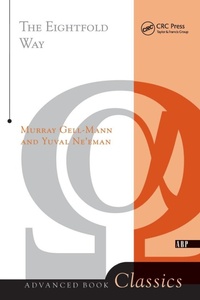
The Eightfold Way
1st Edition
Published on 20. October 2000
Book
Paperback/Softback
398 pages
978-0-7382-0299-0 (ISBN)
Description
This monograph presents thirty research papers dealing with the classification of strongly interacting particles and their interaction according to the eightfold way. In each chapter the authors' commentary introduces the reprints.
More details
Series
Language
English
Place of publication
Oxford
United States
Publishing group
Taylor & Francis Inc
Target group
College/higher education
Professional and scholarly
Dimensions
Height: 229 mm
Width: 152 mm
Thickness: 21 mm
Weight
577 gr
ISBN-13
978-0-7382-0299-0 (9780738202990)
Copyright in bibliographic data and cover images is held by Nielsen Book Services Limited or by the publishers or by their respective licensors: all rights reserved.
Schweitzer Classification
Other editions
Additional editions
Murray Gell-mann
The Eightfold Way
Book
06/2019
1st Edition
CRC Press
€207.50
Shipment within 15-20 days
Person
A pioneer in the field of subatomic physics, Murray Gell-Mann was awarded the Nobel Prize in Physics in 1969 for his quark theory of matter. Gell-Mann coined the term "quark" after the discovery of some 100 particles within the atomic nucleus. He is currently Professor and Co-Chairman of the Science Board of the Santa Fe Institute, where his recent research has focused on complex adaptive systems. He is the author of The Quark and the Jaguar and The Eightfold Way, and lives in Santa Fe, New Mexico.
Content
Remarks on the History of Strong-Interaction Symmetries , The Broken Symmetry and the Mass Formula , The Eightfold Way , Derivation of Strong Interactions from a Gauge Invariance , Note on Unitary Symmetry in Strong Interactions*) , The Decimet and the Omega-Minus , Strange Particle Physics. Strong Interactions , Observation of a Hyperon with Strangeness Minus Three , Further Assignments of Supermultiplets , Eightfold-Way Assignments for Y 1*(1660) and Other Baryons , The Meson ?(725) and the Eightfold Way , Baryon-Baryon Interactions and the Eightfold Way , ?-? Mixing , Possible Existence of a T = 0 Vector Meson at 1020 MeV ? , ?? Mixing , Experimental Consequences of ?-? Mixing , Intensity Rules , The Octet Model and its Clebsch-Gordan Coefficients , Verification of The Tenfold Assignment of The Baryon Resonances , Comparison of A New SU3 Prediction With Experiment , Electromagnetic Interactions of The Hadrons , Electrodynamic Properties of Baryons in The Unitary Symmetry Scheme , Some Consequences of Unitary Symmetry Model 1 , Triplets and Triality , A Schematic Model of Baryons and Mesons 1 , The Weak Current of The Hadrons , The Symmetry Group of Vector and Axial Vector Currents , Unitary Symmetry and Leptonic Decays , Conserved and Partially Conserved Currents in the Theory of Weak Interactions , Symmetries of Baryons and Mesons , Current-Generated Algebras , The Nonleptonic Weak Interaction , Octet Enhancement , Possible Unitary Symmetry Properties of the Intermediate Bosons and their Interactions , Nonleptonic Weak Decays and the Eightfold Way , Broken Symmetry and the Bootstrap Hypothesis , A Mechanism for the Induction of Symmetries Among the Strong Interactions , Spontaneous Breakdown of Octet Symmetry , Self-Consistent Deviations from Unitary Symmetry , The Fifth Interaction , The Physical Uniqueness of the Eightfold Way , The Symmetry Approach to Particle Physics , New Contributions , Particle Theory From S-Matrix to Quarks , Hadron Symmetry, Classification and Compositeness , Appendix I , Appendix II , Appendix III