

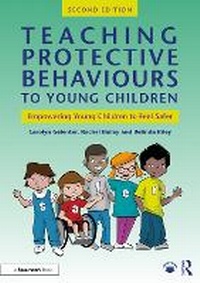
Teaching Protective Behaviours to Young Children
Empowering Young Children to Feel Safer
2nd Edition
Published on 16. August 2024
Book
Paperback/Softback
160 pages
978-1-032-39377-3 (ISBN)
Description
This teaching resource provides staff in education settings with a comprehensive way of supporting children, aged 4-9, to learn that they have a right to feel safe and can talk with someone about anything, even if it feels awful or small.
Fully revised and updated, this second edition provides a practical application of the Protective Behaviours framework, including suggested session plans and accompanying resources. The book explores a range of situations that are faced by children and teaches them to develop a practical understanding of how to reflect on feelings, take safe risks, make responsible choices, and problem solve if they do find themselves in a situation that is uncomfortable or unsafe. The book:
Enables children to develop an awareness of what 'safe' feels like both emotionally and physically.
Empowers children to know and understand that they have the right to consent, even from a young age, and that there are strategies for getting help if needed.
Gives children the skills to understand their feelings, thoughts and behaviours, and to make informed decisions based on their understanding of protective behaviours.
Supports children to identify safe adults and to build a safety network.
Provides guidance for children with varying communication abilities to communicate about their safety in multi-sensory ways.
Includes ideas to share with parents/carers and questions for adults to think about their own learning and practices.
This new edition helps supporting adults teach sessions within an open time frame, offering ideas that can be embedded beyond the classroom, into the culture of the setting or school, and into everyday practice with children. This resource is an essential tool for staff in early years and primary settings, as well as other professionals supporting young children with safety. It also provides parents/carers with a range of related activities that can be used at home to complement and reinforce the language and concepts of protective behaviours being taught in schools.
Fully revised and updated, this second edition provides a practical application of the Protective Behaviours framework, including suggested session plans and accompanying resources. The book explores a range of situations that are faced by children and teaches them to develop a practical understanding of how to reflect on feelings, take safe risks, make responsible choices, and problem solve if they do find themselves in a situation that is uncomfortable or unsafe. The book:
Enables children to develop an awareness of what 'safe' feels like both emotionally and physically.
Empowers children to know and understand that they have the right to consent, even from a young age, and that there are strategies for getting help if needed.
Gives children the skills to understand their feelings, thoughts and behaviours, and to make informed decisions based on their understanding of protective behaviours.
Supports children to identify safe adults and to build a safety network.
Provides guidance for children with varying communication abilities to communicate about their safety in multi-sensory ways.
Includes ideas to share with parents/carers and questions for adults to think about their own learning and practices.
This new edition helps supporting adults teach sessions within an open time frame, offering ideas that can be embedded beyond the classroom, into the culture of the setting or school, and into everyday practice with children. This resource is an essential tool for staff in early years and primary settings, as well as other professionals supporting young children with safety. It also provides parents/carers with a range of related activities that can be used at home to complement and reinforce the language and concepts of protective behaviours being taught in schools.
More details
Edition
2nd edition
Language
English
Place of publication
London
United Kingdom
Publishing group
Taylor & Francis Ltd
Target group
Professional and scholarly
Professional and Professional Practice & Development
Illustrations
99 s/w Abbildungen, 99 s/w Zeichnungen, 23 s/w Tabellen
23 Tables, black and white; 99 Line drawings, black and white; 99 Illustrations, black and white
Dimensions
Height: 297 mm
Width: 210 mm
Weight
480 gr
ISBN-13
978-1-032-39377-3 (9781032393773)
Copyright in bibliographic data and cover images is held by Nielsen Book Services Limited or by the publishers or by their respective licensors: all rights reserved.
Schweitzer Classification
Other editions
Additional editions
Carolyn Gelenter | Rachel Bailey | Belinda Riley
Teaching Protective Behaviours to Young Children
Empowering Young Children to Feel Safer
Book
08/2024
2nd Edition
Routledge
€186.01
Shipment within 10-20 days
Carolyn Gelenter | Rachel Bailey | Belinda Riley
Teaching Protective Behaviours to Young Children
Empowering Young Children to Feel Safer
E-Book
08/2024
2nd Edition
Routledge
€51.49
Available for download
Previous edition
Carolyn Gelenter | Nadine Prescott | Belinda Riley
Teaching Protective Behaviours to Young Children
First Steps to Safety Programme
Book
10/2013
1st Edition
Speechmark Publishing Ltd
€55.00
Article exhausted; check for reprint
Persons
Carolyn Gelenter has extensive experience working across primary education and special educational needs. She is currently a mindfulness teacher for children and young people as well as an adult Mindfulness and Compassion teacher. Carolyn is also an associate co-trainer with the Protective Behaviours Training Partnership, part of the PB Association, delivering accredited PB Foundation courses with schools, settings and organisations.
Rachel Bailey has worked in education for the past 30 years and is currently an education consultant supporting students, staff, governors and parents in primary, secondary, special schools and PRU settings. She has a wealth of expertise in the development and implementation of whole school, curriculum and training programmes and is an experienced trainer in Child Protection and Safeguarding. Rachel qualified as an associate trainer with the Protective Behaviours Training Partnership and delivers accredited training with schools and organisations across the UK.
Belinda Riley had a 17-year social work career in Child Protection and Safeguarding, working as a consultant and specialist safeguarding trainer across London Local Authorities, before moving into the private sector where she specialised in Diversity, Equity and Inclusion (DEI). She currently runs her own DEI Consulting Business and Hypnotherapy Practice and is passionate about ensuring people have equal opportunities to thrive and reach their potential and not be limited by gender, race, ability, social mobility, age, ethnicity or sexual preference.
Rachel Bailey has worked in education for the past 30 years and is currently an education consultant supporting students, staff, governors and parents in primary, secondary, special schools and PRU settings. She has a wealth of expertise in the development and implementation of whole school, curriculum and training programmes and is an experienced trainer in Child Protection and Safeguarding. Rachel qualified as an associate trainer with the Protective Behaviours Training Partnership and delivers accredited training with schools and organisations across the UK.
Belinda Riley had a 17-year social work career in Child Protection and Safeguarding, working as a consultant and specialist safeguarding trainer across London Local Authorities, before moving into the private sector where she specialised in Diversity, Equity and Inclusion (DEI). She currently runs her own DEI Consulting Business and Hypnotherapy Practice and is passionate about ensuring people have equal opportunities to thrive and reach their potential and not be limited by gender, race, ability, social mobility, age, ethnicity or sexual preference.
Content
About the authors
Background research
Introduction
Overall aims of First Steps to Safety
How to use this manual
Session Plans:
Session 1: Exploring Feelings
Session 2: Feeling Safe and Feeling Scary
Session 3: Feeling Scary and Knowing What's Happening in my Body.
Session 4: My Body is my Body
Session 5: Stop, Feel, Think, Do
Session 6: Choosing People for my Helping Hand
General resources
Feelings cards
Character cutouts
Think, Pair, Share
Theme poster
'What are we doing today?' Timetable cards
Games Pack
Songs Pack
Recommended reading list
Story Hand
Take a Word for a Walk
References
Signposts to Organisations and Resources
Background research
Introduction
Overall aims of First Steps to Safety
How to use this manual
Session Plans:
Session 1: Exploring Feelings
Session 2: Feeling Safe and Feeling Scary
Session 3: Feeling Scary and Knowing What's Happening in my Body.
Session 4: My Body is my Body
Session 5: Stop, Feel, Think, Do
Session 6: Choosing People for my Helping Hand
General resources
Feelings cards
Character cutouts
Think, Pair, Share
Theme poster
'What are we doing today?' Timetable cards
Games Pack
Songs Pack
Recommended reading list
Story Hand
Take a Word for a Walk
References
Signposts to Organisations and Resources