

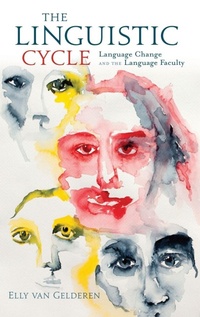
The Linguistic Cycle
Language Change and the Language Faculty
Published on 26. May 2011
Book
Hardback
464 pages
978-0-19-975605-6 (ISBN)
Description
Elly van Gelderen provides examples of linguistic cycles from a number of languages and language families, along with an account of the linguistic cycle in terms of minimalist economy principles. A cycle involves grammaticalization from lexical to functional category followed by renewal. Some well-known cycles involve negatives, where full negative phrases are reanalyzed as words and affixes and are then renewed by full phrases again. Verbal agreement is another example: full pronouns are reanalyzed as agreement markers and are renewed again. Each chapter provides data on a separate cycle from a myriad of languages. Van Gelderen argues that the cross-linguistic similarities can be seen as Economy Principles present in the initial cognitive system or Universal Grammar. She further claims that some of the cycles can be used to classify a language as analytic or synthetic, and she provides insight into the shape of the earliest human language and how it evolved.
More details
Language
English
Place of publication
New York
United States
Target group
College/higher education
Professional and scholarly
Illustrations
36 illustrations
Dimensions
Height: 240 mm
Width: 161 mm
Thickness: 29 mm
Weight
851 gr
ISBN-13
978-0-19-975605-6 (9780199756056)
Copyright in bibliographic data and cover images is held by Nielsen Book Services Limited or by the publishers or by their respective licensors: all rights reserved.
Schweitzer Classification
Other editions
Additional editions
Book
05/2011
Oxford University Press Inc
€88.60
Shipment within 15-20 days
E-Book
04/2011
OUP eBook
€41.49
Available for download
Person
Elly van Gelderen is Regents' Professor in the Department of English at Arizona State University.
Content
PART I; PART II; PART III; PART IV; REFERENCES