

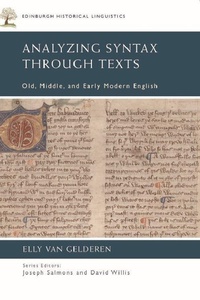
Analyzing Syntax through Texts
Old, Middle, and Early Modern English
Published on 18. December 2017
Book
Hardback
224 pages
978-1-4744-2037-2 (ISBN)
Description
This textbook invites the student to explore early English syntax by looking at the linguistic characteristics of well- known texts throughout the early history of English. It shows how that piece of the language fits in to the broader picture of how English is developing and introduces the student to the real writing of the period as you look at the original manuscript version of selected excerpts.
For each text, issues such as the word order, the presence of auxiliaries, articles, and pronouns, the types of pronouns, and the nature of complex sentences are explored. It is designed for those who have already been introduced to the history of English and who are now going on to look more closely at the syntax and morphology using actual manuscripts. With an emphasis on the original manuscript, this book equips you with the tools to analyse linguistic characteristics of a variety of texts and periods in the early history of English.
For each text, issues such as the word order, the presence of auxiliaries, articles, and pronouns, the types of pronouns, and the nature of complex sentences are explored. It is designed for those who have already been introduced to the history of English and who are now going on to look more closely at the syntax and morphology using actual manuscripts. With an emphasis on the original manuscript, this book equips you with the tools to analyse linguistic characteristics of a variety of texts and periods in the early history of English.
Reviews / Votes
Analyzing Syntax through Texts is a very good book, one that the diachronic-syntactic community has probably been waiting for, and it deserves a place among the ranks of our course books ... Each chapter offers further reading and exercises; the latter are cleverly devised and can effectually be used in class or as homework ... The book concludes with three appendixes [and] van Gelderen also includes a glossary that gives comprehensible definitions of the grammatical terms used. The bibliography is short and therefore reader-friendly, particularly for students, and the index stood up well to random critical cross-checking. All in all, this is a really recommendable book that can well be used for undergraduate courses. -- Renate Bauer, Ludwig-Maximilians-Universitaet Muenchen * Anglia *More details
Series
Language
English
Place of publication
Edinburgh
United Kingdom
Target group
College/higher education
Product notice
sewn/stitched
Cloth over boards
Illustrations
81 colour illustrations
Dimensions
Height: 236 mm
Width: 157 mm
Thickness: 18 mm
Weight
544 gr
ISBN-13
978-1-4744-2037-2 (9781474420372)
Copyright in bibliographic data and cover images is held by Nielsen Book Services Limited or by the publishers or by their respective licensors: all rights reserved.
Schweitzer Classification
Other editions
Additional editions
E-Book
11/2017
1st Edition
Edinburgh University Press
€31.49
Available for download
E-Book
11/2017
1st Edition
Edinburgh University Press
€0.00
Available for download
Person
Elly van Gelderen is Regents' Professor of English at Arizona State University.
Content
List of Abbreviations
Chapter 1 Introduction
1 The history of English in a nutshell
2 Functions and case
3 Verbal inflection and clause structure
4 Language change
5 Sources and resources
6 Conclusion
Chapter 2 The Syntax of Old, Middle, and Early Modern English
1 Major Changes in the Syntax of English
2 Word Order
3 Inflections
4 Demonstratives, pronouns, and articles
5 Clause boundaries
6 Dialects in English
7 Conclusion
Chapter 3 Old English Before 1100
1 The script
2 Historical prose narrative: Orosius
3 Sermon: Wulfstan on the Antichrist
4 Biblical gloss and translation: Lindisfarne, Rushworth, and Corpus Versions
5 Poetic monologue: the Wife's Lament and the Wanderer
6 Conclusion
Chapter 4 Early Middle English 1100-1300
1 Historical prose narrative: Peterborough Chronicle
2 Prose Legend: Seinte Katerine
3 Debate poetry: The Owl and the Nightingale
4 Historical didactic poetry: Physiologus (Bestiary)
5 Prose: Richard Rolle's Psalter Preface
6 Conclusion
Chapter 5 Late Middle English and Early Modern 1300-1600
1 Didactic poem: Cleanness
2 Instructional scientific prose: Chaucer's Astrolabe
3 Religious: Margery of Kempe
4 Romance: Caxton
5 Chronicle and letters: Henry Machyn and Queen Elizabeth
6 Conclusion
Chapter 6 Conclusion
Appendix I Summary of all grammatical information
Appendix II Background on texts
Appendix III Keys to the exercises
Bibliography
Glossary
Index
Chapter 1 Introduction
1 The history of English in a nutshell
2 Functions and case
3 Verbal inflection and clause structure
4 Language change
5 Sources and resources
6 Conclusion
Chapter 2 The Syntax of Old, Middle, and Early Modern English
1 Major Changes in the Syntax of English
2 Word Order
3 Inflections
4 Demonstratives, pronouns, and articles
5 Clause boundaries
6 Dialects in English
7 Conclusion
Chapter 3 Old English Before 1100
1 The script
2 Historical prose narrative: Orosius
3 Sermon: Wulfstan on the Antichrist
4 Biblical gloss and translation: Lindisfarne, Rushworth, and Corpus Versions
5 Poetic monologue: the Wife's Lament and the Wanderer
6 Conclusion
Chapter 4 Early Middle English 1100-1300
1 Historical prose narrative: Peterborough Chronicle
2 Prose Legend: Seinte Katerine
3 Debate poetry: The Owl and the Nightingale
4 Historical didactic poetry: Physiologus (Bestiary)
5 Prose: Richard Rolle's Psalter Preface
6 Conclusion
Chapter 5 Late Middle English and Early Modern 1300-1600
1 Didactic poem: Cleanness
2 Instructional scientific prose: Chaucer's Astrolabe
3 Religious: Margery of Kempe
4 Romance: Caxton
5 Chronicle and letters: Henry Machyn and Queen Elizabeth
6 Conclusion
Chapter 6 Conclusion
Appendix I Summary of all grammatical information
Appendix II Background on texts
Appendix III Keys to the exercises
Bibliography
Glossary
Index