

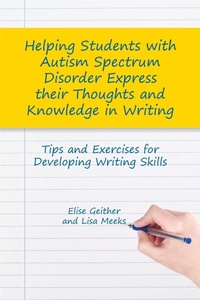
Helping Students with Autism Spectrum Disorder Express their Thoughts and Knowledge in Writing
Tips and Exercises for Developing Writing Skills
Published on 21. August 2014
Book
Paperback/Softback
136 pages
978-1-84905-996-1 (ISBN)
Description
When it comes to academic work, students with Autism Spectrum Disorder (ASD) often have the required knowledge but struggle to get their thoughts down in writing. This is a practical guide to teaching and improving writing skills in students with ASD to meet academic writing standards and prepare for the increased expectations of higher education.
The book covers key considerations for all educators teaching writing skills to high school and college students with ASD including how to address difficulties with comprehension, executive functioning, and motor skills, how to structure ideas into a coherent argument, and how to develop creativity and expression in writing, as well as how to successfully adapt these skills to meet university expectations. Each chapter includes teaching tips, insightful student perspectives, and ready-to-use writing exercises.
The book covers key considerations for all educators teaching writing skills to high school and college students with ASD including how to address difficulties with comprehension, executive functioning, and motor skills, how to structure ideas into a coherent argument, and how to develop creativity and expression in writing, as well as how to successfully adapt these skills to meet university expectations. Each chapter includes teaching tips, insightful student perspectives, and ready-to-use writing exercises.
Reviews / Votes
Finally! A helpful resource on writing for students on the autism spectrum. Elise Geither and Lisa Meeks give us useful tools and tips to assist students in developing this much needed skill. Tutors, professors and academic support professionals as well as teachers will benefit from the experience of these authors and their intensive work in writing. This is the book parents will want to have on hand to share with teachers and tutors who support their students on the Autism Spectrum. -- Jane Thierfeld Brown, Ed.D., Co-Director of College Autism Spectrum and Assistant Clinical Professor, Yale University, Child Study CenterMore details
Language
English
Place of publication
London
United Kingdom
Target group
Professional and scholarly
Product notice
Paperback (UK-trade)
Illustrations
7 black and white diagrams
Dimensions
Height: 233 mm
Width: 156 mm
Thickness: 10 mm
Weight
233 gr
ISBN-13
978-1-84905-996-1 (9781849059961)
Copyright in bibliographic data and cover images is held by Nielsen Book Services Limited or by the publishers or by their respective licensors: all rights reserved.
Schweitzer Classification
Other editions
Additional editions
Dr Elise Geither | Lisa M. Meeks
Helping Students with Autism Spectrum Disorder Express their Thoughts and Knowledge in Writing
Tips and Exercises for Developing Writing Skills
E-Book
08/2014
Jessica Kingsley Publishers
€25.99
Available for download
Persons
Elise Geither, PhD, is Associate Director of Spoken English Programs at Case Western Reserve University, Ohio. She has over 20 years of experience teaching, tutoring, and advising students at the university level and previously worked as an English teacher in secondary level education. She specializes in working with students with Autism Spectrum Disorder who are transitioning from high school to university. She lives in North Ridgeville, OH. Lisa Meeks, PhD, is Director of Student Disability Services at the University of California, San Francisco. She has done extensive work in the area of transitions for students with Autism Spectrum Disorder developing specialized supports at three universities and she frequently consults with corporate and academic institutions regarding effective supports for students on the spectrum. She lives in San Francisco, CA.
Content
Preface. 1. Writing and the Student with an Autism Spectrum Disorder. 2. Processing Information and Comprehension. 3. Executive Functioning. 4. The Writing Process: Tips for Working with Students. 5. The Product. 6. Creativity and Expression in Writing. 7. The Role of the Parent in the Writing Process. 8. Assistive Technology. 9. Preparing for University Life. 10. Extended Writing Projects: Dissertations and Thesis. 11. Conclusions. Appendix A: Charts of Tips, Consolidated from the Text. Appendix B: Summary of ASD Issues with Academic Writing and How Tutors Can Help. References. List of Texts Commonly Used in Composition Courses.