

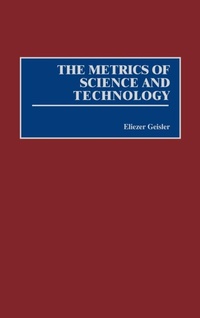
The Metrics of Science and Technology
Published on 30. August 2000
Book
Hardback
400 pages
978-1-56720-213-7 (ISBN)
Description
Dr. Geisler's far-reaching, unique book provides an encyclopedic compilation of the key metrics to measure and evaluate the impact of science and technology on academia, industry, and government. Focusing on such items as economic measures, patents, peer review, and other criteria, and supported by an extensive review of the literature, Dr. Geisler gives a thorough analysis of the strengths and weaknesses inherent in metric design, and in the use of the specific metrics he cites. His book has already received prepublication attention, and will prove especially valuable for academics in technology management, engineering, and science policy; industrial R&D executives and policymakers; government science and technology policymakers; and scientists and managers in government research and technology institutions.
Geisler maintains that the application of metrics to evaluate science and technology at all levels illustrates the variety of tools we currently possess. Each metric has its own unique strengths and weaknesses, but overall, metrics offer the best possible way to evaluate science and technology. He then finds that in general, science and technology have a positive effect on the human experience. Truly state of the art in the study of the metrics of science and technology, their outcomes and contributions to society and the economy, the book provides unique analyses of the academic world and its most useful metrics: the industrial science/technology research and development complex, and the government network of laboratories. For each, Geisler gives a comprehensive analysis of the main metrics and their best applications. His book is thus also usable in certain advanced undergraduate and graduate courses and seminars that treat technology and engineering management, project management in technology industries, and the evaluation of social and economic programs.
Geisler maintains that the application of metrics to evaluate science and technology at all levels illustrates the variety of tools we currently possess. Each metric has its own unique strengths and weaknesses, but overall, metrics offer the best possible way to evaluate science and technology. He then finds that in general, science and technology have a positive effect on the human experience. Truly state of the art in the study of the metrics of science and technology, their outcomes and contributions to society and the economy, the book provides unique analyses of the academic world and its most useful metrics: the industrial science/technology research and development complex, and the government network of laboratories. For each, Geisler gives a comprehensive analysis of the main metrics and their best applications. His book is thus also usable in certain advanced undergraduate and graduate courses and seminars that treat technology and engineering management, project management in technology industries, and the evaluation of social and economic programs.
More details
Language
English
Place of publication
United States
Publishing group
Bloomsbury Publishing Plc
Target group
College/higher education
Professional and scholarly
Interest Age: From 7 to 17 years
Dimensions
Height: 235 mm
Width: 157 mm
Thickness: 28 mm
Weight
795 gr
ISBN-13
978-1-56720-213-7 (9781567202137)
Copyright in bibliographic data and cover images is held by Nielsen Book Services Limited or by the publishers or by their respective licensors: all rights reserved.
Schweitzer Classification
Other editions
Additional editions
Eliezer Geisler
The Metrics of Science and Technology
E-Book
08/2000
1st Edition
Praeger Publishers Inc
€82.49
Available for download
Person
ELIEZER GEISLER is Professor of Organizational Behavior at the Stuart Graduate School of Business, Illinois Institute of Technology. Dr. Geisler is author of more than 70 scientific articles in technology management and related topics, and of four books, including two from Quorum: Managing the Aftermath of Radical Corporate Change (1997), and Methodology, Theory, and Knowledge in the Managerial and Organizational Sciences (1999).
Content
Preface
Historical Overview
A Short History
The Emergence of Institutions
Metrics: Approaches, Methods, Techniques
Measurement: Concepts and Issues
Selecting a Metric
Inputs to Science and Technology
Outputs from Science and Technology: Categories and Metrics
Economic and Financial Metrics
Bibliometric Measures: Publications and Citations
Co-Word Analysis and Mapping of Science and Technology
The Metric of Patents
The Metric of Peer Review
The Metric of Process Outcomes
Performance of Science and Technology
Applications: The Value--In Practice--of Science and Technology
Metrics and Evaluation of Academic Science and Technology
Metrics and Evaluation of Industrial Science and Technology
Science, Technology, and Strategy
Metrics and Evaluation of Public-Sector Science and Technology
Methods and Evaluation of National Innovation Systems
Values, Ethics, and Implications
Selected Bibliography
Index
Historical Overview
A Short History
The Emergence of Institutions
Metrics: Approaches, Methods, Techniques
Measurement: Concepts and Issues
Selecting a Metric
Inputs to Science and Technology
Outputs from Science and Technology: Categories and Metrics
Economic and Financial Metrics
Bibliometric Measures: Publications and Citations
Co-Word Analysis and Mapping of Science and Technology
The Metric of Patents
The Metric of Peer Review
The Metric of Process Outcomes
Performance of Science and Technology
Applications: The Value--In Practice--of Science and Technology
Metrics and Evaluation of Academic Science and Technology
Metrics and Evaluation of Industrial Science and Technology
Science, Technology, and Strategy
Metrics and Evaluation of Public-Sector Science and Technology
Methods and Evaluation of National Innovation Systems
Values, Ethics, and Implications
Selected Bibliography
Index