

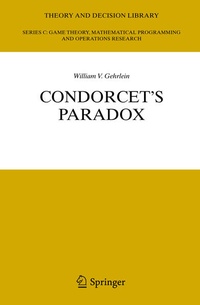
Condorcet's Paradox
Published on 18. July 2006
Book
Hardback
XI, 292 pages
978-3-540-33798-0 (ISBN)
Description
Condorcet's Paradox has been formally studied by an amazing number of people in many different contexts for more than two centuries. Peter Fishburn introduced the basic notion of the Paradox to me in 1971 during a course in Social Choice Theory at Pennsylvania State University. My immediate response to seeing the simple example that he presented was that this phenomenon certainly could not be very likely to ever be observed in reality. Peter quickly suggested that I should work on developing some representations for the probability that the Paradox might occur, and very soon thereafter that pursuit began. It is only after 35 years of effort, with a lot of help from Peter, that I now feel that a good answer can be given to the challenge that was presented in that classroom in 1971. Many people have suggested to me over the years that a book like this should be completed, since the source material is spread over such a wide variety of disciplines of a- demic journals and books that it is very difficult for people to know what has been done, and has not been done, in this area of determining representations for the probability that Condorcet's Paradox would ever be observed in reality.
More details
Series
Edition
2006 ed.
Language
English
Place of publication
Berlin
Germany
Publishing group
Springer Berlin
Target group
Professional and scholarly
Research
Illustrations
XI, 292 p.
Dimensions
Height: 23.5 cm
Width: 15.5 cm
Weight
1340 gr
ISBN-13
978-3-540-33798-0 (9783540337980)
DOI
10.1007/3-540-33799-7
Schweitzer Classification
Other editions
Additional editions
William V. Gehrlein
Condorcet's Paradox
E-Book
08/2006
1st Edition
Springer
€96.29
Available for download
Content
Elections and Voting Paradoxes.- Condorcet's Paradox.- The Cases of Two and Three Candidates.- The Case of More than Three Candidates.- The Impact of Societal Factors.- The Impact of Coherent Preferences.- Individual Intransitivity.