

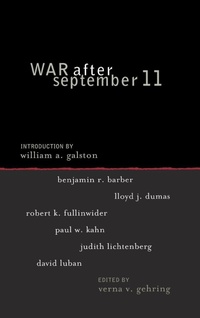
War after September 11
Published on 10. December 2002
Book
Hardback
112 pages
978-0-7425-1467-6 (ISBN)
Description
What are the limits of justified retaliation against aggression? What actions are morally permissible in preventing future aggression? Against whom may retaliation be aimed? These questions have long been part of the debate over the ethics of warfare. They all took on new meaning after terrorists hijacked four U.S. airliners on September 11, 2001.
War after September 11 considers the just aims and legitimate limits of the United States' response to the terrorist attacks. Six essayists from the Institute for Philosophy and Public Policy at the University of Maryland pair off to discuss ethical questions such as, What are the moral challenges posed by terrorism? Can modern terrorism be addressed within the existing paradigms of just war and international law? Should the U.S. respond militarily or by some other means? Taken together, the essays in this volume ask the fundamental question: How should the United States use its power to combat terrorism?
War after September 11 considers the just aims and legitimate limits of the United States' response to the terrorist attacks. Six essayists from the Institute for Philosophy and Public Policy at the University of Maryland pair off to discuss ethical questions such as, What are the moral challenges posed by terrorism? Can modern terrorism be addressed within the existing paradigms of just war and international law? Should the U.S. respond militarily or by some other means? Taken together, the essays in this volume ask the fundamental question: How should the United States use its power to combat terrorism?
Reviews / Votes
The essays in War After September 11 make clear that anyone who is smugly confident about the rightness of U.S. responses to terrorism simply hasn't understood the difficulty of the issues involved. Those who boast about moral clarity have not looked at these complex moral issues with the care of the authors here. -- Stephen Nathanson, professor of philosophy, Northeastern University * Northeastern University *More details
Series
Language
English
Place of publication
United States
Publishing group
Bloomsbury Publishing Plc
Target group
College/higher education
Professional and scholarly
Dimensions
Height: 235 mm
Width: 157 mm
Thickness: 11 mm
Weight
319 gr
ISBN-13
978-0-7425-1467-6 (9780742514676)
Copyright in bibliographic data and cover images is held by Nielsen Book Services Limited or by the publishers or by their respective licensors: all rights reserved.
Schweitzer Classification
Other editions
Additional editions
Verna V. Gehring
War after September 11
E-Book
12/2002
1st Edition
Rowman & Littlefield Publishers
€26.99
Available for download
Persons
Verna Gehring is editor at the Institute for Philosophy and Public Policy at the School of Public Affairs, University of Maryland. She is a philosopher broadly interested in the obligations of state and citizen, and the various accounts of civil society. She serves as editor of Philosophy & Public Policy Quarterly, reviewer of ethics manuscripts for Oxford University Press, and moderator for the Aspen Institute.
Content
Chapter 1 Introduction
Part 2 I: Traditional Paradigms and their Limits
Chapter 3 The Ethics of Retaliation
Chapter 4 Terrorism, Innocence, and War
Part 5 II: The Moral Hazards of Military Response
Chapter 6 The Paradox of Riskless Warfare
Chapter 7 The War on Terrorism and the End of Human Rights
Part 8 III. Looking Ahead: The Possibility of a Comprehensive Approach
Chapter 9 Is Development an Effective Way to Fight Terrorism?
Chapter 10 The War of All against All: Terror and the Politics of Fear
Part 2 I: Traditional Paradigms and their Limits
Chapter 3 The Ethics of Retaliation
Chapter 4 Terrorism, Innocence, and War
Part 5 II: The Moral Hazards of Military Response
Chapter 6 The Paradox of Riskless Warfare
Chapter 7 The War on Terrorism and the End of Human Rights
Part 8 III. Looking Ahead: The Possibility of a Comprehensive Approach
Chapter 9 Is Development an Effective Way to Fight Terrorism?
Chapter 10 The War of All against All: Terror and the Politics of Fear