

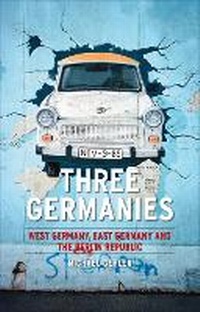
Three Germanies
West Germany, East Germany and the Berlin Republic
Published on 1. October 2010
Book
Paperback/Softback
336 pages
978-1-86189-778-7 (ISBN)
Description
Following the defeat of the Third Reich in 1945, Germany has experienced recurring turmoil and reinvention. In this book Michael Gehler explores the political path Germany has taken since the Yalta Conference, which split post-war Germany into four zones, one each controlled by the Soviets, Americans, French and British. What followed was a tug of war between Eastern and Western powers concerning their influence on the development of the future Germany. In 1949 Germany was officially split into the Federal Republic of Germany and the German Democratic Republic. They became two separate states with opposed political systems, different economies and societies, splitting not only families but also the entire German people ideologically and - with the construction of the Berlin Wall in 1961 - physically too.
Both states contributed to the division of Central Europe and bloc building in East and West. Change began through rapprochement in the years of detente and normalization in the 1970s. But when the Wall came down in 1989 and Germany was reunified, its problems were far from over: even today, the effects of the division are still evident and the different governments have struggled to implement reforms.
Gehler's ambitious study of Germany since 1945 is particularly valuable for his assessment of our own times, as he shows how the three Germanies (Bonn, Pankow and today's 'Berlin Republic') sought to establish governments that could create stable states. This book is written from an independent perspective, observing the different Germanies against the background of the Cold War, European integration and international relations. It will appeal to anyone interested in post-war policy, diplomacy and statecraft, modern history, and the future of Germany.
Both states contributed to the division of Central Europe and bloc building in East and West. Change began through rapprochement in the years of detente and normalization in the 1970s. But when the Wall came down in 1989 and Germany was reunified, its problems were far from over: even today, the effects of the division are still evident and the different governments have struggled to implement reforms.
Gehler's ambitious study of Germany since 1945 is particularly valuable for his assessment of our own times, as he shows how the three Germanies (Bonn, Pankow and today's 'Berlin Republic') sought to establish governments that could create stable states. This book is written from an independent perspective, observing the different Germanies against the background of the Cold War, European integration and international relations. It will appeal to anyone interested in post-war policy, diplomacy and statecraft, modern history, and the future of Germany.
Reviews / Votes
The strength of Michael Gehlers Three Germanies is that it tells the stories of East and West Germany in parallel . . . His description of how the two republics contributed to the division of Germany during the fluid early phase of the cold war that ended with the erection of the Berlin Wall in 1961 is especially perceptive. * <i>New Statesman</i> * The amount of political and economic information provided is prodigious . . . The studys extensive data will serve as a valuable reference source . . . Gehler makes many valuable observations, and his summary chapter is an excellent overview of his detailed presentation . . . this volume should not be overlooked. Recommended. * <i>Choice</i> * This is a really superb overview of post-war German politics and political culture . . . Gehler has brought together an impressive array of live historical debates about both the German Democratic Republic and the Federal Republic of Germany, as well as their successor state. Whilst historians with a current expertise are still likely to find stimulation, the book is invaluable to students as an introduction to German politics after 1945 . . . Three Germanies provides what might be described as a straight political history, but comes into its own when placing political change within its social and cultural context. * <i>European Review of History</i> *More details
Series
Language
English
Place of publication
London
United Kingdom
Illustrations
25 illustrations
Dimensions
Height: 138 mm
Width: 216 mm
ISBN-13
978-1-86189-778-7 (9781861897787)
Copyright in bibliographic data and cover images is held by Nielsen Book Services Limited or by the publishers or by their respective licensors: all rights reserved.
Schweitzer Classification
Other editions
Additional editions
E-Book
06/2013
1st Edition
Reaktion Books
€30.49
Available for download
Person
Michael Gehler is Director of the Institute of History at the University of Hildesheim and Jean Monnet Chair of Comparative European Contemporary History and Europe's integration.