

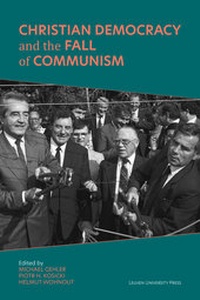
Christian Democracy and the Fall of Communism
Will be published approx. on 20. November 2019
Book
Hardback
352 pages
978-94-6270-216-5 (ISBN)
Description
The role of Christian Democracy in the collapse of the Communist Bloc
Debates on the role of Christian Democracy in Central and Eastern Europe too often remain strongly tied to national historiographies. With the edited collection the contributing authors aim to reconstruct Christian Democracy's role in the fall of Communism from a bird's-eye perspective by covering the entire region and by taking "third-way" options in the broader political imaginary of late-Cold War Europe into account. The book's twelve chapters present the most recent insights on this topic and connect scholarship on the Iron Curtain's collapse with scholarship on political Catholicism.
Christian Democracy and the Fall of Communism offers the reader a two-fold perspective. The first approach examines the efforts undertaken by Western European actors who wanted to foster or support Christian Democratic initiatives in Central and Eastern Europe. The second approach is devoted to the (re-)emergence of homegrown Christian Democratic formations in the 1980s and 1990s. One of the volume's seminal contributions lies in its documentation of the decisive role that Christian Democracy played in supporting the political and anti-political forces that engineered the collapse of Communism from within between 1989 and 1991.
Contributors: Andrea Brait (University of Innsbruck), Alexander Brakel (Konrad Adenauer Foundation, Israel), Ladislav Cabada (Metropolitan University Prague), Giovanni Mario Ceci (Universita degli Studi Roma Tre / IES-Rome), Kim Christiaens (KU Leuven), Michael Gehler (University of Hildesheim), Thomas Gronier (UMR SIRICE), Piotr H. Kosicki (University of Maryland), Slawomir Lukasiewicz (John Paul II Catholic University of Lublin), Anton Pelinka (Central European University in Budapest), Johannes Schoenner (Karl von Vogelsang Institute), Arturas Svarauskas (Lithuanian University of Educational Science), Helmut Wohnout (Austrian Federal Chancellery / Karl von Vogelsang Institute)
This publication is GPRC-labeled (Guaranteed Peer-Reviewed Content).
Debates on the role of Christian Democracy in Central and Eastern Europe too often remain strongly tied to national historiographies. With the edited collection the contributing authors aim to reconstruct Christian Democracy's role in the fall of Communism from a bird's-eye perspective by covering the entire region and by taking "third-way" options in the broader political imaginary of late-Cold War Europe into account. The book's twelve chapters present the most recent insights on this topic and connect scholarship on the Iron Curtain's collapse with scholarship on political Catholicism.
Christian Democracy and the Fall of Communism offers the reader a two-fold perspective. The first approach examines the efforts undertaken by Western European actors who wanted to foster or support Christian Democratic initiatives in Central and Eastern Europe. The second approach is devoted to the (re-)emergence of homegrown Christian Democratic formations in the 1980s and 1990s. One of the volume's seminal contributions lies in its documentation of the decisive role that Christian Democracy played in supporting the political and anti-political forces that engineered the collapse of Communism from within between 1989 and 1991.
Contributors: Andrea Brait (University of Innsbruck), Alexander Brakel (Konrad Adenauer Foundation, Israel), Ladislav Cabada (Metropolitan University Prague), Giovanni Mario Ceci (Universita degli Studi Roma Tre / IES-Rome), Kim Christiaens (KU Leuven), Michael Gehler (University of Hildesheim), Thomas Gronier (UMR SIRICE), Piotr H. Kosicki (University of Maryland), Slawomir Lukasiewicz (John Paul II Catholic University of Lublin), Anton Pelinka (Central European University in Budapest), Johannes Schoenner (Karl von Vogelsang Institute), Arturas Svarauskas (Lithuanian University of Educational Science), Helmut Wohnout (Austrian Federal Chancellery / Karl von Vogelsang Institute)
This publication is GPRC-labeled (Guaranteed Peer-Reviewed Content).
Reviews / Votes
Christian Democracy and the Fall of Communism provides a thoroughly researched and original contribution to the scholarship on the West-East implications in the context of the 1989 historic milestone in general and in terms of Christian Democracy in particular. Individual contributions to this volume are solidly evidence based, in terms of both primary and secondary sources. Their specific viewpoints implicitly complete each other into a sort of a harmonized whole. The resulting picture documents convincingly the role and implication of Christian Democracy in the fall of communism and beyond as a sort of Pyrrhic victory as to its long-term impact on the fate of Christian Democracy in both parts of Europe. This volume might serve as a cogent and coherent methodological lesson on the applicability of Western European political concepts to Central and Eastern Europe.Miloslav Bednar, H-Diplo, H-Net Reviews. June, 2021URL:http://www.h-net.org/reviews/showrev.php?id=56446 La solide introduction de Michael Gehler et surtout la passionnante conclusion de Piotr H. Kosicki offrent, elles, de veritables syntheses qui donnent a penser.Yvon Tranvouez, Archives de sciences sociales des religions [En ligne], 192 | octobre-decembre 2020, URL : http://journals.openedition.org/assr/57637 Christdemokraten waren fuehrende Akteure beim politischen und wirtschaftlichen Wiederaufbau Europas nach dem Zweiten Weltkrieg, und auch vor und nach dem Zusammenbruch des Kommunismus um 1989 spielten sie eine herausragende Rolle. Im Zentrum dieses Sammelbands steht vor allem die bange Frage, warum sich trotz deren Engagements in Mittel- und Osteuropa seither keine soliden christdemokratischen Bewegungen oder Parteien herausgebildet haben? - Regula Zwahlen, Religion & Gesellschaft in Ost und West, Nr. 10/2024, page 31
More details
Series
Language
English
Place of publication
Leuven
Belgium
Target group
College/higher education
US School Grade: College Graduate Student and over
Dimensions
Height: 233 mm
Width: 156 mm
Thickness: 25 mm
Weight
745 gr
ISBN-13
978-94-6270-216-5 (9789462702165)
Copyright in bibliographic data and cover images is held by Nielsen Book Services Limited or by the publishers or by their respective licensors: all rights reserved.
Schweitzer Classification
Other editions
Additional editions
Michael Gehler | Piotr H. Kosicki | Helmut Wohnout
Christian Democracy and the Fall of Communism
E-Book
11/2019
Leuven University Press
€76.49
Available for download
Persons
Michael Gehler is Head of the Institute of History and Jean Monnet Chair for Modern and Contemporary History of Germany and Europe and European Integration at the University of Hildesheim and Professor at Andrassy University Budapest. Piotr H. Kosicki is associate professor of history at the University of Maryland. Helmut Wohnout is department head in the Austrian Federal Chancellery, and since 1993, director of the Karl von Vogelsang Institute Vienna.
Content
Foreword Renato Moro
Acknowledgments Michael Gehler, Piotr H. Kosicki and Helmut Wohnout
Introduction Michael Gehler
SECTION I: CHRISTIAN DEMOCRACY IN THE INTERNATIONAL SYSTEM: INTERNATIONAL INSTITUTIONS AND THE GROUNDWORK FOR 1989 1 The Failure of a Third Way: The World Confederation of Labor and the Globalization of Solidarnosc during the 1980s Kim Christiaens 2 The CSCE Vienna Follow-up Meeting and Alois Mock, 1986-1989 Andrea Brait and Michael Gehler 3 "Helping Hands" across the Fence: The Stance of the European Democrat Union toward Developments behind the Iron Curtain Michael Gehler and Johannes Schoenner
SECTION II: FROM WEST TO EAST: CROSS-IRON CURTAIN MOVEMENT-BUILDING EFFORTS 4 The Community of Taize and the Revolutions in Europe in 1989 Thomas Gronier 5 "To restore dignity to the people in the communist dictatorships": OEVP Contacts with the Political Opposition in Central and Eastern Europe until 1989-1990 Helmut Wohnout 6 Finding Partners in the East: Helmut Kohl and the Fledgling Center-Right in Central and Eastern Europe Alexander Brakel 7 The Italian Christian Democratic Party Confronts the Revolutions of 1989 Giovanni Mario Ceci
SECTION III: MADE BEHIND THE IRON CURTAIN: HOMEGROWN CATHOLIC POLITICS AND THE RISE AND FALL OF CHRISTIAN DEMOCRACY IN EASTERN EUROPE 8 The Christian Democrat Who Wasn't: Tadeusz Mazowiecki and the End of Catholic Politics in Poland Piotr H. Kosicki 9 Hungary: A Decisive Transition - But a Revolution? Anton Pelinka 10 Among the Hussites, Communists, and Neo-liberals: Christian Democratic Political Actors in Communist Czechoslovakia and the Democratic Transition Ladislav Cabada 11 The Restoration of Christian Democracy in Lithuania, 1989-1990: Continuities and Ruptures Arturas Svarauskas 12 Abandoned Patterns: 1989 and the Discontinuation of Cold War Cooperation among Emigre Central and Eastern European Christian Democrats Slawomir Lukasiewicz
Conclusion: Beyond 1989: The Disappointed Hopes of Christian Democracy in Post-Communist Central and Eastern Europe Piotr H. Kosicki
List of Abbreviations Bibliography List of Contributors Index of Persons Colophon
Acknowledgments Michael Gehler, Piotr H. Kosicki and Helmut Wohnout
Introduction Michael Gehler
SECTION I: CHRISTIAN DEMOCRACY IN THE INTERNATIONAL SYSTEM: INTERNATIONAL INSTITUTIONS AND THE GROUNDWORK FOR 1989 1 The Failure of a Third Way: The World Confederation of Labor and the Globalization of Solidarnosc during the 1980s Kim Christiaens 2 The CSCE Vienna Follow-up Meeting and Alois Mock, 1986-1989 Andrea Brait and Michael Gehler 3 "Helping Hands" across the Fence: The Stance of the European Democrat Union toward Developments behind the Iron Curtain Michael Gehler and Johannes Schoenner
SECTION II: FROM WEST TO EAST: CROSS-IRON CURTAIN MOVEMENT-BUILDING EFFORTS 4 The Community of Taize and the Revolutions in Europe in 1989 Thomas Gronier 5 "To restore dignity to the people in the communist dictatorships": OEVP Contacts with the Political Opposition in Central and Eastern Europe until 1989-1990 Helmut Wohnout 6 Finding Partners in the East: Helmut Kohl and the Fledgling Center-Right in Central and Eastern Europe Alexander Brakel 7 The Italian Christian Democratic Party Confronts the Revolutions of 1989 Giovanni Mario Ceci
SECTION III: MADE BEHIND THE IRON CURTAIN: HOMEGROWN CATHOLIC POLITICS AND THE RISE AND FALL OF CHRISTIAN DEMOCRACY IN EASTERN EUROPE 8 The Christian Democrat Who Wasn't: Tadeusz Mazowiecki and the End of Catholic Politics in Poland Piotr H. Kosicki 9 Hungary: A Decisive Transition - But a Revolution? Anton Pelinka 10 Among the Hussites, Communists, and Neo-liberals: Christian Democratic Political Actors in Communist Czechoslovakia and the Democratic Transition Ladislav Cabada 11 The Restoration of Christian Democracy in Lithuania, 1989-1990: Continuities and Ruptures Arturas Svarauskas 12 Abandoned Patterns: 1989 and the Discontinuation of Cold War Cooperation among Emigre Central and Eastern European Christian Democrats Slawomir Lukasiewicz
Conclusion: Beyond 1989: The Disappointed Hopes of Christian Democracy in Post-Communist Central and Eastern Europe Piotr H. Kosicki
List of Abbreviations Bibliography List of Contributors Index of Persons Colophon