

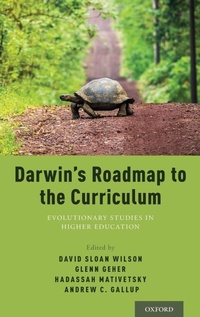
Darwin's Roadmap to the Curriculum
Evolutionary Studies in Higher Education
Published on 13. June 2019
Book
Hardback
512 pages
978-0-19-062496-5 (ISBN)
Description
There is a paradox when it comes to Darwinian ideas within the academy. On one hand, Darwin's theories have famously changed the foundational ideas related to the origins of life, shaping entire disciplines in the biological sciences. On the other hand, people in educated societies across the globe today are famously misinformed and uneducated about Darwinian principles and ideas. Applications of evolutionary theory outside the traditional areas of biology have been slow to progress, and scholars doing such work regularly run into all kinds of political backlash. However, a slow but steady push to advance the teaching of evolution across academic disciplines has been under way for more than a decade.
This book serves to integrate the vast literature in the interdisciplinary field of Evolutionary Studies (EvoS), providing clear examples of how evolutionary concepts relate to all facets of life. Further, this book provides chapters dedicated to the processes associated with an EvoS education, including examples of how an interdisciplinary approach to evolutionary theory has been implemented successfully at various colleges, universities, and degree programs. This book also offers chapters outlining a variety of applications to an evolution education, including improved sustainable development, medical practices, and creative and critical thinking skills. Exploring controversies surrounding evolution education, this volume provides a roadmap to asking and answering Darwinian questions across all areas of intellectual inquiry.
This book serves to integrate the vast literature in the interdisciplinary field of Evolutionary Studies (EvoS), providing clear examples of how evolutionary concepts relate to all facets of life. Further, this book provides chapters dedicated to the processes associated with an EvoS education, including examples of how an interdisciplinary approach to evolutionary theory has been implemented successfully at various colleges, universities, and degree programs. This book also offers chapters outlining a variety of applications to an evolution education, including improved sustainable development, medical practices, and creative and critical thinking skills. Exploring controversies surrounding evolution education, this volume provides a roadmap to asking and answering Darwinian questions across all areas of intellectual inquiry.
Reviews / Votes
Most of my knowledge on evolution is self-taught and in my own psychology education there was no discussion of evolutionary principles. Dont be like meuse this fantastic book to encourage your university to adopt a course on evolution for every student regardless of their disciplinary background! * Mark van Vugt, Professor of Evolutionary Psychology and Work and Organizational Psychology, Vrije Universiteit Amsterdam * To paraphrase Theodosius Dobzhansky, nothing in biology, psychology, development, politics, economics, human health, medicine, and education makes sense except in the light of evolution. If you dont believe this assertion now, you very well may after reading the chapters in this volume edited by David Sloan Wilson and his colleagues. Evolution is for everybody, and this book is especially important for college instructors who would like to convey the excitement and importance of evolutionary theory to their students. * David Bjorklund, Professor of Psychology, Florida Atlantic University *More details
Language
English
Place of publication
New York
United States
Target group
Professional and scholarly
College/higher education
Dimensions
Height: 240 mm
Width: 161 mm
Thickness: 32 mm
Weight
928 gr
ISBN-13
978-0-19-062496-5 (9780190624965)
Copyright in bibliographic data and cover images is held by Nielsen Book Services Limited or by the publishers or by their respective licensors: all rights reserved.
Schweitzer Classification
Other editions
Additional editions
Glenn Geher | David Sloan Wilson | Hadassah Head
Darwin's Roadmap to the Curriculum
Evolutionary Studies in Higher Education
E-Book
05/2019
1st Edition
OUP eBook
€101.99
Available for download
Glenn Geher | David Sloan Wilson | Hadassah Head
Darwin's Roadmap to the Curriculum
Evolutionary Studies in Higher Education
E-Book
05/2019
1st Edition
OUP eBook
€101.99
Available for download
Persons
David Sloan Wilson is Distinguished Professor of Biological Sciences and Anthropology at Binghamton University. He is one of the main architects of Multilevel Selection Theory, which explains how adaptations can evolve-or fail to evolve-at any level of a multi-tier hierarchy. He started the first program teaching evolution across the curriculum at Binghamton University.
Glenn Geher is Professor of Psychology and Founding Director of Evolutionary Studies at the State University of New York at New Paltz. He has won numerous awards in the domains of teaching and research, including the SUNY Chancellor's Award for Excellence in both Teaching and Scholarship. An advocate of evolution education, Geher has published extensively on various topics related to evolution and human behavior.
Hadassah Mativetsky is a software quality engineer. Prior to working as an engineer, Hadassah was the Evolutionary Studies Coordinator at Binghamton University under the direction of David Sloan Wilson.
She has an MS in Systems Science with a focus on evolutionary approaches. She tweets about STEM at @Haddie.
Andrew C. Gallup is Assistant Professor of Evolutionary Cognitive Neuroscience and Director of the Adaptive Behavior and Cognition Lab at SUNY Polytechnic Institute. He has published over 75 journal articles and book chapters, and currently serves as an Associate Editor for Evolutionary Behavioral Sciences, Frontiers in Evolutionary Psychology, Frontiers in Social and Evolutionary Neuroscience, and PLOS ONE.
Glenn Geher is Professor of Psychology and Founding Director of Evolutionary Studies at the State University of New York at New Paltz. He has won numerous awards in the domains of teaching and research, including the SUNY Chancellor's Award for Excellence in both Teaching and Scholarship. An advocate of evolution education, Geher has published extensively on various topics related to evolution and human behavior.
Hadassah Mativetsky is a software quality engineer. Prior to working as an engineer, Hadassah was the Evolutionary Studies Coordinator at Binghamton University under the direction of David Sloan Wilson.
She has an MS in Systems Science with a focus on evolutionary approaches. She tweets about STEM at @Haddie.
Andrew C. Gallup is Assistant Professor of Evolutionary Cognitive Neuroscience and Director of the Adaptive Behavior and Cognition Lab at SUNY Polytechnic Institute. He has published over 75 journal articles and book chapters, and currently serves as an Associate Editor for Evolutionary Behavioral Sciences, Frontiers in Evolutionary Psychology, Frontiers in Social and Evolutionary Neuroscience, and PLOS ONE.
Editor
Director of Evolutionary Studies, Chair and Professor of PsychologyDirector of Evolutionary Studies, Chair and Professor of Psychology, State University of New York at New Paltz
SUNY Distinguished Professor, Departments of Biology and AnthropologySUNY Distinguished Professor, Departments of Biology and Anthropology, Binghamton University
Software Quality EngineerSoftware Quality Engineer, Universal Instruments
Assistant Professor of Evolutionary Cognitive NeuroscienceAssistant Professor of Evolutionary Cognitive Neuroscience, SUNY Polytechnic Institute
Content
- Foreword
- Contributor List
- SECTION 1 EVOLUTIONARY STUDIES IN HIGHER EDUCATION
- Chapter 1 Darwin-Inspired Curricula: The EvoS Revolution in Higher Education
- Glenn Geher, David Sloan Wilson, Andrew Gallup, Hadassah Mativetsky, and Richard H. Holler
- Chapter 2 Evolutionary Studies in Higher Education: Interdisciplinarity and Student Success
- Glenn Geher, Jennifer Waldo, David Sloan Wilson, and Hadassah Mativetsky
- Chapter 3 Building and Evolutionary Studies Program at a Small Liberal Arts College
- Susan M. Hughes
- Chapter 4 The Evolutionary Studies Program: Perspectives from Flies on the Wall
- Nicole Wedberg, Kian Betancourt, Richard H. Holler, and Vania Rolón
- SECTION 2 EVOLUTIONARY STUDIES EMBODIED WITHIN DISCIPLINES
- Chapter 5 Extraordinary Claims, Extraordinary Proof
- Thomas Nolen
- Chapter 6 Charles Darwin and Selection in Relation to Sex in the Color of Monkeys
- Sandra Winters, Megan Petersdorf, and James Higham
- Chapter 7 The New Human Science: Sound, New Evolutionary Theory Gives Us Ultimate Causal Understanding of Human Origins, Behavior, History, Politics and Economics
- Joanne Souza and Paul M. Bingham
- Chapter 8 Controversies Surrounding Evolutionary Psychology
- Glenn Geher and Vania Rolón
- Chapter 9 Evolution, Religion, and Other Meaning Systems
- David Sloan Wilson
- Chapter 10 From Physical Culture to Primal Life: Evolutionary Health Movements in Historical Context
- Hamilton M. Stapell
- Chapter 11 From Genetic Evolution to Engineering Optimization
- Yaser Khalifa
- SECTION 3 APPLIED EVOLUTIONARY STUDIES
- Chapter 12 The Role of Evolutionary Studies in Education for Sustainable Development
- Dustin Eirdosh and Susan Hanisch
- Chapter 13 Evolutionary Approaches to Health Issues and Behaviors Across the Life Course
- Daniel J. Kruger and Jessica S. Kruger
- Chapter 14 Integrating Evolutionary Thinking into Medical Education
- Barbara Natterson-Horowitz and Daniel T. Blumstein
- Chapter 15 How Evolutionary Studies Allows People to Think Outside the Box
- Gordon G. Gallup, Jr., Jennifer A. Stolz, Rebecca L. Burch, Jennifer A. Bremser
- Chapter 16 The "EvoS Effect": The Influence of Evolutionary Training on Critical Thinking Skills
- Richard A. Kauffman, Jr., Ian F. MacDonald, and David Sloan Wilson
- Chapter 17 Our Evolutionary Underpinnings: The Past, Present and Future of Evolution Education in the United States
- Amanda L. Glaze
- Chapter 18 Reconciling Evolution with a Christian Identity: A Professional Development Workshop to Reduce Anxiety and Enhance Self-Efficacy for Science Teachers
- Patricia H. Hawley, Rachael K. Phillips, and Matthew S. Olson
- Chapter 19 The Evolutionary Studies Summer Institute at New Paltz: A High-Impact, Condensed Interdisciplinary Educational Experience for Teachers
- Glenn Geher, Aileen Toback, and Nicole Wedberg
- Chapter 20 Teaching Evolution across the Curriculum: Beyond Campus-Wide Programs
- David Sloan Wilson, Glenn Geher, Andrew Gallup, and Hadassah Mativetsky