

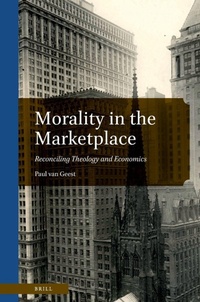
Morality in the Marketplace
Reconciling Theology and Economics
Published on 25. November 2021
Book
Paperback/Softback
180 pages
978-90-04-50174-4 (ISBN)
Description
What does Keynes have to do with Qohelet? At first sight, economy and theology seem to be disciplines with mutually exclusive objectives.
Yet, as the Covid crisis has recently shown, if economic development is to really stand a chance of success, it should go hand in hand with relational values like honesty, reliability and empathy: this will contribute to a society with a culture of reciprocity, respect, love and trust. In this essay, Paul van Geest pleads for a renewal of the old ties between economics and theology as scientific disciplines, so as to arrive at a deeper and richer anthropological fundament for economic research.
Yet, as the Covid crisis has recently shown, if economic development is to really stand a chance of success, it should go hand in hand with relational values like honesty, reliability and empathy: this will contribute to a society with a culture of reciprocity, respect, love and trust. In this essay, Paul van Geest pleads for a renewal of the old ties between economics and theology as scientific disciplines, so as to arrive at a deeper and richer anthropological fundament for economic research.
More details
Language
English
Place of publication
Leiden
Netherlands
Target group
Professional and scholarly
Product notice
Paperback (trade)
Unsewn / adhesive bound
Dimensions
Height: 234 mm
Width: 155 mm
Thickness: 10 mm
Weight
249 gr
ISBN-13
978-90-04-50174-4 (9789004501744)
Copyright in bibliographic data and cover images is held by Nielsen Book Services Limited or by the publishers or by their respective licensors: all rights reserved.
Schweitzer Classification
Person
Paul van Geest, Ph.D, is Professor of Economics and Theology at Erasmus University Rotterdam, Professor of Church History and History of Theology at Tilburg University and Visiting Professor at the Faculty of Theology and Religious Studies at KU Leuven
Content
1 Introduction
2 The Relationship between Economics and Theology as Scientific Disciplines through the Ages
?1 How God Appeared in the Economy (and Economics) of Antiquity, Judaism and Early Christianity
??1.1 Excursus: An Attempt at Economic Exegesis
?2 Market and Morality in the Works of Church Fathers
?3 Economics as a Component of Theology in Scholasticism
?4 Market, Morality and Anthropology during the Reformation and Counter Reformation
?5 How God Disappeared from the Economy
3 Theology as a Coldshouldered Participant in Economic Discussion
?1 Preamble: Religion and Economy or Theology and Economy?
?2 The Course of History as a Prelude to the Disqualification of Theology
?3 The Irrelevance of Theological Sources
?4 The Epistemological Assumptions of Economic and Theological Research
?5 Developments in Theology
4 Towards a Mutual Rapprochement between Economics and Theology: A First Sketch
?1 Introduction: Theological Economics or Economic Theology?
?2 Criticism of the homo economicus, a Prelude to Interdisciplinarity
?3 The Drive for Insight into Motives as a Second Prelude
?4 The Complementarity of the Economic and Theological Views on Nature and Exhaustibility
5 The Indispensability of Theology for Enriching Economic Concepts
?1 Introduction
?2 The Economy and Community Building. Luigino Bruni on Gratuity and Augustine's Doctrine of Grace
?3 The Economy, Probabilities and Uncertainty. Bart Nooteboom on Trust and the Theological Notion of pistis
?4 The homo economicus as a Threat to Social Cohesion. Samuel Bowles on 'Outcrowding' of Morally Responsible Behavior and Augustine on timor servilis and amor castus
?5 Taking Stock
6 Economic Notions Seen in the Light of the History of Theology
?1 Introduction
?2 Negative and Affective Theology as a Prelude to a Deeper Insight into Bounded Rationality
?3 Theological Anthropology as a Source of Insight into Bounded Morality
?4 Bounded Willpower Explained in the Light of the Theology of Grace
?5 Bonus: The Relationship between Happiness as an Economic Variable and Temperance as a 'Theological' Virtue
Epilogue
?1 Market, Model, Morality and Anthropology
?2 Language and Reflection on Economic Processes
?3 Conclusion: Keynes's Take on the Economist and the Theologian
Bibliography
?Primary Sources
?Secondary Sources
Index
2 The Relationship between Economics and Theology as Scientific Disciplines through the Ages
?1 How God Appeared in the Economy (and Economics) of Antiquity, Judaism and Early Christianity
??1.1 Excursus: An Attempt at Economic Exegesis
?2 Market and Morality in the Works of Church Fathers
?3 Economics as a Component of Theology in Scholasticism
?4 Market, Morality and Anthropology during the Reformation and Counter Reformation
?5 How God Disappeared from the Economy
3 Theology as a Coldshouldered Participant in Economic Discussion
?1 Preamble: Religion and Economy or Theology and Economy?
?2 The Course of History as a Prelude to the Disqualification of Theology
?3 The Irrelevance of Theological Sources
?4 The Epistemological Assumptions of Economic and Theological Research
?5 Developments in Theology
4 Towards a Mutual Rapprochement between Economics and Theology: A First Sketch
?1 Introduction: Theological Economics or Economic Theology?
?2 Criticism of the homo economicus, a Prelude to Interdisciplinarity
?3 The Drive for Insight into Motives as a Second Prelude
?4 The Complementarity of the Economic and Theological Views on Nature and Exhaustibility
5 The Indispensability of Theology for Enriching Economic Concepts
?1 Introduction
?2 The Economy and Community Building. Luigino Bruni on Gratuity and Augustine's Doctrine of Grace
?3 The Economy, Probabilities and Uncertainty. Bart Nooteboom on Trust and the Theological Notion of pistis
?4 The homo economicus as a Threat to Social Cohesion. Samuel Bowles on 'Outcrowding' of Morally Responsible Behavior and Augustine on timor servilis and amor castus
?5 Taking Stock
6 Economic Notions Seen in the Light of the History of Theology
?1 Introduction
?2 Negative and Affective Theology as a Prelude to a Deeper Insight into Bounded Rationality
?3 Theological Anthropology as a Source of Insight into Bounded Morality
?4 Bounded Willpower Explained in the Light of the Theology of Grace
?5 Bonus: The Relationship between Happiness as an Economic Variable and Temperance as a 'Theological' Virtue
Epilogue
?1 Market, Model, Morality and Anthropology
?2 Language and Reflection on Economic Processes
?3 Conclusion: Keynes's Take on the Economist and the Theologian
Bibliography
?Primary Sources
?Secondary Sources
Index