

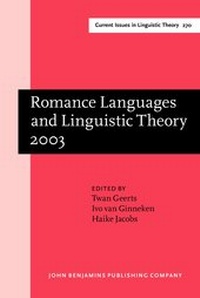
Romance Languages and Linguistic Theory 2003
Selected papers from 'Going Romance' 2003, Nijmegen, 20-22 November
Published on 8. November 2005
Book
Hardback
369 pages
978-90-272-4784-1 (ISBN)
Description
The annual Going Romance conference is the major European discussion forum for theoretically relevant research on Romance languages where current ideas about language in general and about Romance languages in particular are tested. Starting with the thirteenth conference held in 1999, volumes with selected papers of the conferences are published under the title Romance Languages and Linguistic Theory, This is the fifth such volume, containing a selection of papers that have been presented at the seventeenth Going Romance conference, held at the Radboud University Nijmegen (The Netherlands) from 20-22 November 2003. The three-day program included a workshop on 'Diachronic Phonology'. The present volume contains a broad range of articles dealing not only with syntax and phonology, but also with morphology, semantics and acquisition of the Romance languages.
More details
Series
Language
English
Place of publication
Amsterdam
Netherlands
Target group
Professional and scholarly
Dimensions
Height: 245 mm
Width: 164 mm
Weight
820 gr
ISBN-13
978-90-272-4784-1 (9789027247841)
Copyright in bibliographic data and cover images is held by Nielsen Book Services Limited or by the publishers or by their respective licensors: all rights reserved.
Schweitzer Classification
Other editions
Additional editions
Twan Geerts | Ivo van Ginneken | Haike Jacobs
Romance Languages and Linguistic Theory 2003
Selected papers from 'Going Romance' 2003, Nijmegen, 20-22 November
E-Book
11/2005
1st Edition
John Benjamins Publishing Company
€155.99
Available for download
Persons
Content
1. An Integrated Approach to Variation in OT: Evidence from Brazilian Portuguese and Picard (by Cardoso, Walcir); 2. On Facts in the Syntax and Semantics of Italian (by Delfitto, Denis); 3. On the Status of Stems in Morphological Theory (by Embick, David); 4. Italian [VN] Compound Nouns: A Case for a Syntactic Approach to Word Formation (by Ferrari-Bridgers, Franca); 5. The Development of Liquids from Latin to Campidanian Sardinian: The Role of Contrast and Structural Similarity (by Frigini, Chiara); 6. Clitic Placement and the Position of Subjects in the History of European Portuguese (by Galves, Charlotte); 7. Subject Inversion in Spanish Relatice Clauses: A case of Prosody- Induced Word order Variation without Narrow Focus (by Gutierrez-Bravo, Rodrigo); 8. Attrition and Interpretable Features (by Helland, Corine); 9. Acceleration in Bilingual First Language Acquisition (by Kupisch, Tanja); 10. 'Focus VS': A Special Type of French NP subject inversion (by Lahousse, Karen); 11. Aspectual Quantization and [+-] Accusative Case Checking in Romance (by Martin, Juan); 12. Strata, Yes; Structure Preservation, No. Evidence from Spanish (by Roca, Iggy); 13. Durational Asymmetries and the Theory of Quantity: Temporal Proportions at Phonetic Interface (by Saltarelli, Mario); 14. What Lenition and Fortition Tell us about Gallo-Romance Muta cum Liquida (by Scheer, Tobias); 15. The Lazy Frenchman's Approach to the Subjunctive: Speculations on Reference to Worlds and Semantics Defaults in the Analysis of Mood (by Schlenker, Philippe); 16. Vowel Centralization in Romanian Verbs of Slavic Origin: Deliberate Exploitation of an Indigenous Sound Change? (by Schulte, Kim); 17. On the Rumanian ktpt Shift: Coda Lenition or Melodic Contamination? (by Seigneur-Froli, Delphine); 18. Evidence for a Cue-based Theory of Language Change and Language Acquisition: The Null Object in Brazilian Portuguese (by Lopes, Ruth E.V.); 19. Subject Index; 20. Author Index