

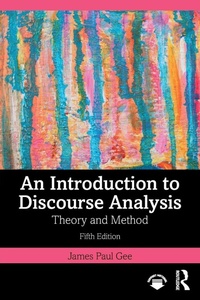
An Introduction to Discourse Analysis
Theory and Method
5th Edition
Published on 28. February 2025
Book
Paperback/Softback
280 pages
978-1-032-88038-9 (ISBN)
Description
This bestselling textbook provides a comprehensive guide to conducting discourse analysis. The book outlines Gee's approach, which involves examining how language is used in context to construct meaning, identities, relationships, and social practices.
The theoretical framework is built around seven "building tasks" that language performs: significance, practices, identities, relationships, politics, connections, and sign systems and knowledge. Gee introduces six "tools of inquiry" for analyzing these tasks: situated meanings, social languages, figured worlds, intertextuality, Discourses, and Conversations.
Methodologically, Gee emphasizes the importance of context and the reciprocal relationship between language and context. He discusses transcription, outlines the components of an "ideal" discourse analysis, and addresses issues of validity.
The book provides practical guidance on analyzing various aspects of language, such as intonation units, stanzas, and the overall organization of oral and written texts. Gee uses interview data to demonstrate how identities and socially situated meanings are constructed through language.
This new edition is updated throughout with new examples and a new chapter on multimodal discourse analysis, demonstrating how Gee's approach can be applied to texts that combine language with other modes of communication, like images or video. Overall, the book equips readers with a robust toolkit for systematically analyzing discourse.
An Introduction to Discourse Analysis can be used as a stand-alone textbook or ideally used in conjunction with the practical companion title How to do Discourse Analysis: A Toolkit. Together they provide the complete resource for students studying discourse analysis.
The theoretical framework is built around seven "building tasks" that language performs: significance, practices, identities, relationships, politics, connections, and sign systems and knowledge. Gee introduces six "tools of inquiry" for analyzing these tasks: situated meanings, social languages, figured worlds, intertextuality, Discourses, and Conversations.
Methodologically, Gee emphasizes the importance of context and the reciprocal relationship between language and context. He discusses transcription, outlines the components of an "ideal" discourse analysis, and addresses issues of validity.
The book provides practical guidance on analyzing various aspects of language, such as intonation units, stanzas, and the overall organization of oral and written texts. Gee uses interview data to demonstrate how identities and socially situated meanings are constructed through language.
This new edition is updated throughout with new examples and a new chapter on multimodal discourse analysis, demonstrating how Gee's approach can be applied to texts that combine language with other modes of communication, like images or video. Overall, the book equips readers with a robust toolkit for systematically analyzing discourse.
An Introduction to Discourse Analysis can be used as a stand-alone textbook or ideally used in conjunction with the practical companion title How to do Discourse Analysis: A Toolkit. Together they provide the complete resource for students studying discourse analysis.
Reviews / Votes
'The main strengths of How to Do Discourse Analysis and An Introduction to Discourse Analysis lie in the clear, engaging style that makes complicated concepts accessible through the use of metaphor, and the abundance of examples. I would recommend everyone who teaches discourse analysis to have these two books in their inventory, if not as main course books, then for selective use as a collection of readings and exercises.'Daria Dayter, Tampere University, Finland
"This revised edition stands out as a valuable resource that will significantly enhance the learning experience for both students and instructors in the field of discourse analysis. To me, Gee's book is the best on the market."
Teresa Bell, Brigham Young University, USA
"This is an excellent new addition to an already excellent book. The new edition contains a substantial amount of new material which makes it more relevant for students today, including the application of DA to current issues such as political polarisation, climate change and social media. The best thing about this edition is how it confronts issues around generative AI in ways that focus on the human side of human-machine communication (and AI's impact on human-human communication), resulting in insights that are not likely to quickly become obsolete as the technology develops. I am also very pleased with the new chapter on multimodality which not only makes the book more comprehensive but also provides a refreshing take on multimodal discourse analysis. "
Rodney Jones, University of Reading, UK
More details
Edition
5th edition
Language
English
Place of publication
London
United Kingdom
Publishing group
Taylor & Francis Ltd
Target group
College/higher education
Postgraduate and Undergraduate Advanced
Illustrations
3 farbige Abbildungen, 2 Farbfotos bzw. farbige Rasterbilder, 1 farbige Zeichnung, 2 farbige Tabellen
2 Tables, color; 1 Line drawings, color; 2 Halftones, color; 3 Illustrations, color
Dimensions
Height: 234 mm
Width: 156 mm
Thickness: 16 mm
Weight
445 gr
ISBN-13
978-1-032-88038-9 (9781032880389)
Copyright in bibliographic data and cover images is held by Nielsen Book Services Limited or by the publishers or by their respective licensors: all rights reserved.
Schweitzer Classification
Other editions
Additional editions
E-Book
02/2025
5th Edition
Routledge
€55.49
Available for download
E-Book
02/2025
5th Edition
Routledge
€55.49
Available for download
Book
02/2025
5th Edition
Routledge
€229.40
Shipment within 10-20 days
Previous edition
Book
01/2014
4th Edition
Routledge
€79.41
Article exhausted; check for reprint
Person
James Paul Gee is a Regents Professor, Emeritus, at Arizona State University and an elected member of the National Academy of Education. He is the author of many books and papers on linguistics, literacy, discourse analysis, and learning. His books include What Video Games Have to Teach Us about Literacy and Learning (2007), Introducing Discourse: From Grammar to Society (2017), and What Is a Human? (2020).
Content
Chapter 1: INTRODUCTION
Chapter 2: WHAT IS DISCOURSE ANALYSIS?
Chapter 3: BUILDING TASKS
Chapter 4: TOOLS OF ENQUIRY AND DISCOURSE
Chapter 5: SOCIAL LANGUAGES, CONVERSATIONS,
AND INTERTEXTUALITY
Chapter 6: CONVERSATIONS AND INTERTEXTUALITY
Chapter 7: APPLYING THE TOOLS
Chapter 8: BASIC MEANINGS, SITUATIONAL MEANINGS, AND FIGURED WORLDS
Chapter 9: FIGURED WORLDS
Chapter 10: MORE ON FIGURED WORLDS
Chapter 11: CONTEXT
Chapter 12: TRANSCRIPTION, AN "IDEAL" DISCOURSE ANALYSIS, AND VALIDITY
Chapter 13: PROCESSING AND ORGANIZING LANGUAGE
Chapter 14: MEANING AND CHOICE
Chapter 15: SAMPLE OF DISCOURSE ANALYSIS 1
Chapter 16: SAMPLE OF DISCOURSE ANALYSIS 2
Chapter 17: MULTIMODALITY
Chapter 2: WHAT IS DISCOURSE ANALYSIS?
Chapter 3: BUILDING TASKS
Chapter 4: TOOLS OF ENQUIRY AND DISCOURSE
Chapter 5: SOCIAL LANGUAGES, CONVERSATIONS,
AND INTERTEXTUALITY
Chapter 6: CONVERSATIONS AND INTERTEXTUALITY
Chapter 7: APPLYING THE TOOLS
Chapter 8: BASIC MEANINGS, SITUATIONAL MEANINGS, AND FIGURED WORLDS
Chapter 9: FIGURED WORLDS
Chapter 10: MORE ON FIGURED WORLDS
Chapter 11: CONTEXT
Chapter 12: TRANSCRIPTION, AN "IDEAL" DISCOURSE ANALYSIS, AND VALIDITY
Chapter 13: PROCESSING AND ORGANIZING LANGUAGE
Chapter 14: MEANING AND CHOICE
Chapter 15: SAMPLE OF DISCOURSE ANALYSIS 1
Chapter 16: SAMPLE OF DISCOURSE ANALYSIS 2
Chapter 17: MULTIMODALITY