

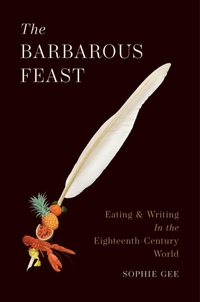
The Barbarous Feast
Eating and Writing in the Eighteenth-Century World
Will be published approx. on 28. July 2026
Book
Hardback
328 pages
978-0-691-20972-2 (ISBN)
Description
A bold new argument about how eating rituals across the eighteenth-century globe reveal an untold story about the rise of the novel
In The Barbarous Feast, Sophie Gee argues that novels and eating rituals were interconnected, but conflicting, systems used to depict selfhood and represent personal inwardness in colonial Europe, the Americas, and Australia. Gee tells a vibrant story of how people living at the margins of colonial power drew upon eating and writing to manage their own interior lives. She coins the term "metabolic subjectivity" to describe the idea of energetic, embodied selfhood that is made by eating and drinking and which connects humans to other living species. This concept, while taken from colonial eating rituals, offers new ways to understand personal inwardness in written texts. Gee tells intersecting stories of eating and writing that range from the Protestant Lord's Supper to West Indian Indigenous predation rituals.
Gee alternates chapters of literary analysis, offering new readings of Daniel Defoe, Richard Ligon, Richard Steele, Henry Fielding, and others, with personal nonfiction essays exploring the afterlife of empire and imperial inwardness in Australia. With The Barbarous Feast, she offers an expansive account of inwardness in and out of novels, and across countries, historical periods, and cultures, putting literary studies in conversation with environmental studies, religious history, Indigenous studies, and food studies.
In The Barbarous Feast, Sophie Gee argues that novels and eating rituals were interconnected, but conflicting, systems used to depict selfhood and represent personal inwardness in colonial Europe, the Americas, and Australia. Gee tells a vibrant story of how people living at the margins of colonial power drew upon eating and writing to manage their own interior lives. She coins the term "metabolic subjectivity" to describe the idea of energetic, embodied selfhood that is made by eating and drinking and which connects humans to other living species. This concept, while taken from colonial eating rituals, offers new ways to understand personal inwardness in written texts. Gee tells intersecting stories of eating and writing that range from the Protestant Lord's Supper to West Indian Indigenous predation rituals.
Gee alternates chapters of literary analysis, offering new readings of Daniel Defoe, Richard Ligon, Richard Steele, Henry Fielding, and others, with personal nonfiction essays exploring the afterlife of empire and imperial inwardness in Australia. With The Barbarous Feast, she offers an expansive account of inwardness in and out of novels, and across countries, historical periods, and cultures, putting literary studies in conversation with environmental studies, religious history, Indigenous studies, and food studies.
More details
Language
English
Place of publication
New Jersey
United States
Product notice
Trade binding
Illustrations
11 b/w illus.
Dimensions
Height: 235 mm
Width: 156 mm
ISBN-13
978-0-691-20972-2 (9780691209722)
Copyright in bibliographic data and cover images is held by Nielsen Book Services Limited or by the publishers or by their respective licensors: all rights reserved.
Schweitzer Classification
Person
Sophie Gee is associate professor of English at Princeton University and the Vice Chancellor's Fellow at the University of Sydney. She is the author of Making Waste: Leftovers and the Literary Imagination (Princeton) and The Scandal of the Season, a historical novel recreating Alexander Pope's The Rape of the Lock. She cohosts the popular literary podcast The Secret Life of Books.