

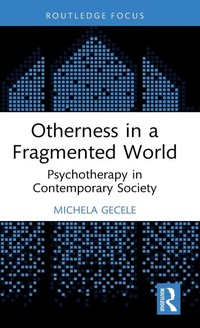
Otherness in a Fragmented World
Psychotherapy in Contemporary Society
1st Edition
Published on 31. January 2025
Book
Hardback
86 pages
978-1-032-84723-8 (ISBN)
Description
This book explores a key theme both for humanity and for psychotherapy-how we can understand ourselves as a web of relational connections within the wider world that shapes us all.
Grounds are the often invisible scenery of our life. They are all that concern us as human beings-the sum total of relationships, events, all that happens and has happened, our conquests, and our connections together with what is unfinished and what has yet to emerge. Moving within a horizon of phenomenology and Gestalt therapy, the author explores how we are continuously built and kept alive through our unceasing engagement with otherness-whether cultural, social, linguistic, gender or otherwise, and so how humanity is intrinsically made by otherness, novelty, and challenging experiences that transform us in a way we can never anticipate. At the same time, we also define ourselves by identifying with certain groups which become part of who we see ourselves as being. Her aim is to describe and connect the forms of suffering and the creative adjustments found today with the grounds from which they emerge, rather than with the figures that stand out more visibly and can blind us.
Drawing on extensive clinical practice and a deep understanding of Gestalt Therapy, this is essential reading for all psychotherapists and anyone seeking to understanding how we exist as human beings and as part of a plurality of affiliations and non-affiliations.
Grounds are the often invisible scenery of our life. They are all that concern us as human beings-the sum total of relationships, events, all that happens and has happened, our conquests, and our connections together with what is unfinished and what has yet to emerge. Moving within a horizon of phenomenology and Gestalt therapy, the author explores how we are continuously built and kept alive through our unceasing engagement with otherness-whether cultural, social, linguistic, gender or otherwise, and so how humanity is intrinsically made by otherness, novelty, and challenging experiences that transform us in a way we can never anticipate. At the same time, we also define ourselves by identifying with certain groups which become part of who we see ourselves as being. Her aim is to describe and connect the forms of suffering and the creative adjustments found today with the grounds from which they emerge, rather than with the figures that stand out more visibly and can blind us.
Drawing on extensive clinical practice and a deep understanding of Gestalt Therapy, this is essential reading for all psychotherapists and anyone seeking to understanding how we exist as human beings and as part of a plurality of affiliations and non-affiliations.
More details
Series
Language
English
Place of publication
London
United Kingdom
Publishing group
Taylor & Francis Ltd
Target group
College/higher education
Professional and scholarly
Postgraduate and Professional Practice & Development
Dimensions
Height: 222 mm
Width: 145 mm
Thickness: 9 mm
Weight
268 gr
ISBN-13
978-1-032-84723-8 (9781032847238)
Copyright in bibliographic data and cover images is held by Nielsen Book Services Limited or by the publishers or by their respective licensors: all rights reserved.
Schweitzer Classification
Other editions
Additional editions
Book
approx. 10/2026
1st Edition
Routledge
€25.00
Not yet published
E-Book
04/2025
Routledge
€25.99
Available for download
E-Book
04/2025
Routledge
€25.99
Available for download
Person
Michela Gecele is an MD, Psychiatrist, and Gestalt psychotherapist. She formerly coordinated, in Turin, a psychological and psychiatric service for immigrants. She is an international trainer and supervisor, co-director of the International Institute of Gestalt Therapy and Psychopathology (IPSIG) and of the Turin School of Psychopathology, and co-founder of the International Study Group on Emergent Self and Field Theory (IG-FEST).
Content
1. Culture as a Plurality of Maps Chapter 2. "Cultivating Humanity"-Intercultural Training Chapter 3. Otherness, Othernesses Chapter 4. Invisible Grounds Chapter 5. Narrating, Communicating, Translating Chapter 6. Linguistic Grounds-Bringing Reality to Life Chapter 7. Novelty, Familiarity, Support- Relational Intentionality in Creative Adjustment References Hunger and Doubt. Afterword by Francesco Remotti Conclusions and Openings