

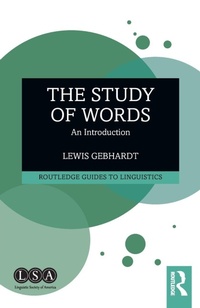
The Study of Words
An Introduction
1st Edition
Published on 31. March 2023
Book
Paperback/Softback
176 pages
978-0-367-46641-1 (ISBN)
Description
The Study of Words introduces the study of word structure, also known as morphology, without assuming any prior knowledge of linguistics. Introducing concepts in an accessible way, Gebhardt illustrates how to understand and produce both existing and new words. This book:
* Provides an overview of words, word components and the rules by which components can and cannot be assembled into words;
* Introduces the area of morphology with a data-driven approach, exposing readers to sets of words in a variety of languages and prompting them to identify their components and seek patterns;
* Features exercises and questions throughout to provoke thought and point readers to unresolved morphological issues.
Aimed at students at undergraduate level with no background in linguistics, The Study of Words is essential reading for those studying morphology for the first time as part of linguistics, language and general education courses.
* Provides an overview of words, word components and the rules by which components can and cannot be assembled into words;
* Introduces the area of morphology with a data-driven approach, exposing readers to sets of words in a variety of languages and prompting them to identify their components and seek patterns;
* Features exercises and questions throughout to provoke thought and point readers to unresolved morphological issues.
Aimed at students at undergraduate level with no background in linguistics, The Study of Words is essential reading for those studying morphology for the first time as part of linguistics, language and general education courses.
Reviews / Votes
'The Study of Words is an excellent introduction to the field of Morphology. Specifically designed for students with little or no background in linguistics, it is clear and concise in its prose while providing a wide array of examples from a diverse range of languages.'John Boyle, California State University, Fresno, USA
'Using a wide array of examples from English and diverse languages around the world, Professor Gebhardt lures the reader into an understanding of major principles of morphology as related to other areas of linguistics. Recommended as an introductory textbook or general resource.'
Fred E. Anderson, Professor Emeritus, Kansai University, Japan
More details
Series
Language
English
Place of publication
London
United Kingdom
Publishing group
Taylor & Francis Ltd
Target group
College/higher education
Undergraduate Core
Illustrations
3 s/w Tabellen
3 Tables, black and white
Dimensions
Height: 198 mm
Width: 129 mm
Thickness: 11 mm
Weight
223 gr
ISBN-13
978-0-367-46641-1 (9780367466411)
Copyright in bibliographic data and cover images is held by Nielsen Book Services Limited or by the publishers or by their respective licensors: all rights reserved.
Schweitzer Classification
Other editions
Additional editions
E-Book
03/2023
1st Edition
Routledge
€35.49
Available for download
E-Book
03/2023
1st Edition
Routledge
€35.49
Available for download

Book
03/2023
1st Edition
Routledge
€117.60
Shipment within 15-20 days
Person
Lewis Gebhardt is Associate Professor of Linguistics at Northeastern Illinois University, Chicago, USA. As well as teaching morphology for the past decade, his main research interests are syntax, morphology and semantics.
Content
Contents
Acknowledgements
List of Abbreviations
Glossary of Terms
1 Introduction
1.1 Preliminaries
1.2 Words and Grammar and What We Know About Them
1.3 Knowledge of Language
1.4 Spelling Conventions and the International Phonetic Alphabet
1.5 Presentation of Language Data
1.6 Summary
1.7 Exercises
1.8 Arguable Answers to Exercises
2 The Lexicon
2.1 Preliminaries
2.2 Morphemes and the Lexicon
2.3 Kinds of Morphemes
2.3.1 Free and Bound
2.3.2 Lexical and Functional
2.3.3 Productive and Nonproductive Morphemes
2.3.4 Roots, Stems and Affixes
2.3.5 A Few Other Kinds of Morphemes
2.4 Summary
2.5 Exercises
2.6 Arguable Answers to Exercises
3 Words: What They Are and Where They Come From
3.1 Preliminaries
3.2 What's a Word?
3.3 So, How Many Words?
3.4 Source of the Lexicon
3.4.1 Early and Later Acquisition
3.4.2 Transmission Across Generations
3.5 What's in the Lexicon?
3.6 Summary
3.7 Exercises
3.8 Arguable Answers to Exercises
4 Inflectional Morphology
4.1 Preliminaries
4.2 Formation of Wordforms
4.3 Noun Inflections
4.3.1 Number
4.3.2 Gender
4.3.3 Definiteness/Indefiniteness
4.3.4 Case
4.3.5 Pronouns
4.3.6 Portmanteau Inflections
4.3.7 Nonconcatenative Inflection
4.4 Verb Inflections
4.4.1 Agreement
4.4.2 A Few Other Verbal Affixes
4.5 Crosslinguistic Generalizations in Inflectional Morphology
4.6 Summary
4.7 Exercises
4.8 Arguable Answers to Exercises
5 Derivation
5.1 Preliminaries
5.2 Creating Lexemes With Affixes: Case Study With -ness
5.3 Derivational Affixes
5.3.1 Zero Derivation
5.3.2 Other Kinds of Derivation
5.3.3 Iterative Derivation
5.3.4 Derivation in Other Languages
5.4 Compounds
5.4.1 Compound or Phrase
5.5 Incorporation
5.6 Putting Together Derivation and Inflection
5.7 Derivation v. Inflection
5.8 Clitics
5.9 Summary
5.10 Exercises
5.11 Arguable Answers to Exercises
6 Final Comments
Bibliography
Index
Acknowledgements
List of Abbreviations
Glossary of Terms
1 Introduction
1.1 Preliminaries
1.2 Words and Grammar and What We Know About Them
1.3 Knowledge of Language
1.4 Spelling Conventions and the International Phonetic Alphabet
1.5 Presentation of Language Data
1.6 Summary
1.7 Exercises
1.8 Arguable Answers to Exercises
2 The Lexicon
2.1 Preliminaries
2.2 Morphemes and the Lexicon
2.3 Kinds of Morphemes
2.3.1 Free and Bound
2.3.2 Lexical and Functional
2.3.3 Productive and Nonproductive Morphemes
2.3.4 Roots, Stems and Affixes
2.3.5 A Few Other Kinds of Morphemes
2.4 Summary
2.5 Exercises
2.6 Arguable Answers to Exercises
3 Words: What They Are and Where They Come From
3.1 Preliminaries
3.2 What's a Word?
3.3 So, How Many Words?
3.4 Source of the Lexicon
3.4.1 Early and Later Acquisition
3.4.2 Transmission Across Generations
3.5 What's in the Lexicon?
3.6 Summary
3.7 Exercises
3.8 Arguable Answers to Exercises
4 Inflectional Morphology
4.1 Preliminaries
4.2 Formation of Wordforms
4.3 Noun Inflections
4.3.1 Number
4.3.2 Gender
4.3.3 Definiteness/Indefiniteness
4.3.4 Case
4.3.5 Pronouns
4.3.6 Portmanteau Inflections
4.3.7 Nonconcatenative Inflection
4.4 Verb Inflections
4.4.1 Agreement
4.4.2 A Few Other Verbal Affixes
4.5 Crosslinguistic Generalizations in Inflectional Morphology
4.6 Summary
4.7 Exercises
4.8 Arguable Answers to Exercises
5 Derivation
5.1 Preliminaries
5.2 Creating Lexemes With Affixes: Case Study With -ness
5.3 Derivational Affixes
5.3.1 Zero Derivation
5.3.2 Other Kinds of Derivation
5.3.3 Iterative Derivation
5.3.4 Derivation in Other Languages
5.4 Compounds
5.4.1 Compound or Phrase
5.5 Incorporation
5.6 Putting Together Derivation and Inflection
5.7 Derivation v. Inflection
5.8 Clitics
5.9 Summary
5.10 Exercises
5.11 Arguable Answers to Exercises
6 Final Comments
Bibliography
Index