

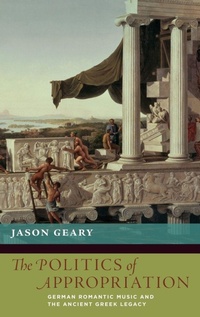
The Politics of Appropriation
German Romantic Music and the Ancient Greek Legacy
Published on 27. February 2014
Book
Hardback
288 pages
978-0-19-973611-9 (ISBN)
Description
The Politics of Appropriation uncovers a largely forgotten chapter in music history by considering the intersection of music and Hellenism in nineteenth-century Germany. While the influence of Greece on the literature, art, architecture, and philosophy of this period has been much discussed, its significance for music has received considerably less attention. Beginning in 1841 with Felix Mendelssohn's wildly popular score for the groundbreaking Prussian court production of Sophocles' Antigone, author Jason Geary draws on research from the fields of musicology, history, classical studies, and theater studies, to explore the trend of combining music and Greek tragedy that also included productions of Euripides' Medea, Sophocles' Oedipus at Colonus, and Sophocles' celebrated Oedipus the King with music by Wilhelm Taubert, Mendelssohn, and Franz Lachner, respectively. Staged at royal courts in Berlin and Munich, these productions reflect an effort by the rulers who commissioned them to appropriate the legacy of Greece for the creation of a German cultural and national identity, while the music involved seemed to its contemporaries to mark the advent of an entirely new Romantic genre. By drawing a line between these compositions and Wagner's very different approach to recovering classical tragedy, Geary offers a reassessment of the composer's reception of the Greeks, highlighting the degree to which he was reacting against works such as Mendelssohn's Antigone when he called for the creation of a music drama rooted in the spirit of Attic tragedy. Geary further argues that Wagner's Ring cycle can be understood as the composer's attempt to reclaim the mythic significance of the Oedipus myth in the service of his own aesthetic aims. Placing these developments within the context of Germany's longstanding obsession with Greece, The Politics of Appropriation demonstrates the enduring significance of antiquity as a trope that helped to shape the European cultural and artistic landscape of the nineteenth century.
Reviews / Votes
Gearys monograph is well researched and engagingly written, and his painstaking approach to interpretation makes it a model of this kind of scholarship ... it is by far the most useful point of access to this intriguing and significant body of music currently available, and will command the interest of classicists and cultural historians as well as musicologists. * James Garratt, Music and Letters *More details
Series
Language
English
Place of publication
New York
United States
Target group
College/higher education
Professional and scholarly
Illustrations
36 music examples, 3 halftones
Dimensions
Height: 240 mm
Width: 161 mm
Thickness: 21 mm
Weight
645 gr
ISBN-13
978-0-19-973611-9 (9780199736119)
Copyright in bibliographic data and cover images is held by Nielsen Book Services Limited or by the publishers or by their respective licensors: all rights reserved.
Schweitzer Classification
Other editions
Additional editions
E-Book
01/2014
1st Edition
OUP eBook
€22.99
Available for download
Person
Jason Geary is an Associate Professor of Musicology at the University of Michigan. He earned his Ph.D. in musicology from Yale University and also holds degrees from the San Francisco Conservatory of Music and the University of Michigan. His research interests center primarily on the music of the nineteenth century, in particular that of Felix Mendelssohn, and he has published several articles and book chapters exploring the intersection of music and Hellenism. He has also been the recipient of many prestigious grants and fellowships, including a Fulbright Grant and membership in the School of Historical Studies at the Institute for Advanced Study in Princeton.
Content
Introduction ; 1. Ancient Greece and the German Cultural Imagination ; 2. Mendelssohn's Antigone and the Rebirth of Greek Tragedy ; 3. The Reception of Antigone and the Aesthetics of Appropriation ; 4. The Growth of a Genre: Taubert's Medea and the Greek Stage ; Revival in Berlin ; 5. Mendelssohn and Oedipus in the Age of Christianity ; 6. Lachner and the Emergence of a New Athens ; 7. The Wagnerian Turn ; 8. Epilogue: The Decline of a Genre ; Bibliography