

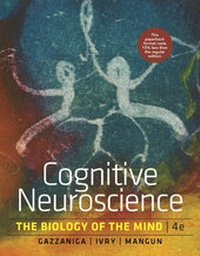
Cognitive Neuroscience
The Biology of the Mind
4th Edition
Published on 26. August 2016
Book
Paperback/Softback
752 pages
978-0-393-91203-6 (ISBN)
Description
The first textbook for the course, and still the market leader, Cognitive Neuroscience has been thoroughly refreshed, rethought, and reorganized to enhance students' and instructors' experience. A stunning, all new art program conveys data and concepts clearly, and new chapter-opening Anatomical Orientation figures help students get their bearings. The table of contents and the chapters themselves have been reorganized to improve the logical flow of the narrative, and the world renowned author team has kept the book fully up to date on the latest research in this fast moving field.
More details
Edition
Fourth Edition
Language
English
Place of publication
New York
United States
Target group
College/higher education
Edition type
Revised edition
Dimensions
Height: 277 mm
Width: 216 mm
Thickness: 25 mm
Weight
1348 gr
ISBN-13
978-0-393-91203-6 (9780393912036)
Copyright in bibliographic data and cover images is held by Nielsen Book Services Limited or by the publishers or by their respective licensors: all rights reserved.
Schweitzer Classification
Persons
Michael Gazzaniga is the director of the SAGE Center for the Study of Mind at the University of California, Santa Barbara. He received his PhD from the California Institute of Technology, where he worked with Roger Sperry and had primary responsibility for initiating human split-brain research. He has established Centers for Cognitive Neuroscience at Cornell Medical School; the University of California, Davis; and Dartmouth College. He is founder of the Cognitive Neuroscience Institute and founding editor of the Journal of Cognitive Neuroscience. He was a member of the President's Council on Bioethics from 2001 to 2009. He is a member of the American Academy of Arts and Science, the Institute of Medicine, and the National Academy of Sciences. Richard B. Ivry is Professor of Psychology and Neuroscience at the University of California, Berkeley. He received his Ph.D. from the University of Oregon. His research focuses on the relationship of cognition and action, using the many methods of cognitive neuroscience. Dr. Ivry is a senior editor for the Journal of Cognitive Neuroscience and serves on the editorial boards of a number of other journals. Among his many honors, Dr. Ivry received the Troland Research Award from the National Academy of Sciences in 1997, and was elected a fellow of the Society of Experimental Psychologists in 2003 and the Association for Psychological Science in 2006.
George R. Mangun is Professor of Psychology and Neurology in the Center for Mind and Brain at the University of California, Davis. He received his Ph.D. from the University of California, San Diego. He was the founding director of the Center for Mind and Brain, and also of the Center for Cognitive Neuroscience at Duke University. In 1992, with Michael S. Gazzaniga and others, he founded the Cognitive Neuroscience Society. Dr. Mangun serves as an associate editor for the Journal of Cognitive Neuroscience, and is Editor-in-Chief of the series The Neuroscience of Attention, published by Oxford University Press. He uses cognitive neuroscience tools in the study of brain attention mechanisms. He is a fellow of the Association for Psychological Science, and the American Association for the Advancement of Science.
George R. Mangun is Professor of Psychology and Neurology in the Center for Mind and Brain at the University of California, Davis. He received his Ph.D. from the University of California, San Diego. He was the founding director of the Center for Mind and Brain, and also of the Center for Cognitive Neuroscience at Duke University. In 1992, with Michael S. Gazzaniga and others, he founded the Cognitive Neuroscience Society. Dr. Mangun serves as an associate editor for the Journal of Cognitive Neuroscience, and is Editor-in-Chief of the series The Neuroscience of Attention, published by Oxford University Press. He uses cognitive neuroscience tools in the study of brain attention mechanisms. He is a fellow of the Association for Psychological Science, and the American Association for the Advancement of Science.