

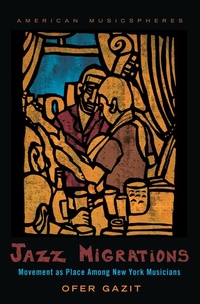
Jazz Migrations
Movement as Place Among New York Musicians
Published on 29. August 2024
Book
Paperback/Softback
208 pages
978-0-19-768278-4 (ISBN)
Description
Since the 1990s, migrant musicians have become increasingly prominent in New York City's jazz scene. Challenging norms about who can be a jazz musician and what immigrant music should sound like, these musicians create mobile and diverse notions of jazz while inadvertently contributing to processes of gentrification and cultural institutionalization. In Jazz Migrations, author Ofer Gazit discusses the impact of contemporary transnational migration on New York jazz, examining its effects on educational institutions, club scenes, and jam sessions.
Drawing on four years of musical participation in the scene, as well as interviews with musicians, audience members, venue owners, industry professionals, and institutional actors, Gazit transports readers from music schools in Japan, Israel, and India to rehearsals and private lessons in American jazz programs, and to New York's immigrant jazz hangouts: an immigrant-owned music school in the Bronx; a weekly jam session in a Haitian bar in central Brooklyn; a Colombian-owned jazz room in Jackson Heights, Queens; and a members-only club in Manhattan. Along the way, he introduces the improvisatory practices of a cast of well-known and aspiring musicians: a South Indian guitarist's visions of John Coltrane and Carnatic music; a Chilean saxophonist's intimate dialogue with the sound of Sonny Rollins; an Israeli clarinetist finding a home in Brazilian Choro and in Louis Armstrong's legacy; and a multiple Grammy-nominated Cuban drummer from the Bronx. Jazz Migrations concludes with a call for a collective reconsideration of the meaning of genre boundaries, senses of belonging, and ethnic identity in American music.
Drawing on four years of musical participation in the scene, as well as interviews with musicians, audience members, venue owners, industry professionals, and institutional actors, Gazit transports readers from music schools in Japan, Israel, and India to rehearsals and private lessons in American jazz programs, and to New York's immigrant jazz hangouts: an immigrant-owned music school in the Bronx; a weekly jam session in a Haitian bar in central Brooklyn; a Colombian-owned jazz room in Jackson Heights, Queens; and a members-only club in Manhattan. Along the way, he introduces the improvisatory practices of a cast of well-known and aspiring musicians: a South Indian guitarist's visions of John Coltrane and Carnatic music; a Chilean saxophonist's intimate dialogue with the sound of Sonny Rollins; an Israeli clarinetist finding a home in Brazilian Choro and in Louis Armstrong's legacy; and a multiple Grammy-nominated Cuban drummer from the Bronx. Jazz Migrations concludes with a call for a collective reconsideration of the meaning of genre boundaries, senses of belonging, and ethnic identity in American music.
More details
Series
Language
English
Place of publication
New York
United States
Product notice
Paperback (trade)
Unsewn / adhesive bound
Illustrations
13 music examples, 2 photos, 2 maps
Dimensions
Height: 236 mm
Width: 157 mm
Thickness: 15 mm
Weight
318 gr
ISBN-13
978-0-19-768278-4 (9780197682784)
Copyright in bibliographic data and cover images is held by Nielsen Book Services Limited or by the publishers or by their respective licensors: all rights reserved.
Schweitzer Classification
Other editions
Additional editions
Book
04/2024
Oxford University Press Inc
€79.23
Shipment within 15-20 days
E-Book
04/2024
OUP eBook
€24.99
Available for download
E-Book
04/2024
OUP eBook
€24.99
Available for download
Person
Ofer Gazit is a Senior Lecturer in Music at Tel Aviv University. He teaches and writes about issues of migration, borders, and citizenship from a musical perspective. He has contributed widely to publications in sound and media studies, ethnomusicology, and jazz studies.
Content
Acknowledgments
About the Companion Website
Introduction: A Moving Scene
1. The Loop
2. Jam Session
3. The Scene
4. History
5. Home
6. The Village
Conclusion: Places that Move
Notes
References
Selected Discography
Interviews and Conversations
For Further Listening
Index
About the Companion Website
Introduction: A Moving Scene
1. The Loop
2. Jam Session
3. The Scene
4. History
5. Home
6. The Village
Conclusion: Places that Move
Notes
References
Selected Discography
Interviews and Conversations
For Further Listening
Index